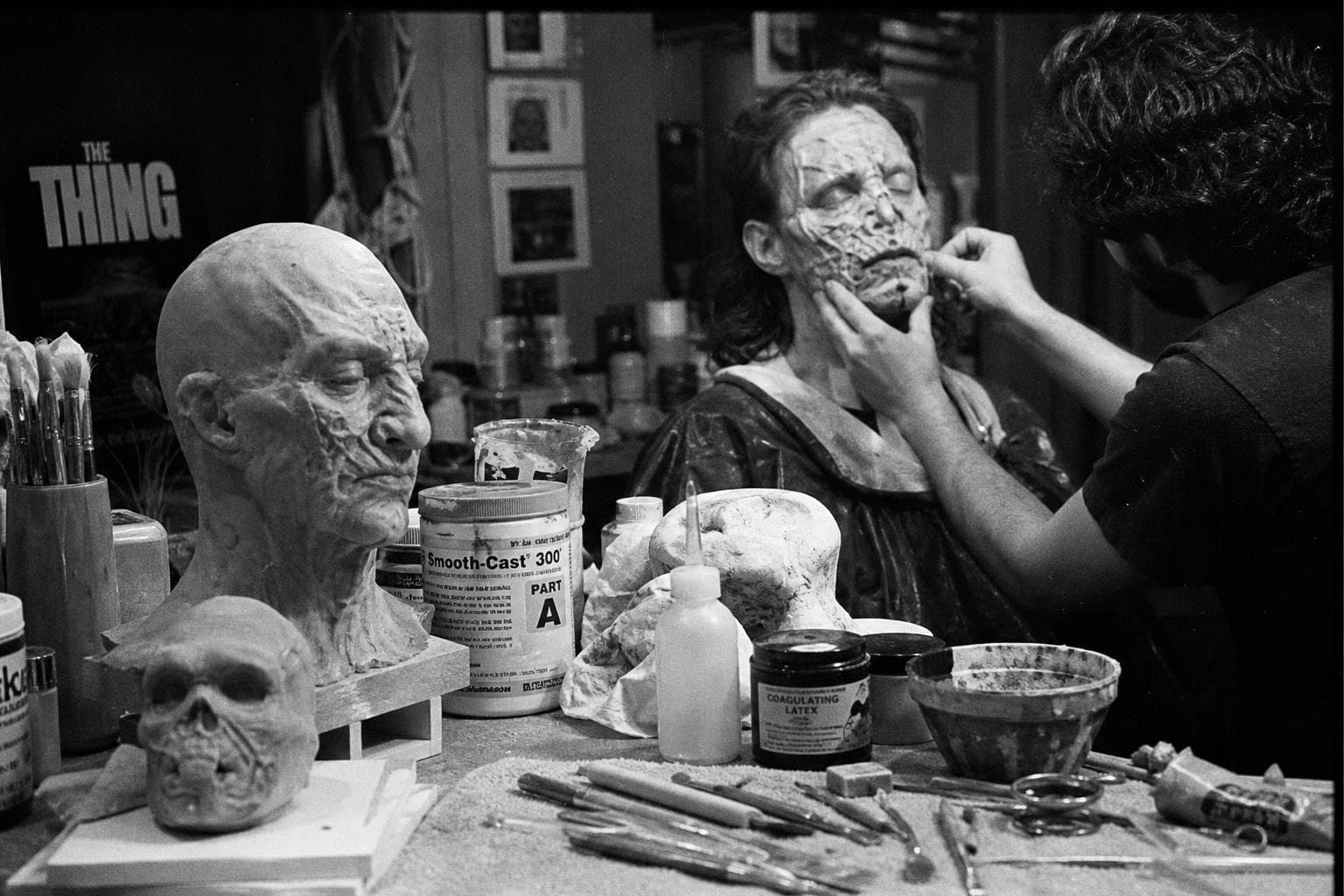

There's a shot in The Substance where Demi Moore's character wakes up to find herself bald, naked, and hunched into something between a witch and a Gollum. According to prosthetics designer Pierre Olivier Persin, that single reveal took six and a half hours of makeup application to achieve — and it wasn't even one performer. It was three: Moore for the close-ups, a "very skinny actress" in full prosthetic arms for body shots, and a stunt double slamming into a bathroom sink (The Credits). That's not a shortcut. That's a production choosing to solve a creative problem with labor and silicone instead of a render farm.
The film's financial return on that choice is the more interesting story. Universal originally planned to distribute Coralie Fargeat's film and balked at her final cut, specifically the ending; Mubi picked it up instead and gave it a wide theatrical release (Radio Times). The film went on to gross more than $78 million worldwide, described as over four times its production budget (The Conversation). That multiple matters more than any single dollar figure — it tells you a studio passed on a movie that a niche distributor turned into one of the year's most profitable horror releases, awards attention included, with five Oscar nominations among them Best Picture, Best Director, and Best Screenplay (The Credits).
The Craft Argument: Why Analog Won the Monster Design
Persin, speaking to Variety, put a number on the film's effects work: 70 to 80 percent practical, with CGI reserved for supplementary polish ("We did tons of designs and used everything from computer-generated sculptures to Photoshop to traditional sculptures and drawings to find the character that Coralie liked," he said), as reported via The Cold Magazine. The film's most notorious sequence — a roughly 20-minute, blood-drenched finale involving the fused creature Monstro — came out of a literal fireman's-hose rig built by Persin and effects coordinator Jean Miel to spray blood across the set (The Cold Magazine).
I'd argue this is the real craft decision worth studying: not that practical effects look better in the abstract, but that body horror specifically depends on an audience sensing weight, mess, and physical consequence. A digital mutation reads as spectacle. A rubber maquette sculpted by hand and smeared with real fake blood reads as something happening to a body that used to look like Demi Moore's. The genre's whole appeal — what horror scholar Xavier Aldana Reyes described as content "made for people who have always enjoyed body horror" — depends on that tactile believability (Radio Times).
A Wider Pattern, Not an Isolated Bet
The Substance landed inside a cluster of films — Love Lies Bleeding, I Saw the TV Glow, Titane — that have pulled body horror out of its midnight-movie ghetto and into mainstream awards conversations (The Conversation). The practical-effects instinct is showing up beyond horror proper, too. The Cold Magazine points to Bring Her Back, from Danny and Michael Philippou, as part of the same analog turn (The Cold Magazine). And the argument has leaked into blockbuster-scale filmmaking: at a packed premiere screening, Tom Cruise framed his pivot into Alejandro G. Iñárritu's Digger partly as a bet that "people want real things," pushing back against AI-driven production shortcuts even on a film with a reported budget north of $125 million (The Hollywood Reporter).
Those two movies sit at wildly different budget tiers and genres, but they're making the same bet from opposite ends of the industry: that audiences can tell the difference between a body and a render, and that the difference is worth paying for. The Substance won that bet decisively — a specialty acquisition outperforming the studio that walked away from it. Digger is still finding out, tracking a disappointing opening weekend against a production cost that reportedly climbed well past its original greenlight (Variety).
What's worth watching isn't whether practical effects come back into fashion — they never really left, they just got expensive to justify on a spreadsheet. It's whether a specialty distributor's four-times-budget return on a prosthetics-heavy body horror film changes what gets greenlit at the mid-budget tier, where the appetite for silicone over CGI has been hardest to finance.


