


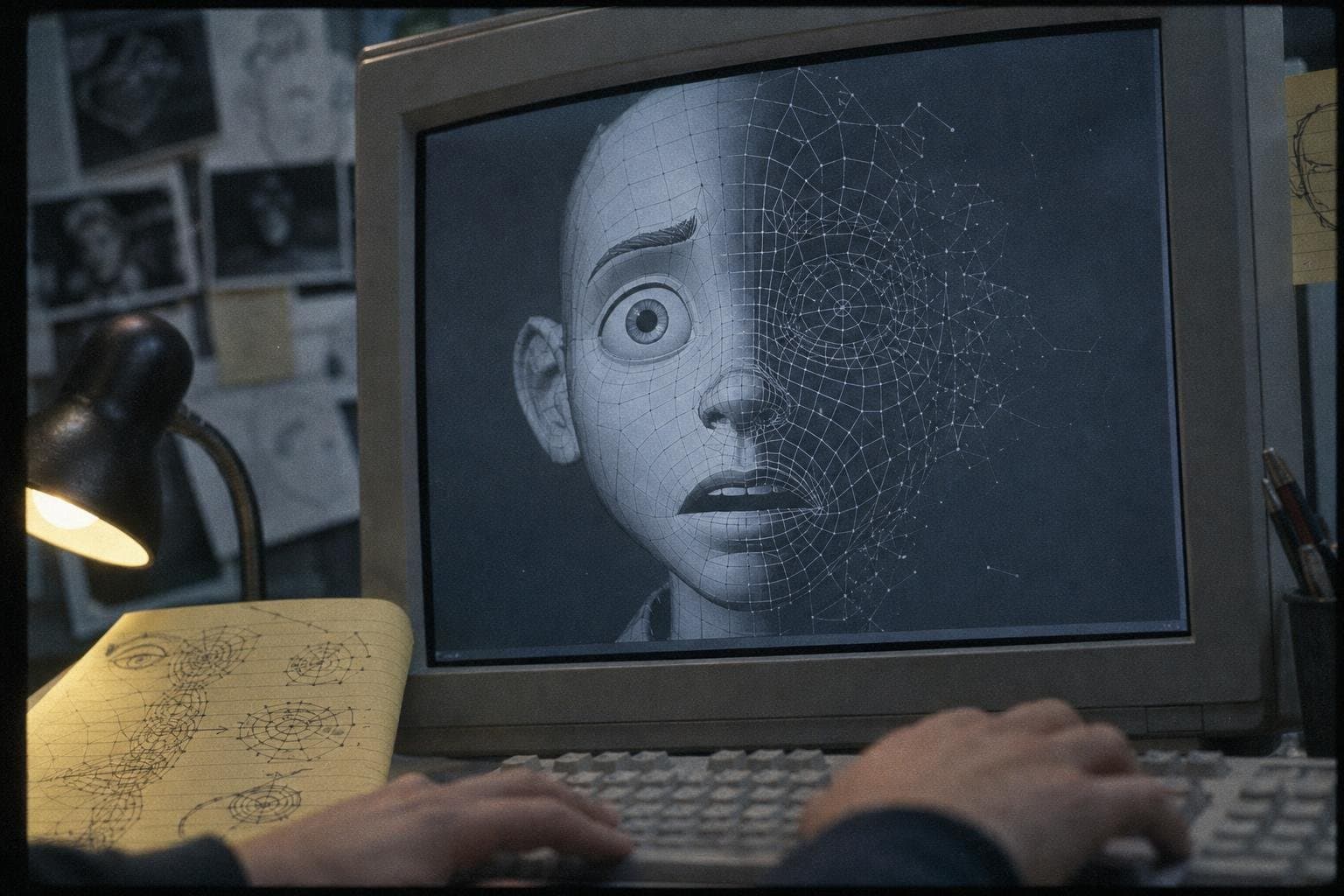

There's a moment in every animated film where a character's face does something almost impossible — a lip trembling into a smile while the eyes stay sad, or a jaw dropping in a way that reads as shock rather than vacancy. That moment doesn't come from the voice actor or the animator alone. It comes from a decision made months earlier, by someone you've never heard of, about where to put an edge loop on a polygon mesh.
That unglamorous technical choice — topology — is the hidden architecture of character animation. And right now, it sits at the center of a genuine tension in the industry: as AI tools promise to automate more of the 3D production pipeline, the craft decisions that actually make characters feel alive are stubbornly resistant to shortcuts.
The Foundation Nobody Talks About
João Victor, a character artist who worked on Pixar's Inside Out 2, recently released a Gnomon Workshop course on topology for animated characters — and the subject matter itself is a quiet argument about what animation actually requires. The course covers loop direction, polycount management, edge flow for rigging and texturing, and the strategic placement of what are called poles: vertices where three, four, or five edges meet. Get a pole in the wrong place on a face, and the mesh will crumple when a character smiles. Get it right, and the deformation is invisible — which is exactly the point.
This is the kind of work that doesn't show up in a making-of featurette. It's pre-animation, pre-rigging, pre-everything that gets celebrated. But it determines whether an animator can actually execute what a director imagines. A mesh with bad topology forces animators to work around its limitations; a mesh with clean topology disappears and lets performance breathe.
The reconstructible mesh pipeline Victor describes — where models are built so that topology can be edited without breaking downstream work — is a production efficiency argument as much as a craft one. On a film with a large cast of characters, that kind of systematic thinking compounds. Every hour saved in rigging or corrective sculpting is time that goes back into performance.
Where AI Fits (and Where It Doesn't)
The broader animation industry is actively experimenting with AI at nearly every stage of production. AI tools now handle tasks like in-betweening (generating frames between keyframes), auto lip-sync, motion capture processing, and background generation — genuinely useful automation that compresses timelines without touching the core creative decisions.
Pre-production has seen similar gains: AI-driven script breakdown tools can scan a 120-page screenplay in seconds, categorizing props, locations, and production requirements that used to take days of manual work. The efficiency argument is real.
But topology sits in a different category. It's not a task that scales well with automation because it's fundamentally a problem-solving discipline, not a pattern-recognition one. Every character design presents a unique set of deformation challenges — where does this particular face need to stretch, compress, or twist? What does this character's performance range actually require? Those questions don't have generalizable answers that a model can learn from a training set. They require someone to look at a specific design and reason about how it will move.
This is the gap that Hollywood's current AI conversation tends to skip over. The debate focuses on what AI can generate — images, scripts, voices — rather than on the structural craft decisions that determine whether generated content can actually be animated, rigged, and performed. Generation and production-readiness are different problems.
What This Reveals About the Moment
The existence of a Gnomon Workshop course on topology — taught by a Pixar artist, aimed at intermediate professionals — is itself a signal. Studios aren't deskilling this work; they're investing in training pipelines for it. The Hollywood Reporter's AI issue frames the industry's AI moment as existential uncertainty, but the ground-level reality in character animation looks more like a division of labor taking shape: AI handles the automatable, and human craft concentrates on the decisions that require judgment.
That division isn't stable forever. But for now, the edge loops still need to go in the right place. And someone who knows why is still the most important person in the room before the animator ever touches a rig.
Watch for how studios start crediting technical directors and character modelers in their production materials — it's a leading indicator of whether the industry is treating this craft as a competitive advantage or quietly treating it as a cost to eliminate.