


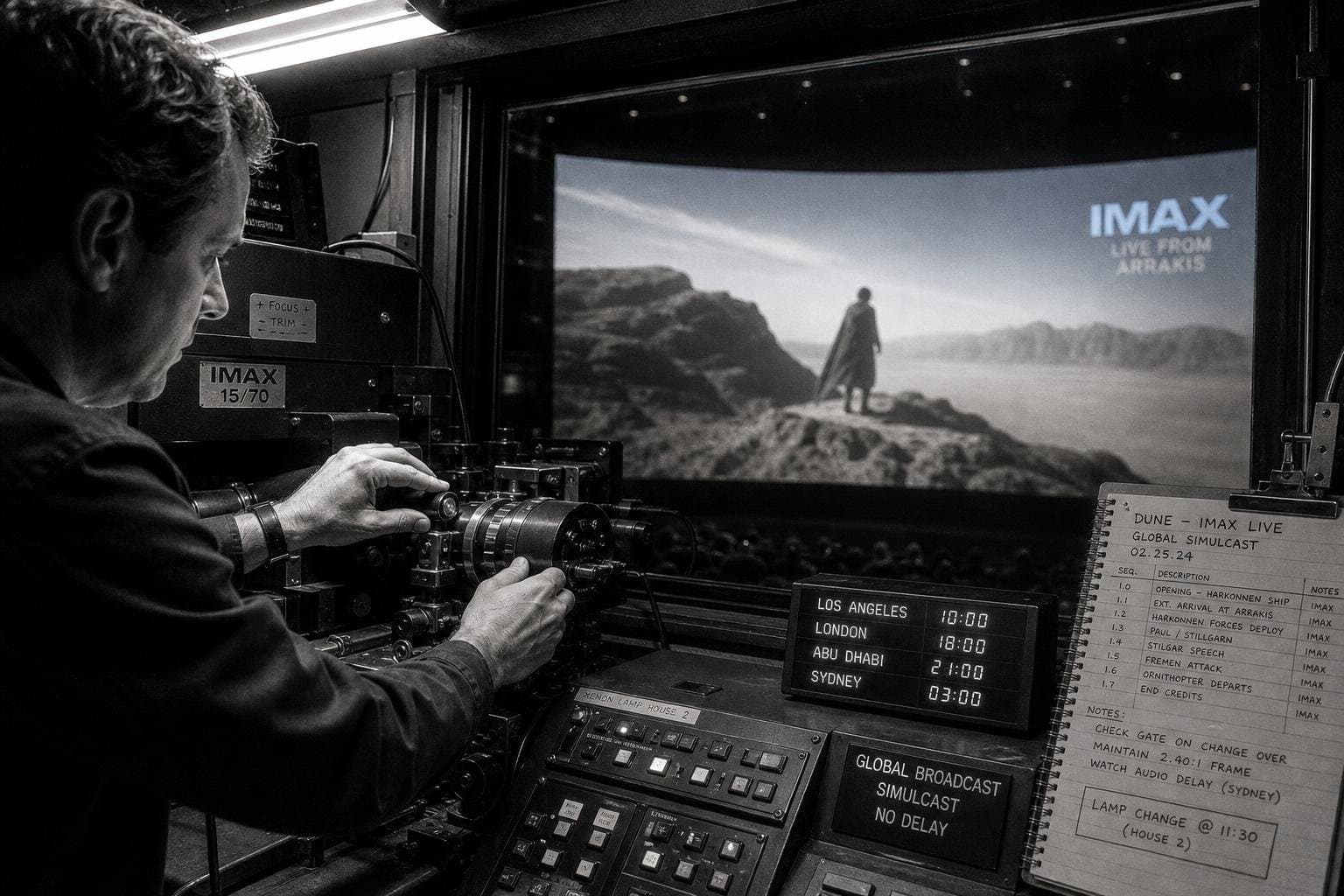

There's a telling detail buried in the coverage of last week's Dune: Part Three trailer launch. Denis Villeneuve didn't just drop the footage online. He staged a global IMAX fan event — simultaneously screening in Los Angeles, London, Berlin, Abu Dhabi, Chicago, Dallas, Toronto, Montreal, and Mexico City. And the trailer itself will run attached to IMAX 70mm screenings of The Odyssey, Nolan's upcoming epic.
That's not a marketing department decision. That's a filmmaker signaling exactly what kind of object his film is meant to be.
The Format Is the Thesis
Villeneuve has been consistent about something across this trilogy: the scale of the image is inseparable from the argument of the story. Dune is, at its core, about the overwhelming weight of destiny — a young man crushed under the pressure of prophecy, empire, and ecological catastrophe. The IMAX frame doesn't just show you Arrakis; it makes you feel the pressure of it.
So when Villeneuve chose to unveil Part Three footage inside IMAX theaters rather than on YouTube, he was doing something deliberate. He was insisting, again, that this story belongs to a specific kind of attention. The simulcast format — linking audiences across nine cities simultaneously — recreates, in miniature, the communal experience he's been arguing for since the first film.
This matters because Part Three is, by his own account, a genuine departure. Villeneuve has described the new film as "more of a thriller" and "more intense" than its predecessors — a tonal shift driven by the source material, Frank Herbert's Dune Messiah, which Herbert wrote partly to complicate readers' heroic readings of Paul Atreides. Where the first film was contemplative and the second functioned as a war movie, Villeneuve has called the third "more action-packed and tense" — and his most personal of the trilogy.
A thriller in IMAX is a different proposition than an epic in IMAX. The question the format now has to answer is whether it can serve intimacy and dread as well as it serves spectacle.
Urgency as Creative Strategy
What's striking about the production context is how quickly Villeneuve moved. He had told his team he was taking a break after Part Two. He didn't. Images kept arriving in the night. He wrote the screenplay immediately. "Would it be a better idea," he told press at the trailer launch, "to, instead of going back to Arrakis for nostalgia, to go there by necessity?"
That word — necessity — is doing a lot of work. It's the opposite of franchise obligation. And it connects directly to the IMAX strategy: you don't build a nine-city simultaneous event around a film you're making out of contractual duty. The exhibition choice is a confidence signal, a declaration that the creative urgency behind the camera justifies the premium ask at the box office.
Timothée Chalamet, who showed up unannounced at the trailer event, put it plainly: "It wasn't like, 'OK, we found a formula and now we're going to run it back.' This is a different movie." The first two films are "siblings,"