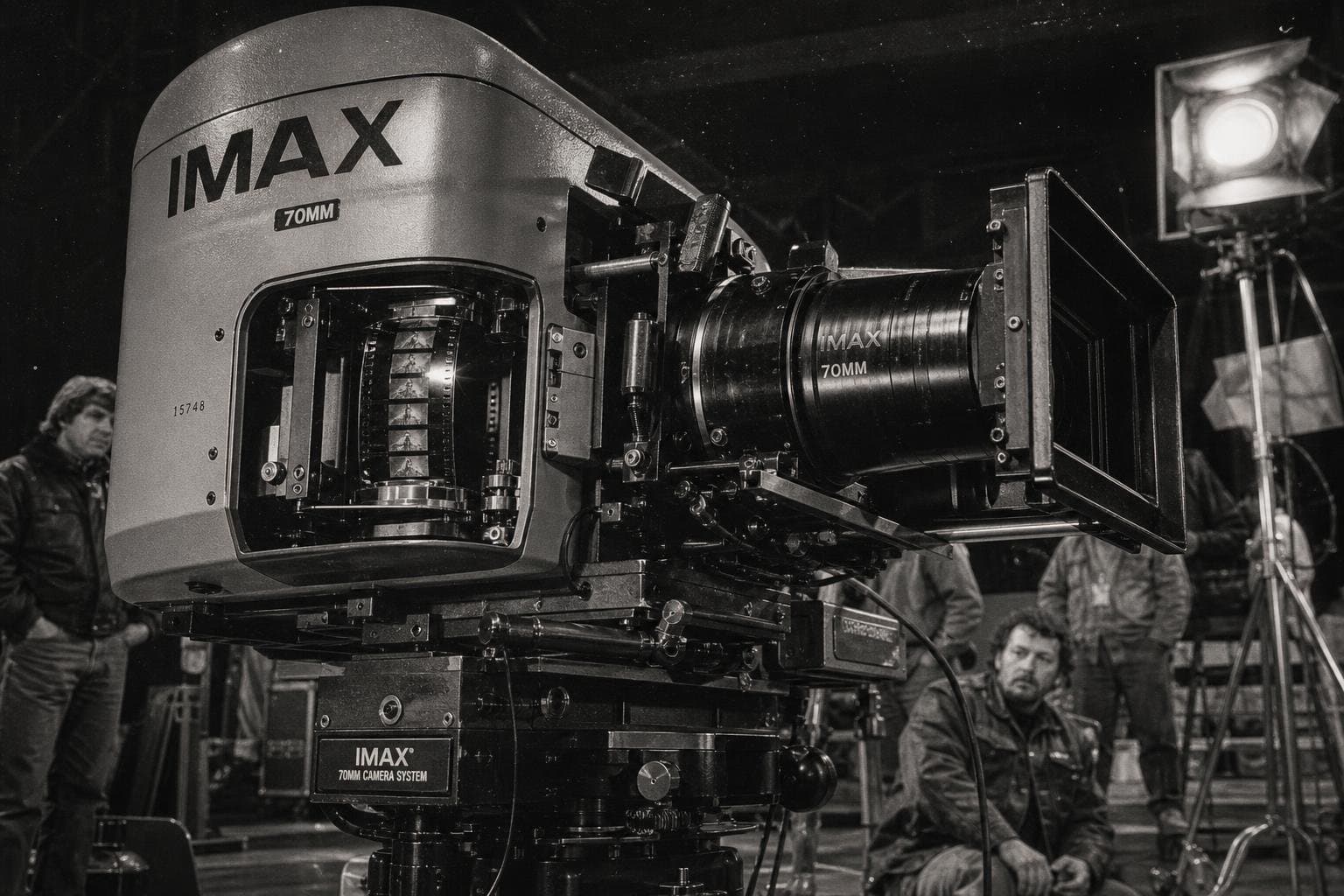

There's a telling data point buried in Imax's second quarter earnings report: Imax accounted for 20% of The Odyssey's global opening weekend box office while operating on less than a fraction of the total screen count. That ratio — enormous revenue share from a tiny footprint — is the clearest possible argument for what premium large format has become. Not a supplement to a film's release. The release.
Which brings us to Denis Villeneuve, and what the Odyssey moment means for Dune: Part Three.
Nolan Built the Proof of Concept Villeneuve Will Inherit
The Odyssey is the first feature shot entirely with Imax cameras, and according to Variety, the production cost $250 million — the most expensive film of Nolan's career. The economics of that choice are staggering even before you get to the creative rationale: raw film stock runs approximately $1.50 per foot, and the production consumed roughly two million feet, putting stock costs alone at around $3 million. Each 70mm print costs $50,000. These are not incidental line items.
But the bet paid off in a way that reframes the entire calculation. As of its current run, The Odyssey has reached nearly $650 million globally, with $140 million coming from Imax screens, and the 70mm screenings remain sold out for weeks. Meanwhile, Imax's global box office hit $285 million in the second quarter — its highest second-quarter result since 2019, driven in part by the frenzy surrounding The Odyssey's release. The demand didn't find the format. The format created the demand.
Imax CEO Rich Gelfond called the film "a transformational event" — language that's easy to dismiss as earnings-call enthusiasm until you look at what he's pointing toward: Imax has $60 million in pre-sales for future Odyssey showtimes. That's not a film performing well in premium. That's a film for which audiences are planning ahead, buying tickets weeks out, treating a cinema visit the way they'd treat a concert.
Villeneuve's Partial Bet — and Why It's Smarter Than It Sounds
Villeneuve watched all of this happen while finishing Dune: Part Three, and his approach reveals a filmmaker thinking carefully about where format serves story rather than simply chasing the prestige of the Nolan playbook. At the film's trailer event, he explained his hybrid strategy directly: "A big part of it was shot in Imax film, which was the first time for me, but I kept the desert in digital because I like the brutality of the digital Imax."
That's a genuinely interesting creative distinction. The desert — Arrakis, the franchise's visual signature — stays in digital Imax because Villeneuve has already established what that texture means. The brutality he's describing is specific: the harshness of digital in extreme conditions, the way it renders sand and heat without the warmth that film tends to introduce. Introducing Imax film for other sequences creates a tonal contrast that's intentional, not a compromise.
He's also being honest about the learning curve. "When you see the result on screen, it's quite unmatchable," he said of the Imax film cameras — but he also called the experience of filming with them "unique" in a way that suggests genuine unfamiliarity. Nolan has been building toward full-Imax production for over a decade. Villeneuve is making his first significant move in that direction, and he's doing it on a franchise film with a built-in audience and a December release window that Imax has already flagged as a major event.
What the Alex Theatre Tells Us About Where This Goes
The detail that sticks with me is that a century-old theater in Glendale, California — the Alex Theatre, which hadn't screened a first-run film since Terminator 2 in 1991 — invested $500,000 in technical upgrades specifically to show The Odyssey in 70mm, and became the highest-grossing venue in the country for those screenings. The venue is now scheduling Dune: Part Three for December and Greta Gerwig's Narnia for February 2027. A theater dormant for first-run cinema is building a programming calendar around premium large-format releases specifically.
That's the downstream effect Gelfond was gesturing at when he said The Odyssey's success would "reverberate across the creative community." The infrastructure is expanding to meet demand that films like The Odyssey — and soon Dune: Part Three — are actively generating. Imax installed 38 new theater systems in the second quarter alone, and the company's revenue rose 12% year-over-year to $102.8 million in the same period.
It's also worth noting what The Odyssey is competing against in its current theatrical run: Spider-Man: Brand New Day is now sharing a portion of Imax screens with Nolan's film, the kind of screen-time pressure that would have ended most films' premium runs. The Odyssey is still selling out weeks in advance.
The assigned topic for this issue asked about Villeneuve's IMAX strategy and a $290 million budget figure — that specific number doesn't appear in the sources available, so I'm not going to invent a confirmation. What the sources do confirm is something more interesting: Villeneuve is making his first serious move into Imax film photography on a franchise that already commands premium audiences, at exactly the moment Nolan has demonstrated that the format can drive a film's entire commercial logic. Whether Dune: Part Three clears the bar Nolan


