


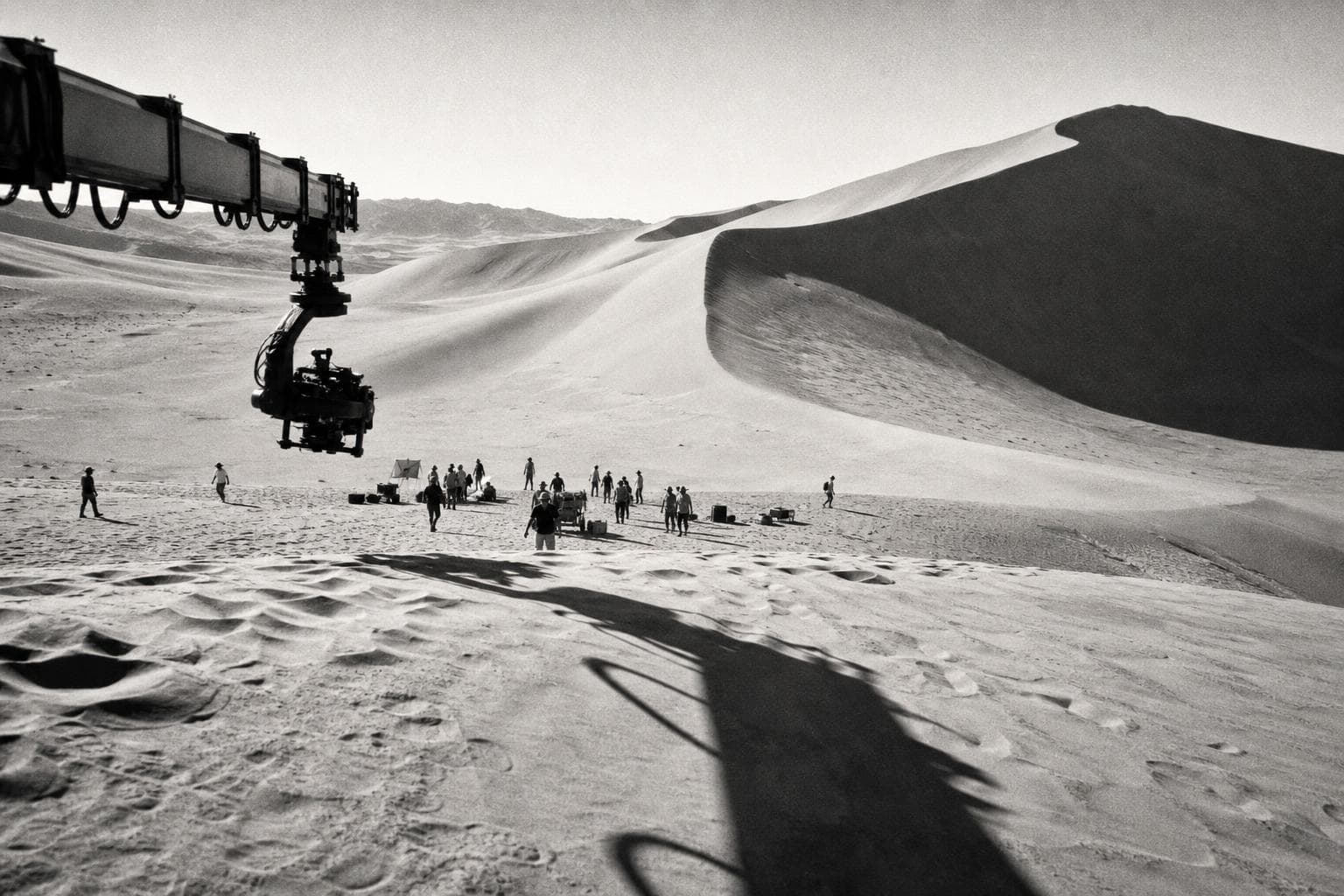

There's a moment in Dune: Part One where Paul Atreides steps onto Arrakis for the first time and the camera doesn't cut to his face. It stays on the sand. The light. The scale. Villeneuve is making an argument with that shot — not about Paul, but about the planet itself. The desert isn't backdrop. It's the film's central character, and every dollar of the production budget is in service of making you believe that.
That's an unusual way to spend $165 million.
The World Has to Cost Something
Production design in blockbusters usually means spectacle in service of plot — a villain's lair, a battle sequence, a set piece that advances the story. Villeneuve and production designer Patrice Vermette took a different approach: they built an ecology. The architecture of the Atreides palace on Caladan reads as wet, heavy, oceanic — stone that has absorbed centuries of rain. Arrakis reads as its opposite: bleached, angular, hostile to moisture. Every surface is a contrast argument.
Film Patrol's review noted that Vermette's production design was "elaborate and well-conceived," but that framing undersells the strategic logic. The design isn't elaborate for its own sake — it's doing the exposition work that dialogue would otherwise have to carry. You understand the political stakes of the spice trade partly because you can see how different these worlds are from each other. The budget isn't buying spectacle. It's buying legibility.
Cinematography as Environmental Argument
Greig Fraser's work on Dune has been analyzed extensively — I wrote about the score's world-building function last year, and the same logic applies to the visuals. Fraser and Villeneuve made a deliberate choice to treat Arrakis's light as a threat rather than a resource. Shadows are deep and sharp. The sun doesn't illuminate — it menaces. As one analysis of desert epic cinematography put it, "the sun isn't just lighting the scene; it is a threat."
That's a craft decision with real budget implications. Controlling light at that scale — on location in Jordan and Abu Dhabi, with massive practical sets — requires time, equipment, and the kind of shooting schedule that only a nine-figure budget buys. The alternative, shooting faster and correcting in post, would have produced a different film. Flatter. Less physically oppressive. The money isn't on screen in the way that, say, a Marvel battle sequence puts money on screen. It's in the quality of the silence between action beats.
What CinemaCon Reveals About the Franchise Logic
The recent CinemaCon preview of Dune: Part Three offered something useful: Villeneuve describing each film in the trilogy by its dominant register. The first was "meditative." The second was "a war film." The third, set 17 years later, is "a thriller." That's not just marketing language — it's a production design brief. Each tonal shift requires a different visual grammar, which means the world-building investment in Parts One and Two is now infrastructure that Part Three can build on or deliberately subvert.
The CinemaCon footage reportedly opened with warriors on a transport ship, a massive tower bursting from the ground — epic in scale, but the principals weren't present. Villeneuve is apparently comfortable spending screen time on the world itself, not just the characters moving through it. That's a bet that the audience has internalized Arrakis enough to find the environment meaningful on its own terms. It's a bet the first film's production design had to earn.
The Argument the Budget Was Making
Here's what's easy to miss: the $165 million wasn't primarily a special effects budget. It was a coherence budget. The stillsuits, the ornithopters, the Harkonnen aesthetic — these work because they feel like they emerged from the same design logic, the same material culture. Nothing looks like it was built for a different movie and imported. That kind of unified visual language is genuinely expensive to achieve, and it's the thing that separates world-building from set decoration.
The franchise has now proven the investment out. Part Two performed strongly enough to greenlight a third film. But the economic case was always downstream of the creative one: Villeneuve needed the audience to believe in Arrakis before they'd follow Paul anywhere. The desert had to cost something, because it had to mean something.
Watch whether Part Three's reported thriller register — tighter, faster, more intimate — requires Villeneuve to pull back from that environmental immersion, or whether seventeen years of in-world time becomes an excuse to show us an Arrakis that has changed. That tension between franchise momentum and world coherence is where the next production design argument will be made.