


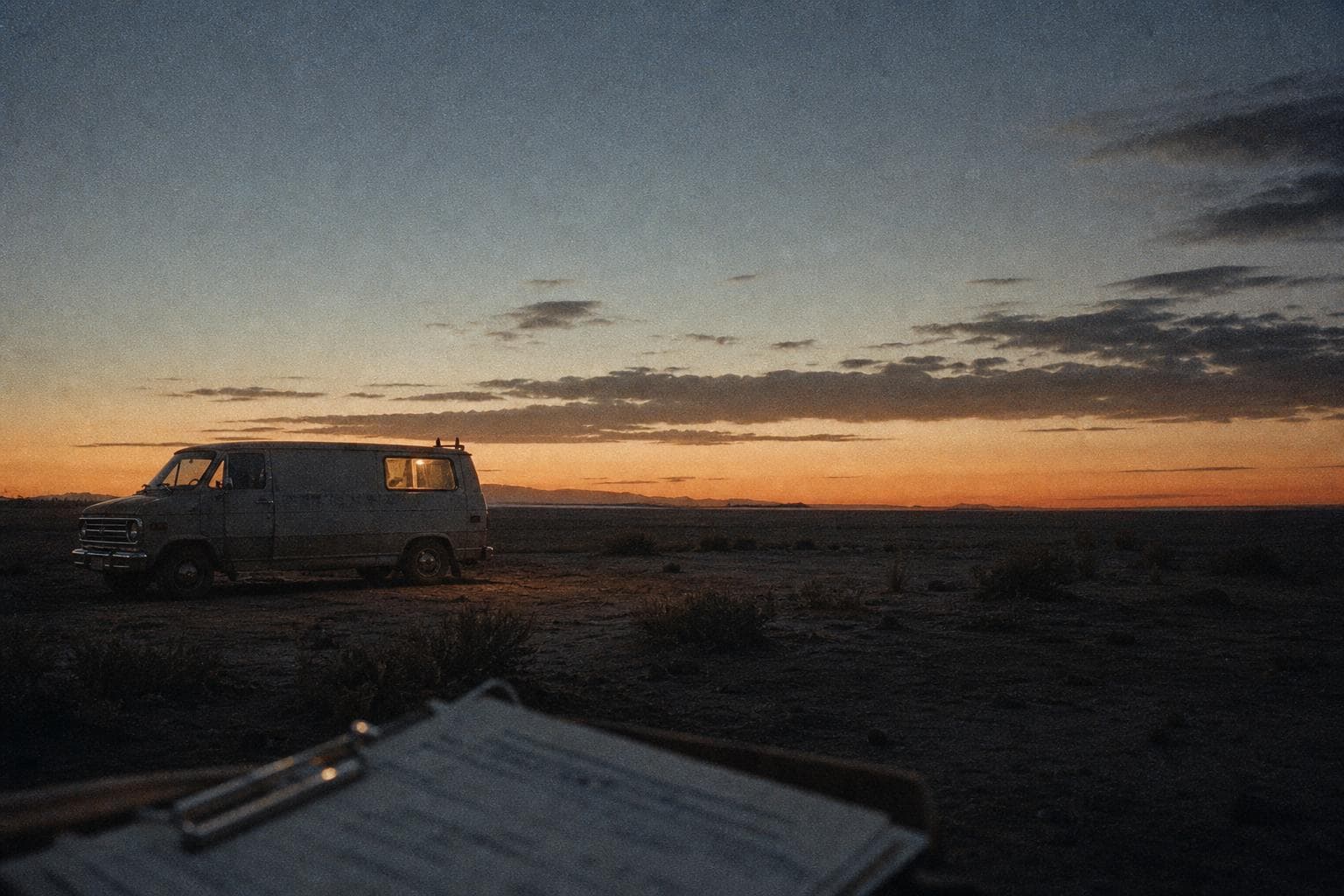

There's a moment in Nomadland where Fern, played by Frances McDormand, sits with a group of nomads around a campfire and listens to them describe their lives. The people talking aren't actors. They're the actual people whose lives the film is about — real van-dwellers, real seasonal workers, real Americans who ended up on the road after the economy finished with them. The scene works because it can't be performed. You can feel the difference.
That casting decision — only two professional actors in a feature film — isn't a stylistic flourish. It's the film's central argument made structural.
The Blurred Line Was the Point
Nomadland uses a documentary hybrid approach that goes well beyond handheld cameras and natural light, though it uses those too. Zhao built the film around real nomads and non-professional actors, with McDormand and David Strathairn as the only trained performers in the cast. The result is a film where the boundary between fiction and documentary isn't blurred accidentally — it's the mechanism through which the film makes its case about what it means to live outside the American mainstream.
The technique has a specific effect on the viewer. When the camera is handheld and lit only by sunlight through a van window or a campfire at night, the audience stops registering the camera's presence. The frame feels like a human eye rather than a piece of equipment. That perceptual shift matters enormously — it's the difference between watching a story about nomadic life and feeling briefly implicated in it.
But the deeper move is what the non-professional cast does to the film's credibility. When real nomads describe their choices, their losses, their reasons for staying on the road, no amount of performance craft could replicate that specificity. Zhao understood that the film's subject — people who fell through the cracks of a particular American economic moment — required witnesses, not actors playing witnesses.
Constraint as Method
This is where the economics and the aesthetics converge. Nomadland was made on a modest budget, and Zhao's approach to natural light and location shooting reflects real production constraints as much as artistic philosophy. But constraint here became method. The film couldn't afford to manufacture a world, so it inhabited a real one. That necessity shaped everything: the pacing, the texture, the emotional register.
Zhao has described her directorial instinct as drawing from "intuition, relationships, community and interdependence" rather than conventional Hollywood structure — a sensibility she's articulated as fundamentally at odds with the dominant industry model. Nomadland is the clearest expression of that instinct. The film's structure is episodic and cyclical rather than goal-driven. Fern doesn't arc toward resolution; she moves through seasons, through landscapes, through encounters that accumulate meaning without resolving into a lesson.
That structure mirrors the lives it depicts. The nomads in the film aren't on a journey toward something. They're in motion because motion is what's available to them. A conventional narrative architecture — rising stakes, climax, transformation — would have falsified the subject. The documentary hybrid approach isn't just a stylistic choice; it's the only honest way to tell this particular story.
What the Technique Reveals About the Moment
The U.S. Gypsum plant in Empire, Nevada — the real town whose closure sets Fern's story in motion — shut down in 2011 after 88 years of operation, taking the town's ZIP code with it. That's not backstory. That's the film's actual subject, and Zhao's formal choices are calibrated to honor its specificity. You can't dramatize the erasure of a community with a conventional Hollywood production. The scale is wrong. The emotional register is wrong. The genre expectations would overwhelm the reality.
By casting the people who actually lived through versions of this — who actually work Amazon warehouses in the off-season and park their vans in the desert — Zhao made a film that functions simultaneously as fiction and as record. The story of Fern is invented. The world she moves through is not.
That's the real achievement of Nomadland's hybrid approach: it found a form that could hold both things at once. The fiction gives the audience a way in. The documentary reality gives them something they can't dismiss when they leave.