


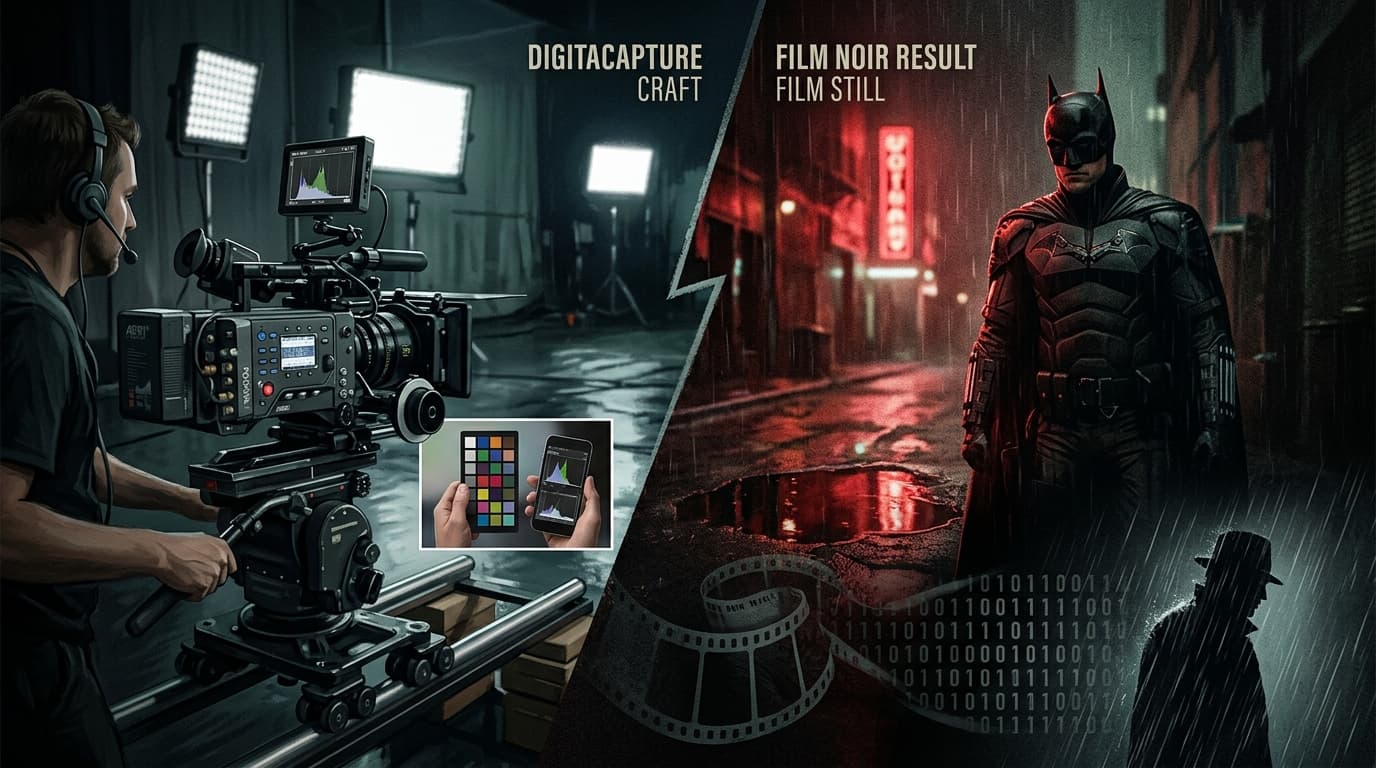

The assigned topic asks about Greig Fraser choosing film over digital for The Batman. The sources don't confirm that. What they confirm is more interesting: Fraser shot The Batman on digital, and it still looks like the grainiest, most shadow-drenched noir since the 1940s. That's the actual craft story worth telling.
The Look Was a Choice, Not a Format
The Batman (2022) was shot digitally — but director Matt Reeves and Fraser built a visual grammar that deliberately evoked photochemical film. The Wikipedia production article on The Batman documents the meticulous creative process Reeves brought to the project: a standalone story, separated from prior DC continuity, built around a younger, more detective-focused Bruce Wayne. That creative isolation extended to the cinematography. Without the obligation to match an existing visual universe, Fraser had room to make aggressive choices.
The result was a film that looks underexposed by conventional blockbuster standards — faces half-swallowed by shadow, neon bleeding into rain-slicked streets, the camera often struggling to resolve what it's looking at. That's not a technical limitation. It's a position.
What Fraser Actually Does With Light
The Variety interview with Fraser about Project Hail Mary — his most recent major project — reveals how he thinks about light as a problem to solve rather than a resource to distribute. On Project Hail Mary, he describes engineering a sun effect to illuminate a tunnel scene, building the light source into the logic of the story's world. The same instinct was at work on The Batman: Gotham's light sources are almost always diegetic — a bare bulb, a car headlight, a burning building. The camera doesn't cheat toward visibility. It accepts the darkness the scene's world would actually produce.
That approach has a name in cinematography: available-light logic, even when the light is entirely constructed. It's what separates noir from merely dark. Classic noir wasn't underlit because the technology was limited — it was underlit because shadow was doing narrative work, hiding information the audience wasn't supposed to have yet. Fraser applied that grammar to a $200 million superhero film and largely got away with it.
Why a Superhero Movie Could Afford This
The economics matter here. The Batman wasn't carrying a shared universe on its back. Reeves negotiated a standalone film, which meant Warner Bros. wasn't protecting a visual continuity investment across a dozen other productions. That creative freedom — documented in the film's production history — is what allowed Fraser to make a Batman movie that looks nothing like any previous Batman movie.
I'd argue this is the underappreciated business logic behind the film's visual identity: the separation from the DCEU wasn't just a narrative decision, it was a permission structure. When a film doesn't have to match anything else, the cinematographer can take real risks. Fraser's subsequent work on Dune and now Project Hail Mary — which ABC News describes as his most technically challenging film yet — suggests a career built on exactly these kinds of high-constraint, high-ambition problems.
The deeper pattern: the most visually distinctive blockbusters of the last decade tend to be the ones that were, for one reason or another, freed from franchise obligation. The Batman looked like nothing else in the DC catalog because it was allowed to. The craft followed the contract.