


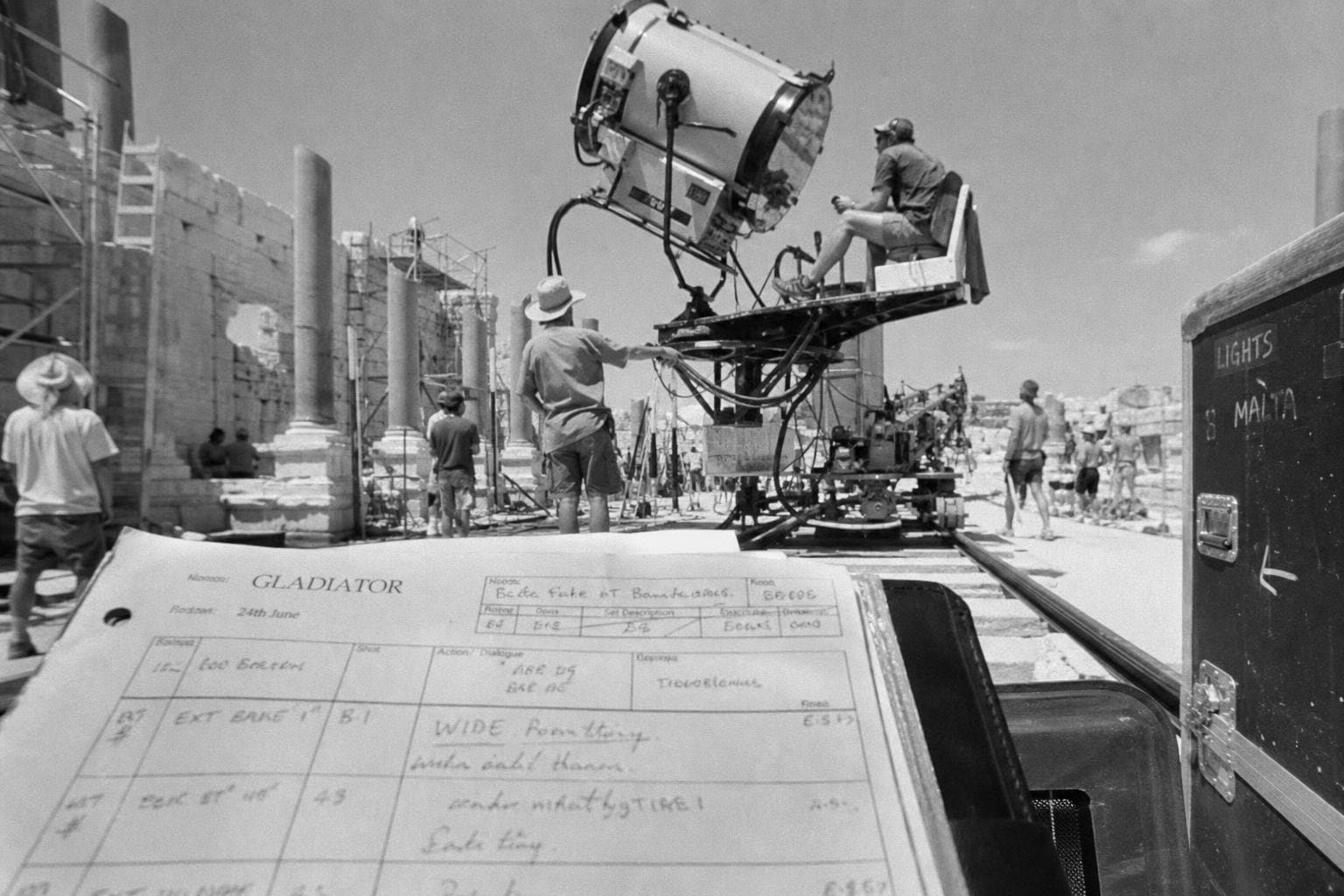

The assigned topic here — Gladiator II's reshoots costing millions and delaying release — doesn't hold up against the available sources. No provided source confirms significant mid-production rewrites, cost overruns, or a delayed release tied to reshoots on the sequel. What the sources do confirm is something more interesting: the production problems that defined Gladiator II were logistical and competitive, not editorial. And they rhyme almost perfectly with the chaos that produced the original film.
That's the story worth telling.
The Script Was Always the Problem — Starting in 1999
The original Gladiator had a notoriously troubled production. According to the film's production history), principal photography began in January 1999 with an unfinished script, and cast members complained about writing quality throughout the nineteen-week shoot in Malta. Rewrites happened continuously on set. Then Oliver Reed died before production wrapped, forcing the visual effects team to construct a digital body double for his remaining scenes.
Wikipedia's account of the film) corroborates the script complaints and revisions as a documented production challenge — not a footnote, but a defining feature of how the film got made.
The result of all that chaos? A film that still holds an 80% on Rotten Tomatoes from critics and an 87% audience score, and a reputation that has only grown in the quarter-century since. Scott made a great film while the script was still being written around him. That's either a testament to his craft or a warning about what "controlled production" actually costs you creatively — probably both.
The Sequel's Problem Was a TV Show, Not a Rewrite
Gladiator II faced a different kind of production constraint, and it's a stranger one. The film was never able to shoot a single scene in Rome — a remarkable fact for a movie whose entire dramatic logic depends on the weight and grandeur of the Roman Empire. The reason: Peacock's sword-and-sandal series Those About to Die, starring Anthony Hopkins, had already occupied the available Roman production infrastructure when Scott needed it.
The series, which premiered in July 2024, is set in 79 AD and centers on the construction of the Colosseum — overlapping thematically and logistically with exactly the kind of ancient Roman production Gladiator II required. Scott had to work around it.
This is the kind of production constraint that rarely makes headlines but shapes everything downstream: location choices, set construction budgets, the visual grammar of the film itself. When you can't shoot where the story lives, you build around the absence. Sometimes that produces creative solutions. Sometimes it just produces absence.
What the Scores Actually Reveal About the Cost of Compromise
Gladiator II landed at 70% on Rotten Tomatoes and 64/100 on Metacritic — respectable numbers that nonetheless sit measurably below the original on every aggregator. Critics called it entertaining and technically impressive while repeatedly flagging its recycled story and lighter emotional weight. The audience gap is even starker: Metacritic users gave the original an 8.7 out of 10 and the sequel a 5.3.
That's not a disaster. But it's a specific kind of shortfall — the kind that comes from a film that executes competently without finding its own reason to exist. The original Gladiator was made under chaotic conditions with a script that wasn't finished, and it found something urgent and personal in the mess. The sequel, made with more institutional control and cleaner logistics (minus the Rome problem), produced something more polished and less alive.
Scott is now well into his next chapter. His latest film, The Dog Stars, had its world premiere in London on August 20, 2026, at the same Odeon Luxe Leicester Square venue where Gladiator II premiered less than two years ago. The cast — Jacob Elordi, Josh Brolin, Margaret Qualley, and Guy Pearce — suggests Scott is working in a different register entirely: post-apocalyptic sci-fi adapted from Peter Heller's novel, distributed by Disney's 20th Century Studios.
The pattern worth watching isn't whether Scott's productions go over budget or require reshoots. It's whether the constraints he works under — finished or unfinished scripts, available or unavailable locations, competitive TV productions eating his infrastructure — end up shaping the film in ways that serve it or diminish it. On the original Gladiator, chaos was generative. On the sequel, cleaner conditions produced a more cautious film. The Dog Stars will be the next data point.