
The conventional story about Christopher Nolan is that he earned unlimited creative freedom somewhere around the second billion dollars of Dark Knight box office. The reality, as Nolan himself tells it, is more interesting and more specific than that.
In a recent appearance on The Daily Show, Nolan explained exactly why The Odyssey exists: "Oppenheimer had way more success than I think we had any right to expect. And that gives you an opportunity to get something made that you might not otherwise be able to get made." Jon Stewart pushed back — after Inception, after Interstellar, after three Batman films, Nolan still needed to prove himself? "I think it helped that it was very successful," Nolan replied. "I think the Oscar thing helped."
That's a remarkably candid admission from one of Hollywood's most commercially reliable directors. And it reframes what Oppenheimer actually was: not just a film, but a negotiating position.
What Oppenheimer Actually Proved
The numbers matter here because they were genuinely surprising. Oppenheimer earned $330 million in North America and $975 million globally, numbers that shattered expectations for a three-hour, R-rated period drama about the physics of mass destruction. It opened in second place domestically — behind Barbie, of all things — and still ran for months. It won Best Picture. It demonstrated something studios had largely stopped believing: that adult audiences would show up, in enormous numbers, for a film that demanded their full attention.
That proof of concept is what made The Odyssey possible. The film cost $250 million to produce, with Universal spending around $125 million more on global marketing — a staggering commitment for any project, let alone one adapted from an 8th-century BCE poem. Without Oppenheimer's track record, the argument for that budget would have been much harder to make.
The Constraint That Shaped Everything
Here's what makes Nolan's creative economics genuinely fascinating: he doesn't spend the latitude he earns on comfort. He spends it on difficulty.
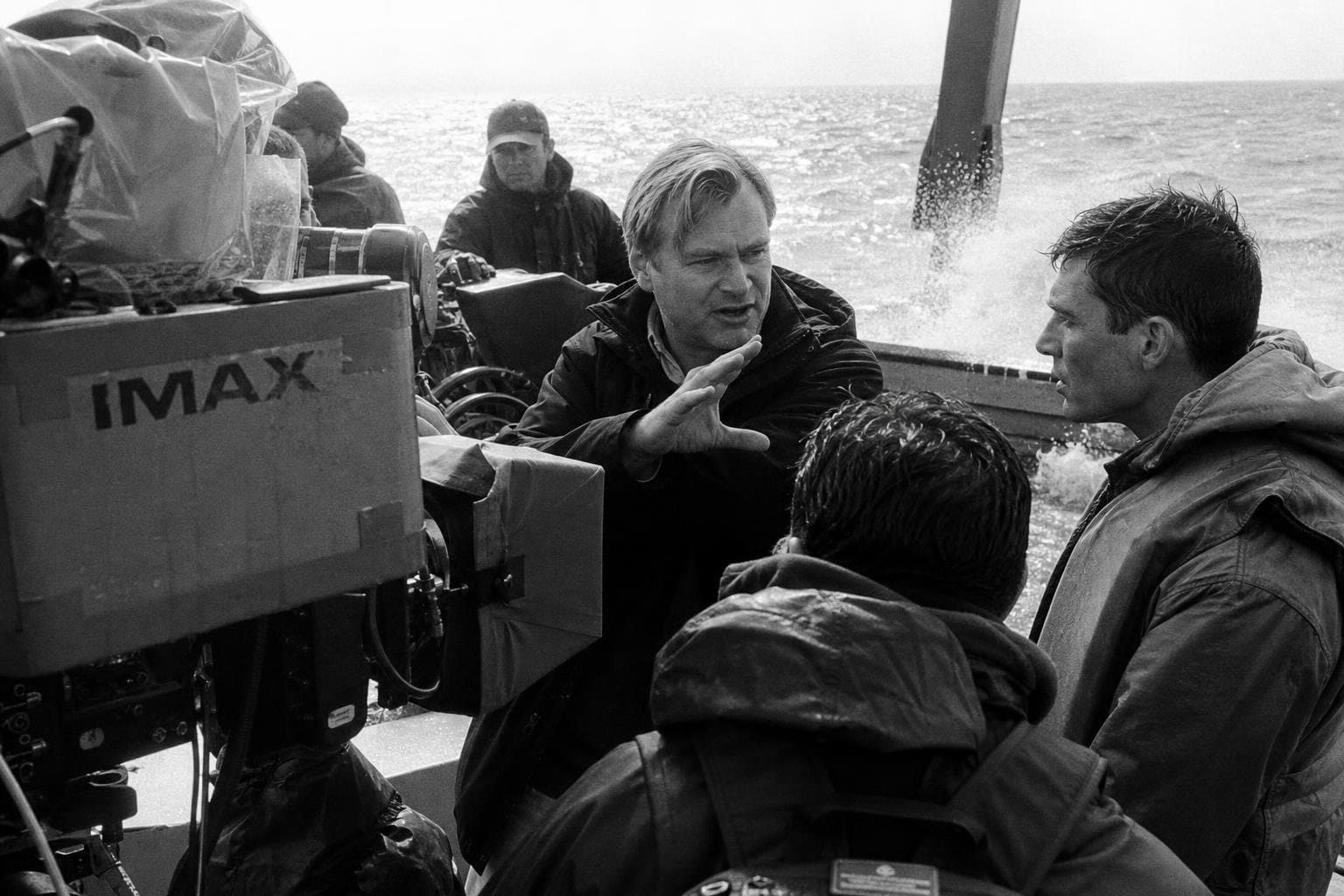
The Odyssey shot for 91 days across six countries, and became the first Nolan film shot entirely on IMAX cameras. The director has been pushing toward this for decades — he traces his obsession with the format to age 16, watching documentaries at the Museum of Science and Industry in Chicago, and has spent his career incrementally expanding how much of each film he could shoot in it. The Odyssey represents the completion of that project. "It's the closest imaging format to the way the eye sees that's ever been devised," Nolan told the BFI. "You can really give people the feeling of being there."
The production also went practical wherever possible — actors on real boats in real storms, real locations across multiple continents, animatronics and puppetry alongside CG for the mythological creatures. "We're using every trick in the book," Nolan said. The goal was to make the fantastical elements feel as grounded as the real ones. That's an expensive philosophy. It's also, demonstrably, what audiences respond to.
Nolan finished ahead of schedule — 91 days into a planned 100-day shoot, he told Stewart, "we couldn't have taken another step." That discipline matters commercially. A director who consistently delivers on time and under budget earns a different kind of trust than one who bleeds money and extensions.
The Bet Universal Is Now Making
The Odyssey is projected to open to $85–100 million domestically, with another $110 million overseas, for a global opening north of $200 million. For context, Oppenheimer launched to $82 million domestically and $181 million worldwide — and that was with Barbie on the same marquee splitting the cultural conversation. The Odyssey arrives as the weekend's only major wide release.
The critical reception has been strong — 96% on Rotten Tomatoes and 89 on Metacritic — which matters for the long run. Nolan films tend to leg out, and awards momentum extends the theatrical window.
What's worth watching now is whether The Odyssey does for its genre what Oppenheimer did for its: prove that a specific kind of ambitious, demanding cinema can still command mainstream audiences at scale. If it does, the next negotiation — whatever Nolan wants to make after this — starts from an even stronger position. That's how creative capital compounds in Hollywood. You don't earn freedom once. You earn it film by film, opening weekend by opening weekend.


