



Robert Eggers didn't just want Count Orlok to look scary. He wanted him to look like he'd stepped out of the specific folklore of a specific region, wearing clothes that specific aristocrats would have actually worn. That's a strange thing to prioritize when you're remaking a 102-year-old silent film that most audiences know only as "that creepy vampire with the long fingers." But it's exactly the kind of priority that defines how Eggers makes movies, and Nosferatu, which arrived in theaters on Dec. 25, is maybe the purest distillation of it yet.
The Costume Is a History Lesson, Not a Costume
Most vampire movies treat the vampire's look as pure design — whatever reads as "menacing" on screen. Eggers went the other direction. According to RogerEbert.com, his Orlok (played by Bill Skarsgård) is dressed in traditional Romanian aristocratic garb, and his conception of the character draws specifically on Balkan and Slavic vampire lore rather than the gothic-count shorthand that's calcified around the character since Bela Lugosi. The decision reframes Orlok as a rotting corpse pulled from a specific folk tradition rather than a generic creature of the night — a distinction that matters only if you believe the audience can feel the difference even when they can't articulate it. Eggers clearly believes that.
The same piece notes that the film recreates the Biedermeier furnishings and brick Gothic buildings of 1838 Germany, which is the kind of detail that costs a production designer and art department enormous hours and yields almost nothing that a casual viewer will consciously register. Nobody leaves the theater saying "the chairs were period-accurate." But accumulate enough of those unnoticed accuracies and the whole frame starts to feel load-bearing in a way that cheaper, vaguer period dressing never does.
The Same Four People, Every Time
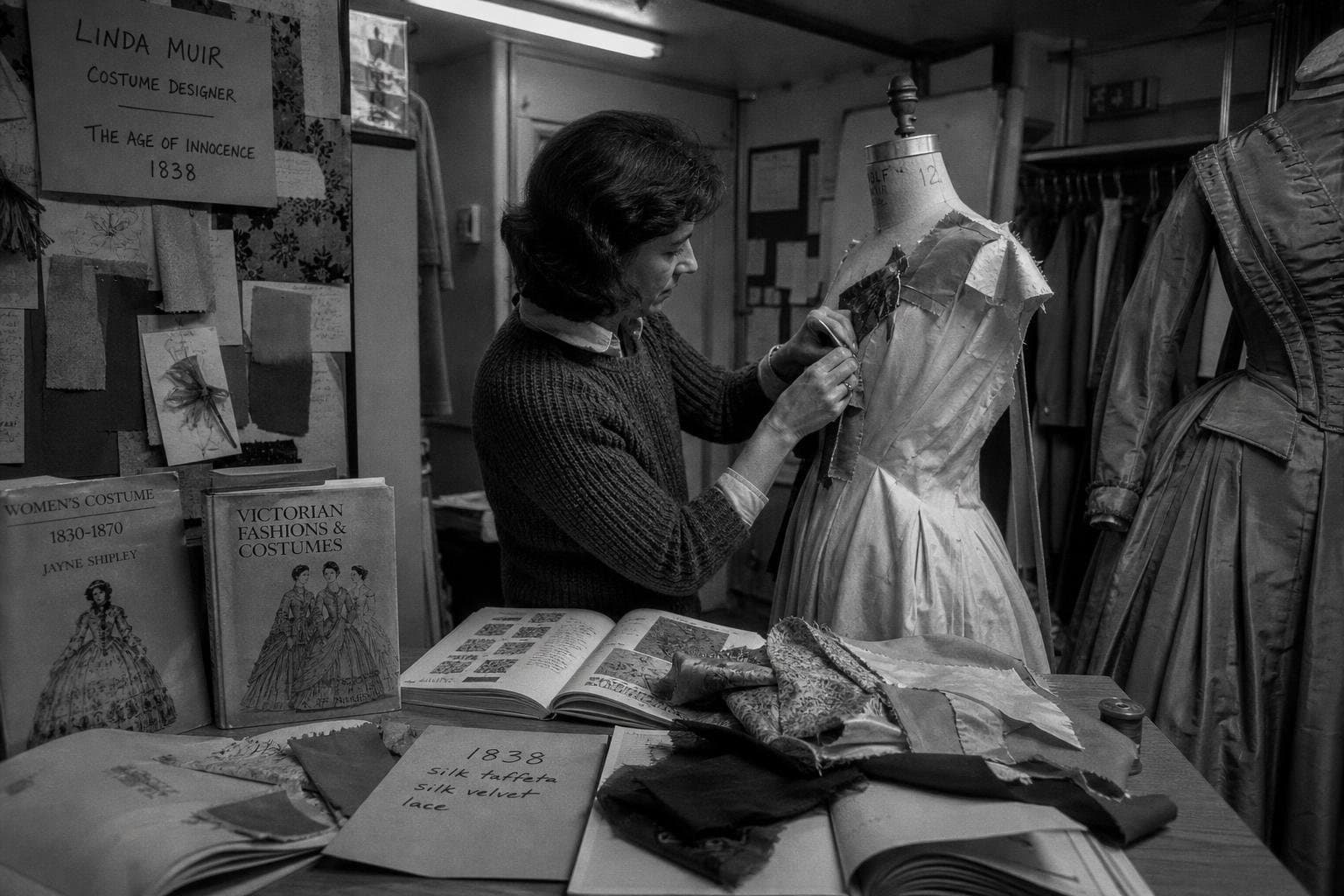
What's striking about RogerEbert.com's account is that this isn't a one-off research binge for a single project — it's the output of a team Eggers has kept together across his entire filmography. Cinematographer Jarin Blaschke, production designer Craig Lathrop, editor Louise Ford, and costume designer Linda Muir have worked on all of his films, per that same reporting. That continuity is its own kind of authenticity infrastructure. A costume designer who's spent three previous productions inside Eggers' research-first process doesn't need to be told twice why a specific weave or cut matters; she's already built the muscle for it.
American Cinematographer frames this Nosferatu explicitly as the fourth collaboration between Eggers and Blaschke, following The Witch, The Lighthouse, and The Northman — a run of films where visual language has been treated less as individual design problems and more as an ongoing argument about how to make the past feel physically present rather than illustrated.
Ellen's Story Required the World to Be Real First
Time reports that Eggers' version shifts the story's center of gravity toward Ellen Hutter (Lily-Rose Depp), reframing her sleepwalking and nightmares through 19th-century beliefs about women who were thought to be in touch with another realm. That's a thematic choice, but it only works if the 1838 setting feels solid enough to make her psychological unraveling legible as a collision with a specific, constrained society rather than generic gothic atmosphere. You can't dramatize a woman being ostracized by her era's social and medical assumptions if the era itself is wallpaper. The production design isn't decoration for that idea — it's the argument's supporting evidence, scene by scene.
This is the thing that makes Eggers useful to think about even if you've never cared about vampires specifically: he treats historical accuracy as a storytelling tool rather than a prestige flourish. The wicker chair isn't there to be admired. It's there so the scene built around repression and desire has something solid to push against.
Whether that philosophy keeps scaling with him — into bigger stories, bigger studios, bigger expectations about turnaround — is the thing worth watching next. The team has stayed the same for four films running. The real test is what happens the first time it can't.