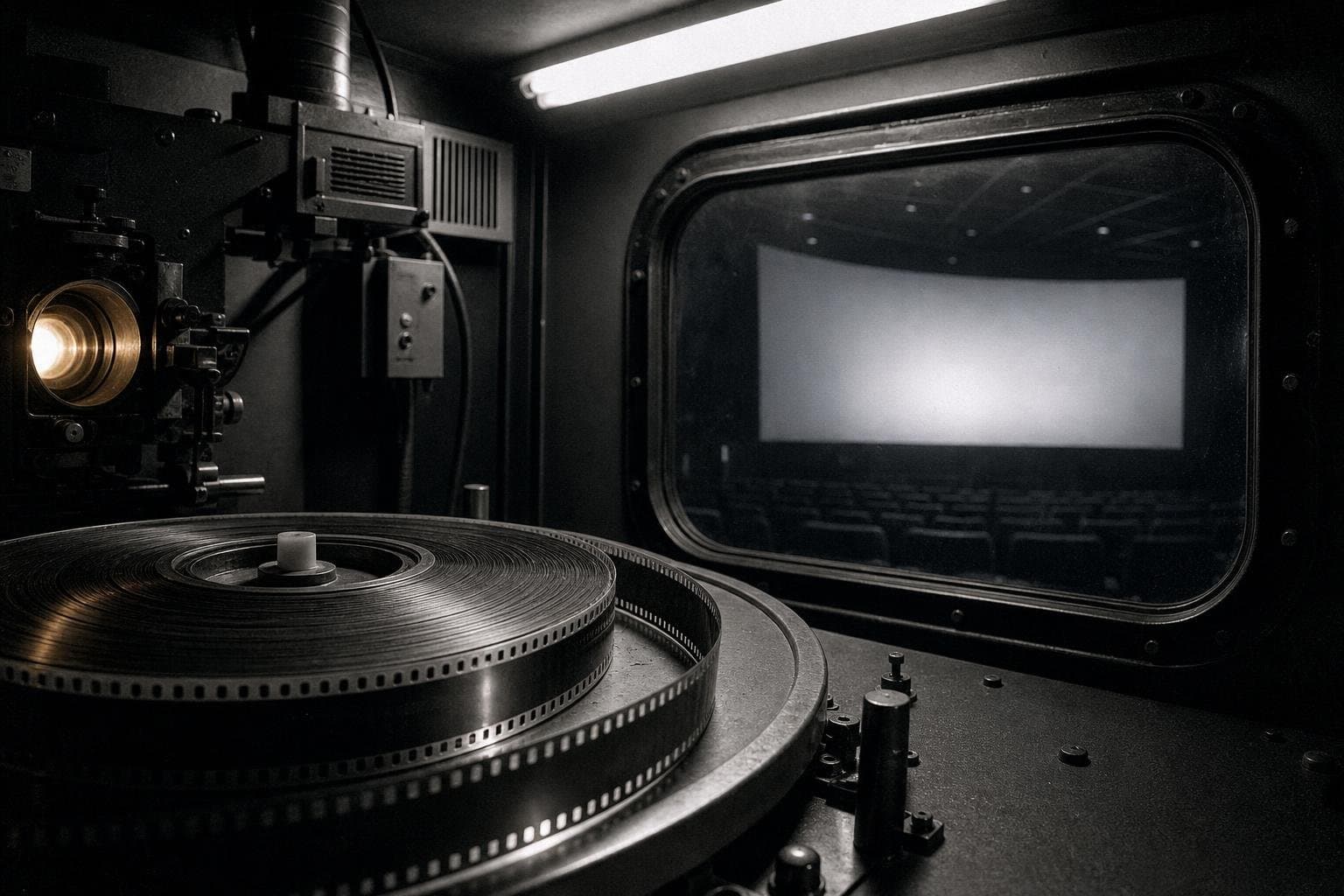

The BFI Imax sold 28,000 tickets for Christopher Nolan's The Odyssey in a single day — breaking the venue's all-time first-day record and more than quadrupling what Oppenheimer generated in the same window. That last detail is worth sitting with. Oppenheimer was itself a record-setter at that venue. The film that proved a three-hour, R-rated, dialogue-heavy historical drama could become a billion-dollar phenomenon is now the baseline that its own director's next project had to lap.
That's not a footnote. That's the whole story of how Hollywood's relationship with long runtimes changed.
The Bet Oppenheimer Was Never Supposed to Win
When Universal greenlit Oppenheimer at a reported three-hour runtime, the conventional wisdom said they were leaving money on the table. Fewer daily showtimes per screen. No obvious franchise hook. A subject — the Manhattan Project — that skews older and more male than the broad four-quadrant audience studios prefer. The film was, by every standard metric, an uncomfortable commercial proposition.
What happened instead became the template. Oppenheimer didn't just succeed despite its length; the length was part of the argument the film made about itself. A three-hour runtime signals seriousness. It tells the audience this is an event, not a product — something worth arranging your evening around rather than streaming while folding laundry. Warner Bros. co-chair Michael De Luca, speaking at a Produced By panel, acknowledged the film's cultural weight while noting that the studio's earlier "popcorn experiment" had cost them Nolan — a candid admission of how much the relationship between a filmmaker and his studio shapes what gets made and at what scale.
The runtime, in other words, wasn't a concession to an auteur's ego. It was a positioning decision. Long films don't just tell longer stories — they occupy a different category in the audience's mind entirely.
Runtime as Marketing, Not Just Storytelling
Here's the counterintuitive economics: a three-hour film is harder to schedule but easier to market. The length itself becomes the story. When Oppenheimer opened, the runtime was discussed in every review, every social post, every conversation about whether to see it. That friction — "can I sit through three hours of this?" — generates exactly the kind of cultural engagement that no advertising budget can buy.
Collider reported that The Odyssey carries a runtime of 2 hours 52 minutes and a $250 million budget — Nolan's most expensive film since The Dark Knight Rises in 2012. That budget requires a break-even point north of $500 million, which sounds terrifying until you remember that Oppenheimer approached $1 billion globally. The studio isn't betting against the runtime; the studio is betting on it, because Oppenheimer demonstrated that prestige length and blockbuster scale are no longer mutually exclusive categories.
The pre-sale data bears this out. The Odyssey generated £750,000 ($1 million) at the BFI Imax alone in its first 24 hours of ticket sales — a full month before release. Tickets for opening weekend screenings had already sold out in under an hour, a year in advance. Scalpers were listing seats on eBay for up to $1,500. These are not the numbers of an audience tolerating a long film. These are the numbers of an audience that has decided the length is a feature.
What Oppenheimer Actually Proved
The runtime question was never really about attention spans. It was about trust — whether audiences trusted a filmmaker enough to surrender three hours to his vision, and whether studios trusted that the filmmaker's judgment about length was commercially defensible.
Oppenheimer answered both questions. And the answer has restructured how prestige blockbusters get greenlit. Industry analysis of the current moment points to a broader pattern: films like Avengers: Endgame and Dune: Part Two have established long runtimes as markers of cinematic ambition rather than commercial liability. The theatrical experience, under pressure from streaming, has found its differentiator — and it turns out to be exactly the thing streaming can't replicate: the commitment, the scale, the shared duration.
Nolan's The Odyssey — shot entirely on Imax 70mm, per Deadline — arrives as the fullest expression of this logic yet. The film is nearly three hours long, costs a quarter of a billion dollars, and is selling out premium screens a month before anyone has seen a frame of it. That's not despite Oppenheimer. That's because of it.
The studios didn't greenlit long runtimes because they stopped being afraid of them. They greenlit them because one film made the fear look like the mistake.


