



A year after Sean Baker's Anora swept the Oscars, the company that distributed it isn't expanding into a mini-major on its own terms. It's selling stakes, watching its executives get poached by Warner Bros., and fielding takeover interest that traces back to Qatari money. That's not what victory laps usually look like — and it tells you something about what an indie distribution win is actually worth once the awards season confetti settles.
The Stake Sale Is the Real Verdict on Anora's Value
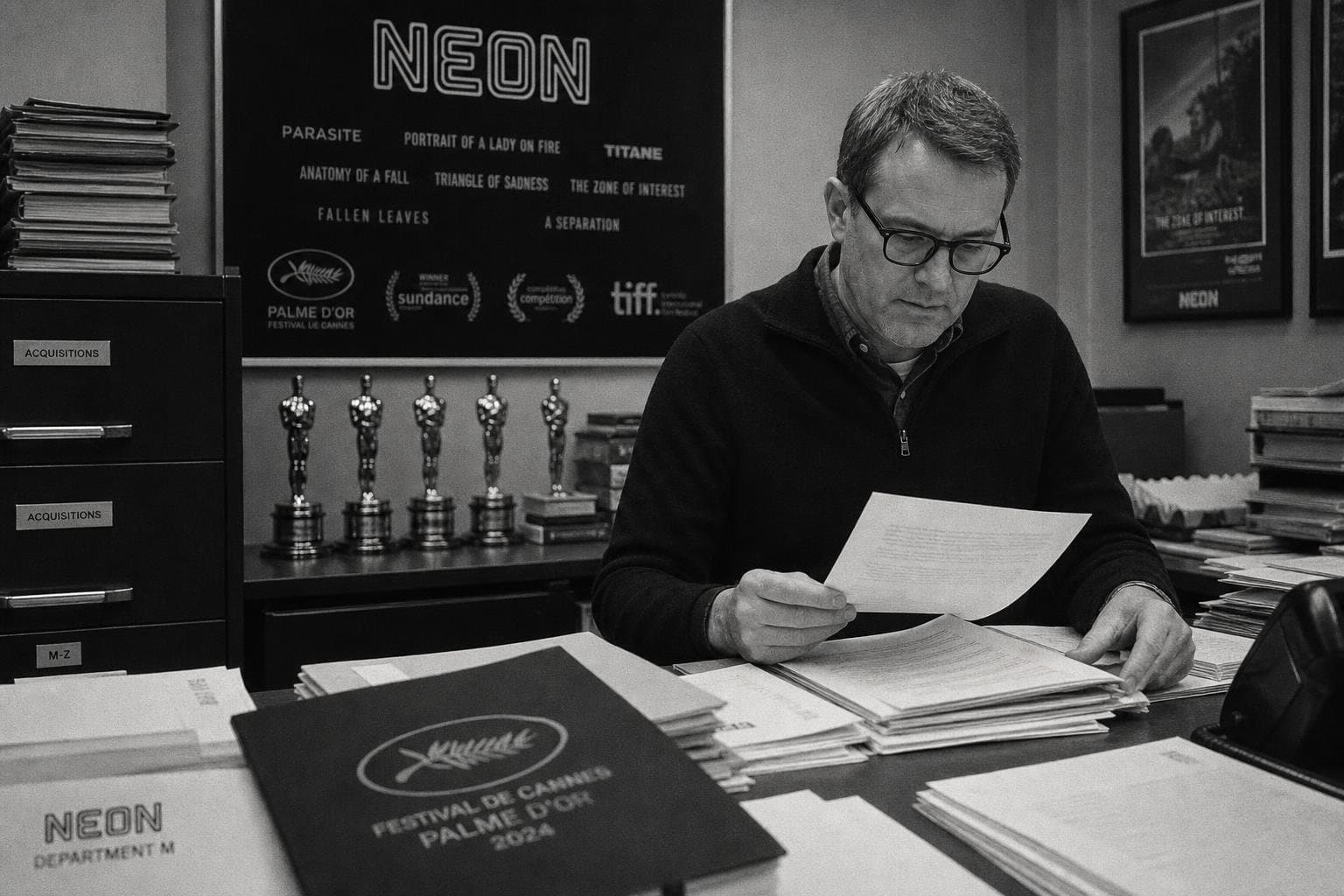
In February, Deadline reported that Department M — a company formed by Mike Larocca and Michael Schaefer with backers that reportedly include Qatari investors — was in talks to acquire a significant stake in Neon. By the fall, Variety confirmed the deal had closed, with Tom Quinn staying on as CEO and Department M's Schaefer becoming chief content officer. Terms weren't disclosed, but the shape of the deal matters more than the number: Neon's longtime backer, the Friedkin Group, stayed on as a shareholder rather than being bought out entirely, which suggests this was less a rescue and more a scaling-up move for a company whose asset is really its pipeline — a streak of Palme d'Or acquisitions and two Best Picture winners in Parasite and Anora.
That pipeline is the product being valued here, not any single film. Quinn told Deadline back when talks first surfaced that Neon gets "a ton of incoming" interest and has fielded takeover conversations before, including one with Indian Paintbrush backer Steven Rales that fell apart in 2022. What changed between then and now wasn't Neon's taste — it was proof. Anora's Best Picture win, on top of the Parasite precedent, turned "we bet on auteur cinema and it sometimes breaks out" into a repeatable model with a demonstrated payout.
The Awards Campaign Is Where the Real Money Gets Spent
Sean Baker himself has been unusually candid about what that model costs once a film is in the race rather than just in theaters. Speaking at a festival Q&A, Baker said he was surprised by the size of Neon's awards campaign budget for Anora — a detail that's easy to skip past but that reframes the entire "scrappy indie beats the studios" narrative. The theatrical release is only step one. The campaign spend that turns a well-reviewed festival film into an Oscar frontrunner is where a specialty distributor either proves it can compete with the studios or doesn't, and Neon's willingness to spend big on that stage is arguably the more replicable part of its formula than any single acquisition decision at Cannes.
Baker's own next moves reinforce the point. He's said his follow-up will be "probably around the size of Anora" rather than a leap into $100–150 million studio filmmaking, and that film — Ti Amo! — didn't even stay with Neon. It landed at Clockwork, the new Warner Bros. specialty label built, tellingly, by hiring former Neon marketing and acquisitions executives. Warners didn't just want a Sean Baker movie. It wanted the people who knew how to run the campaign machinery that got Anora across the finish line.
What Buying Into Neon Actually Buys
Heading into this year's Oscars, The Hollywood Reporter noted Neon arrived with 18 nominations across a slate that included Sentimental Value and The Secret Agent — second only to Warner Bros. itself. That's the asset Department M is buying a piece of: not one film's box office, but a nomination-generating machine with a Palme d'Or streak that keeps supplying it. Neon is now reportedly eyeing a U.K. distribution launch of its own, expanding the same model into new territory rather than selling it off wholesale.
The lesson from Anora's afterlife isn't that a $6 million-scale indie beat the system once. It's that the system underneath it — festival relationships, disciplined acquisitions, and a willingness to outspend expectations on the campaign — became valuable enough that a studio would rather hire it away than compete with it, and investors would rather buy in than watch from outside. Worth watching whether Department M's involvement changes what kind of films get that campaign treatment next, or whether Quinn's taste stays the same and the money just gets bigger behind it.