


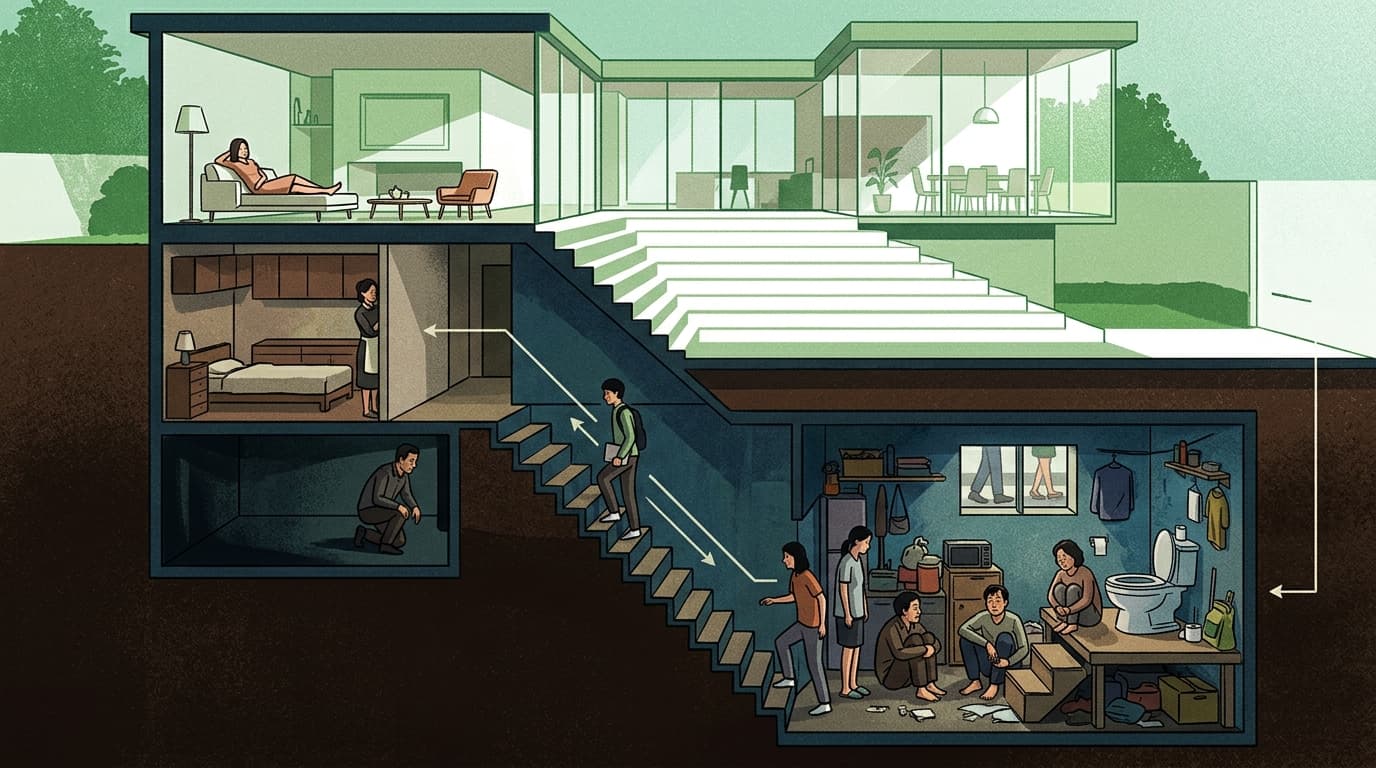

The Kim family lives in a semi-basement. Not underground, not at street level — halfway between. That spatial limbo isn't incidental set dressing. It's Bong Joon-ho's thesis made physical.
Parasite is structured around a single architectural logic: elevation equals status, and every movement between floors is a class transaction. The Parks live at the top of a hill, behind a gate, in a house designed by a fictional architect named Namgoong — all glass and clean horizontal lines, flooded with light. The Kims occupy a cramped semi-basement where the windows frame passing feet and the toilet sits on a raised platform to avoid sewage backup. The film won four Academy Awards including Best Picture, but the real achievement was making that contrast do the narrative work that dialogue usually handles.
The House Doesn't Just Contain the Story — It Generates It
Production designer Lee Ha-jun built the Park residence as a complete set rather than shooting in an existing location, which gave Bong precise control over sightlines and spatial relationships. The result is a house that functions like a diagram. Every room communicates hierarchy: the housekeeper's quarters are hidden behind a bookcase, literally concealed within the walls of wealth. The basement beneath the basement — when it's revealed — isn't a plot twist so much as an architectural punchline. Of course there's another level down. There's always another level down.
The staircase is where the film lives. Characters ascend to perform, descend to scheme, and the camera follows them with a kind of gravitational inevitability. I'd argue no film since Metropolis has used vertical space this deliberately to encode class — and Bong is doing it in a genre-blending thriller, not an expressionist allegory.
What the Smell Motif Adds
The one class marker that architecture can't contain is smell. The Parks can't see the Kims' poverty, but they can smell it — the semi-basement odor that clings to Ki-woo's clothes regardless of what floor he's standing on. The BBC's Cannes review noted the film's ability to work simultaneously as thriller and social critique, and this is exactly the mechanism: the sensory detail that pierces the visual performance of class mobility.
It's a clever solution to a storytelling problem. How do you show that the Kims' infiltration of the Park household is ultimately doomed without telegraphing the ending? You give the audience a detail that can't be scrubbed away.
Why This Still Matters as a Craft Model
The film's production design works because it commits fully to a single metaphor and trusts the audience to read it. No character explains what the house means. The architecture just keeps making the argument — quietly, persistently, in every establishing shot and every staircase descent.
That's the discipline worth studying: Bong and Lee Ha-jun built a set that thinks. The story couldn't have been told in a different house.