
Here's a sentence that should stop you cold: a major studio spent money developing a film, finished it, and then declined to release it — not because it tested badly, but because the company's corporate parent had just become a business partner of the man the film is about. That's the story behind Luca Guadagnino's Artificial, and it's a cleaner illustration of how corporate entanglement shapes what gets made than anything I could invent.
The Film Amazon Couldn't Afford to Release
Artificial is Guadagnino's dramedy about the OpenAI boardroom crisis of November 2023, when Sam Altman was fired and then reinstated within days — with Andrew Garfield playing Altman and Yura Borisov playing Ilya Sutskever, the co-founder who moved to oust him (The Hollywood Reporter). The film was developed at Amazon MGM Studios before Guadagnino came aboard to direct, and it carried a reported $40 million budget (The Hollywood Reporter). Then Amazon's parent company announced a planned $50 billion investment in OpenAI, and months later, Amazon MGM decided not to release the movie it had just finished paying to make (Hollywood Reporter).
I've written before about how studios weigh fan service, runtime, and franchise economics against creative ambition. This is a different animal: a studio weighing its own finished product against the business interests of its corporate family. Guadagnino himself named the dynamic bluntly, telling THR that "the concept of a conflict of interest is a very important, let's say, elephant in the room here" when describing how studios reacted to screening the film (The Hollywood Reporter). WIRED framed the film's broader project even more sharply, describing it as a work that roasts AI's creators while delivering a dark warning about the dangers of the technology they built (WIRED).
The Deal Structure Tells You Who Had Leverage
What happened next is the part worth studying if you care about how indie distribution actually works. Neon held a secret early-morning screening for its executives at CAA, got in before Netflix, Searchlight, and A24 even had a look, and ultimately acquired the film in a deal where it paid nothing up front but committed to a $15 million marketing spend (Hollywood Reporter).
That structure is its own kind of statement. A zero-dollar acquisition price means Neon wasn't betting on Artificial as a safe commercial play — it was betting on the marketing campaign itself, and on being the distributor willing to touch a film every other major passed on. The reported reasons for those passes ranged from budget concerns to the film simply not clicking with buyers, but the timing — right after Amazon's OpenAI investment became public — is hard to separate from the outcome (Hollywood Reporter). The film premiered at the New York Film Festival before its Christmas Day theatrical release (The Hollywood Reporter).
Guadagnino Shot a Dystopia Inside a Failed Utopia
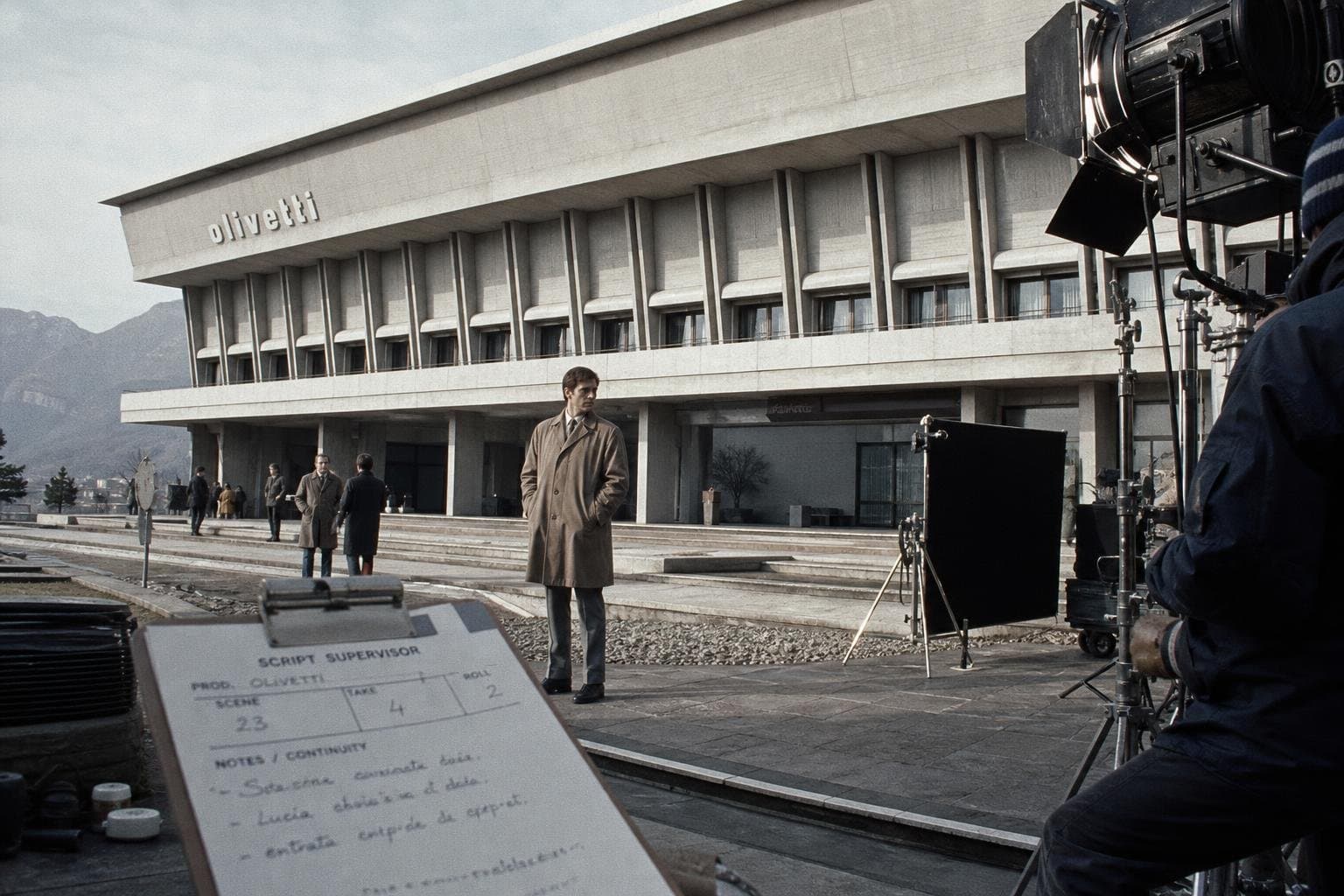
The craft choices back up the politics. Guadagnino shot much of the film in Northern Italy, at the old Olivetti campus — the Italian company once famous for typewriters and early personal computers, built by Adriano Olivetti as a workers'-welfare utopia that collapsed after his death (Vulture). "This was a utopia, and it didn't succeed," Guadagnino told Vulture. "The movie is a dystopia, and it's triumphing" (Vulture). That's a director using a location's own failed idealism as commentary on the one he's filming — the kind of choice that only works if you know the history of the room you're shooting in.
It's also worth noting that Guadagnino made this film in the same stretch of his career where IndieWire was simultaneously reviewing his seven-hour Bertolucci documentary and still referring to him, in passing, as "the 'Challengers' director" — a reminder that he's now prolific enough to be defined by whichever recent film a given outlet has in front of it (IndieWire).
What to Watch
The real test comes at the box office over the film's Christmas release window and in how distributors talk about Artificial afterward — whether Neon's zero-upfront, marketing-heavy model gets cited as a template the next time a studio gets cold feet about a film that embarrasses its own business partners. If Artificial performs, expect more of these pass-the-hot-potato acquisitions. If it doesn't, the lesson studios will take isn't about courage — it's that declining to release a finished, well-reviewed film is now just a normal cost of doing business with the companies you're also trying to build with.


