


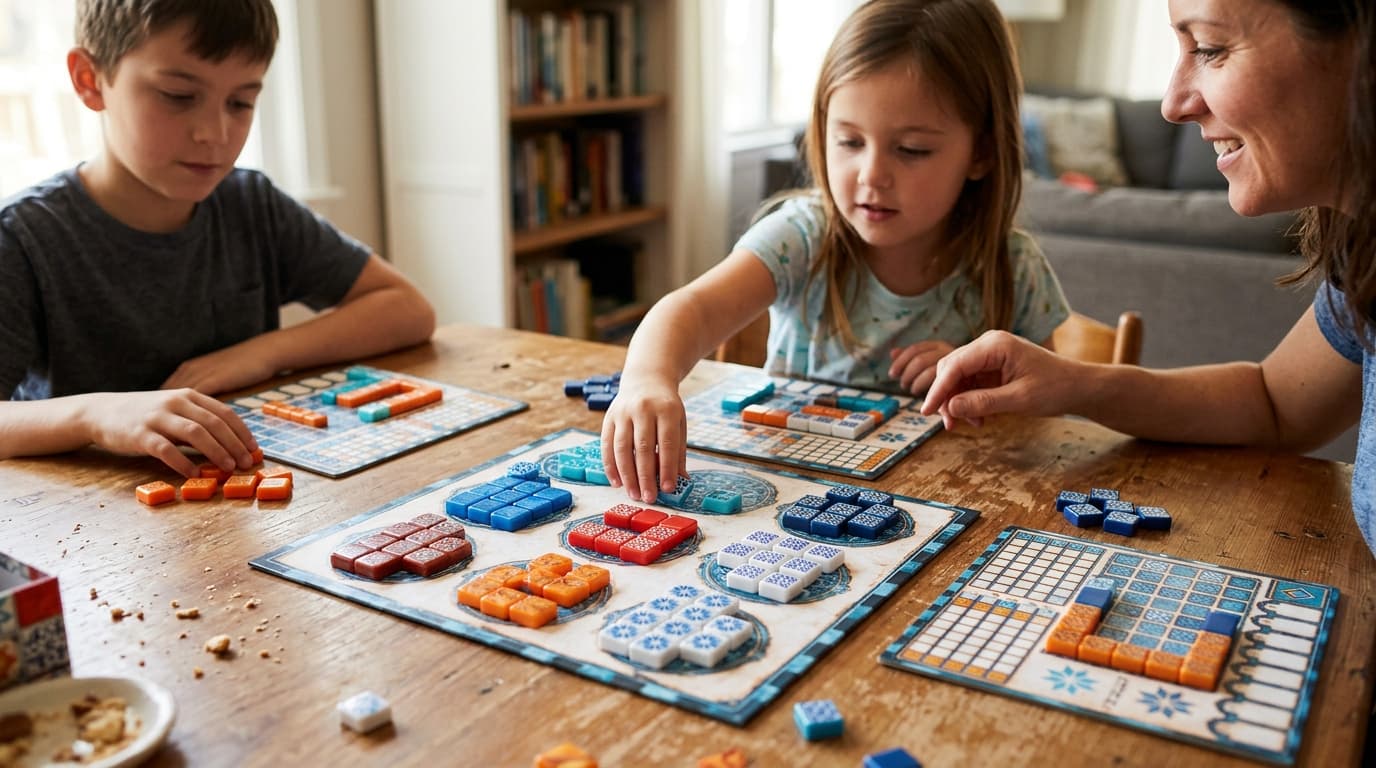

A 6-year-old can pick up Azul faster than a 10-year-old. That should not work. The box says 8+. But younger kids keep touching the tiles — the smooth, chunky, almost-too-satisfying-to-put-down tiles — and that tactile obsession turns into actual engagement with the game.
That is the thing about Azul that reviewers undersell: the physical pieces are not just nice production value. They are the on-ramp. Kids who would normally drift during setup are already invested before a single rule lands, because the tiles feel like something worth protecting.
The game itself is tile-drafting: you pull colored tiles from a central pool, build rows on your personal board, and score points when rows complete and tiles transfer to your wall. IGN's buying guide calls it "simple enough to pick up in a round or two" while noting the strategy gets genuinely deep at higher levels — which is exactly the profile you want for a mixed-age table.
That depth gap is what makes it work across ages. A 6-year-old can play a perfectly valid game by just collecting colors they like and filling rows. A 10-year-old starts noticing they can deny tiles to other players. An adult is running three-move sequences and watching everyone else's boards. Everyone is playing the same game; nobody is playing the same game. One family reviewer noted their daughter started at 6 — two years below the box recommendation — and had no trouble, while also observing that as she aged up, she was visibly grasping more advanced strategies. That progression is real. It is not a game you outgrow; it is a game that grows with you.
The competitive edge is worth flagging honestly. There is a move in Azul where you take a tile specifically to prevent someone else from having it, and it stings. The same reviewer cops to doing exactly this to his spouse and being fine with it — but notes that in a highly competitive family, this could curdle. With younger kids, you will want to make a judgment call about whether to play that way. The blocking tends to be light enough that it reads as clever rather than mean, but every family's tolerance for that stuff varies.
Setup is fast, cleanup is fast, and the game runs about 30 minutes. Those three things together are worth more than any mechanic when you are playing at 7:45 on a Tuesday.
If you do not own it yet, it is widely available and worth the shelf space.