


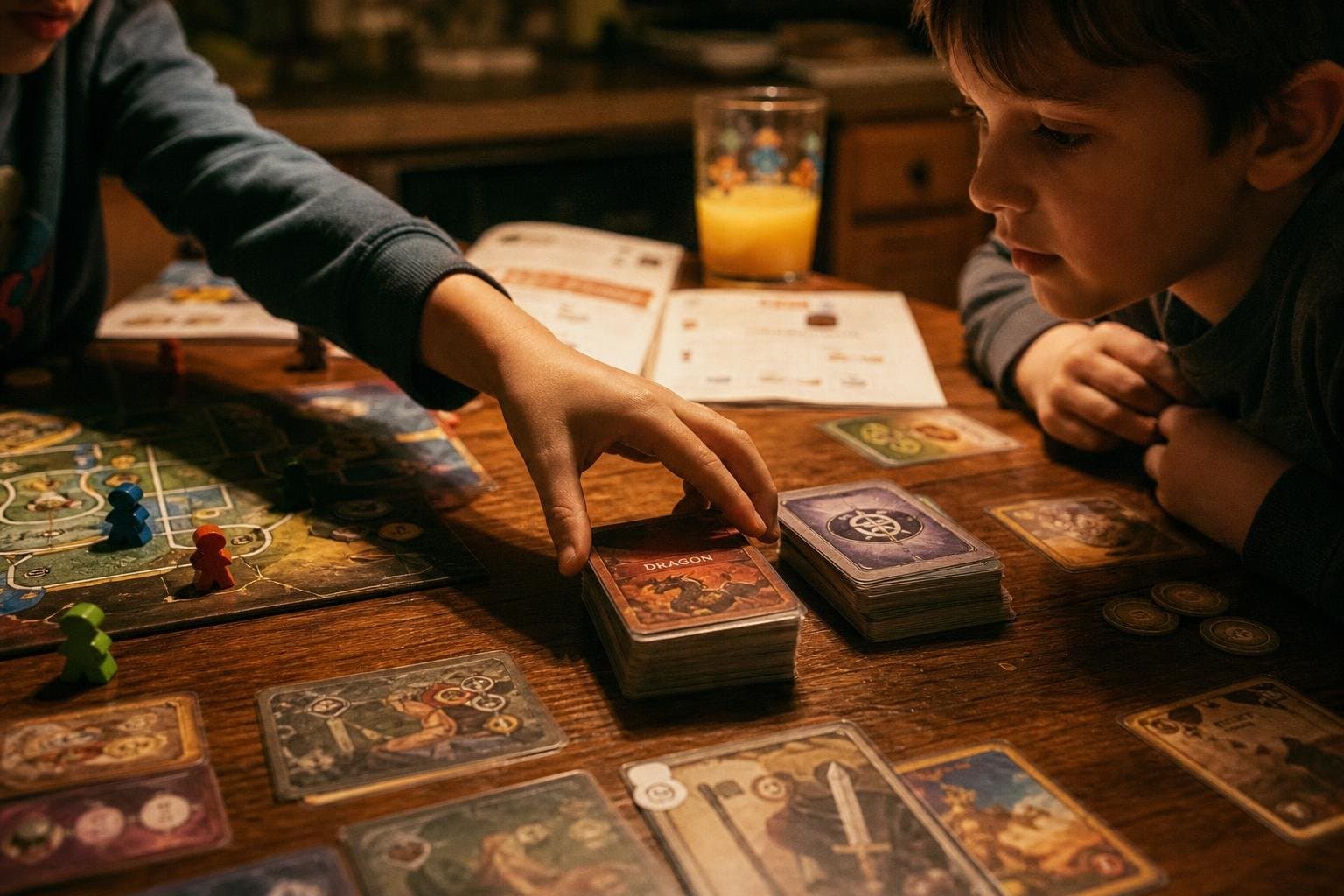

My ten-year-old beat my seven-year-old at Catan so decisively last spring that the seven-year-old cried, then quit, then declared Catan "a bad game forever." My ten-year-old, to his credit, looked guilty. The game wasn't bad. The matchup was.
This is the core problem with mixed-age game night, and it doesn't get solved by finding a game that's "fun for all ages" — that phrase is on approximately every box ever made and means almost nothing. The real question is mechanical: what decides who wins? If the answer is reading speed, vocabulary, general knowledge, or strategic depth, you've handed the older kid a structural advantage and called it family fun.
Gabeocreative's family game night guide puts it plainly: most family games quietly reward skills that are proxies for age. The teenager wins, the youngest loses, and everyone learns the evening isn't really for them. Three mechanics avoid that trap — luck, bluffing, and creativity. None of them have an age curve.
What Actually Levels the Field
Luck is the obvious one, but it's worth being specific about how it works. Pure dice-rolling bores older kids fast. The games that hold mixed ages are ones where luck creates situations that everyone has to respond to — where the randomness is the starting point, not the whole game.
Bluffing is underrated for mixed-age play. Small kids are often startlingly good at it, and adults are worse than they think. A seven-year-old who can keep a straight face has a genuine advantage over a twelve-year-old who telegraphs everything. That's rare in family games, and it matters.
Creativity — drawing, storytelling, silly voices — has no age curve at all. A six-year-old's drawing is just as likely to get guessed as a teenager's, sometimes more so, because the younger kid's interpretation is weirder and funnier and somehow more obvious.
King Panda Games' 2026 rankings highlight Cover Your Assets specifically for this: "it makes a seven-year-old and a forty-year-old genuinely equal." The mechanic — only the top set in your stack can be stolen — means every player is always in the game, always at risk, and the steal that triggers the table erupting is as likely to come from the youngest player as anyone else. Their review gave it a perfect score and flagged it as best at four players, with a 20–40 minute play time.
Sushi Go Party! earns a similar note in the same rankings: the take-a-card, pass-the-rest mechanic is learnable in two minutes, and the menu-building element means the game feels different each time without adding rules complexity. Ages 8 and up, 20–30 minutes — short enough for a weeknight, varied enough to stay interesting.
The Team Rule That Fixes Almost Everything Else
For games where the skill gap is real and unavoidable, the Gabeocreative guide offers the most practical fix I've seen: don't handicap the younger player, pair them with an adult as a team. Handicaps single a child out and they still get knocked out first. Teams keep them at the table for the whole game — the adult handles the fiddly bits, the child makes the decisions.
This works especially well with cooperative games, where Mind Games' family game night guide notes the natural advantage: instead of celebrating one winner, everyone has to discuss options and make a plan together. The trade-off — an assertive adult accidentally running the whole table — gets neutralized when you deliberately give the younger player ownership of specific decisions. Their cards. Their clues. Their call.
The readthetale.com family game night guide adds something worth keeping: the evening doesn't have to end on the main game. Ending on a competitive loss is why so many game nights finish badly — whoever lost goes to bed having lost. A quick non-competitive round at the end, even just a silly drawing prompt or a conversation question, resets the mood before anyone has to sleep on it.
The Sequence Matters as Much as the Games
Gabeocreative's running order is worth stealing directly: something fast and silly for the first ten minutes (gets everyone laughing before anyone's competitive), the main game in the middle when attention is highest, and something quiet and non-competitive at the end. The structure does work that no single game can do on its own.
The mistake most families make is treating game selection as the whole problem. It's half the problem. A great mixed-age game played in the wrong order — after everyone's already tired and prickly, or right before bed when losing feels catastrophic — will still fall apart. The game has to be right. The timing has to be right. And someone has to be willing to call it before the meltdown, not after.
My seven-year-old still thinks Catan is a bad game. He's not entirely wrong about that evening. But last week he asked to play Cover Your Assets again, specifically because he wanted to steal his brother's stack. That's the whole goal, right there.