


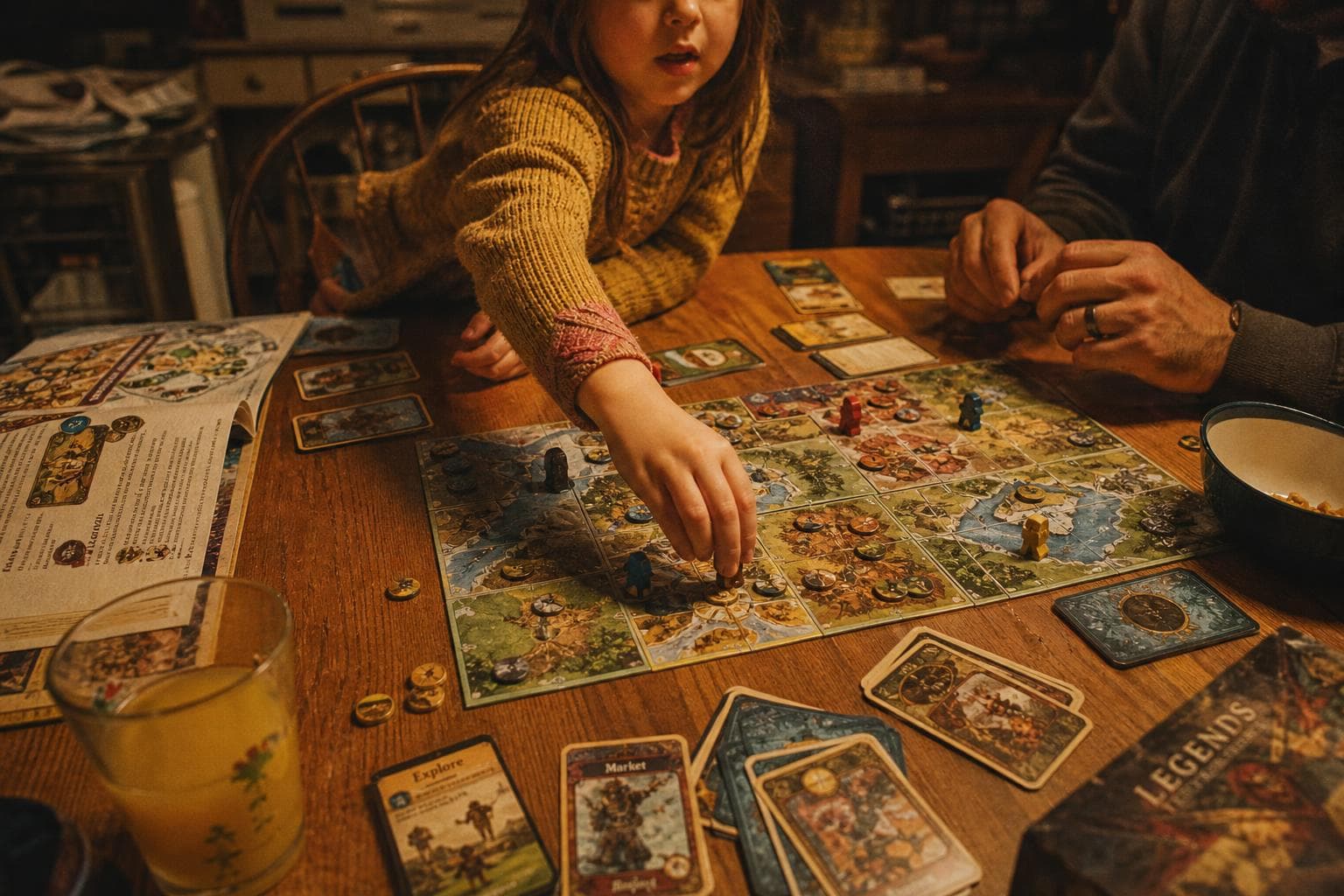

My son once declared, mid-game, that the rule was now "you get two turns if you're losing." He was losing. He was seven. And honestly? He wasn't wrong to try it.
Rule-bending kids get a bad reputation at the game table. We treat it as a discipline problem — the child who can't follow instructions, who needs to be corrected, who's ruining it for everyone. But I'd argue the kid who starts improvising rules is usually doing one of two things: they're bored, or they're overwhelmed. Either way, the game is failing them before they fail the game.
The question isn't how to enforce rules better. It's whether your game can survive — and even benefit from — a little chaos.
Games That Break Under Pressure Reveal Themselves Fast
There's a category of game that looks great in the box and falls apart the moment a real child sits down at the table. The rules are technically clear, but they depend on everyone caring about the same things: winning fairly, taking turns patiently, accepting that luck is luck. Kids, especially tired weeknight kids, don't always care about those things.
Competitive games with high stakes and long waits are the most fragile. Aceshowbiz's family game roundup puts it plainly: most classic board games were designed for competitive adults, not mixed-age families. When an eight-year-old lands on Boardwalk with a hotel, they don't think "that's the game." They think the game is broken and someone should fix it. So they try to fix it.
The house rule isn't the problem. The house rule is the symptom.
Cooperative Games Absorb Chaos Better Than Competitive Ones
Here's what I've noticed after a lot of weeknight game nights: cooperative games don't just reduce conflict — they make rule-bending less tempting in the first place. When everyone's on the same team, there's no incentive to cheat. You can't gain an advantage over people you're not competing against.
Eyas Landing's guide for neurodiverse families makes a point that applies well beyond that specific context: cooperative games promote teamwork and shared problem-solving rather than pitting players against each other. When the game itself is the opponent, kids have somewhere to direct their competitive energy that isn't each other — or the rulebook.
I've seen this play out with Forbidden Island specifically. When the island starts sinking faster than you expected, nobody's thinking about bending rules. They're thinking about how to save the last treasure. The urgency of a shared problem is a better behavior management tool than any rule enforcement I've tried.
Aceshowbiz recommends Forbidden Island as a starting point for exactly this reason — ages 8+, about 30 minutes, rules explainable in under two minutes. That last part matters more than it sounds. A game you can explain fast is a game kids can hold in their heads. A game they can hold in their heads is a game they don't need to improvise around.
When House Rules Are Actually Fine
Not all rule-bending is a red flag. Some of it is kids doing what game designers do: noticing that a rule creates a bad experience and trying to fix it.
Eyas Landing suggests being flexible with victory conditions — adapting how someone "wins" to focus on participation rather than pure competition. That's a house rule. It's a good one. The difference between a house rule that helps and one that derails the game is usually whether it serves everyone at the table or just the person proposing it.
My working test: if a kid suggests a rule change and I can't immediately see how it advantages them specifically, I try it. "What if we all start with one extra card?" — sure, let's see what happens. "What if I get to go again because I rolled a one?" — that one we talk about.
The Smoothie Wars bank holiday guide makes a useful point about mixed-age tables: you need games that don't force an eight-year-old to sit silently while teenagers strategize. When a younger kid starts inventing rules, they're often just trying to stay relevant. Give them a game where they're already relevant, and the improvisation drops off on its own.
Pick Games That Have Slack Built In
The games that survive chaos aren't necessarily the simplest ones. They're the ones with enough flexibility in the design that small variations don't break anything. Tile-laying games, cooperative games, games with multiple paths to a goal — these absorb a lot of table noise without collapsing.
The games that don't survive are the ones where every rule is load-bearing. If one bent rule cascades into three more arguments, the game was too brittle for a real family table. That's not a character flaw in your kids. That's a design problem you can shop your way out of.
The kid who changes the rules mid-game is giving you useful information. The best response isn't to shut it down — it's to find a game that makes the impulse irrelevant.