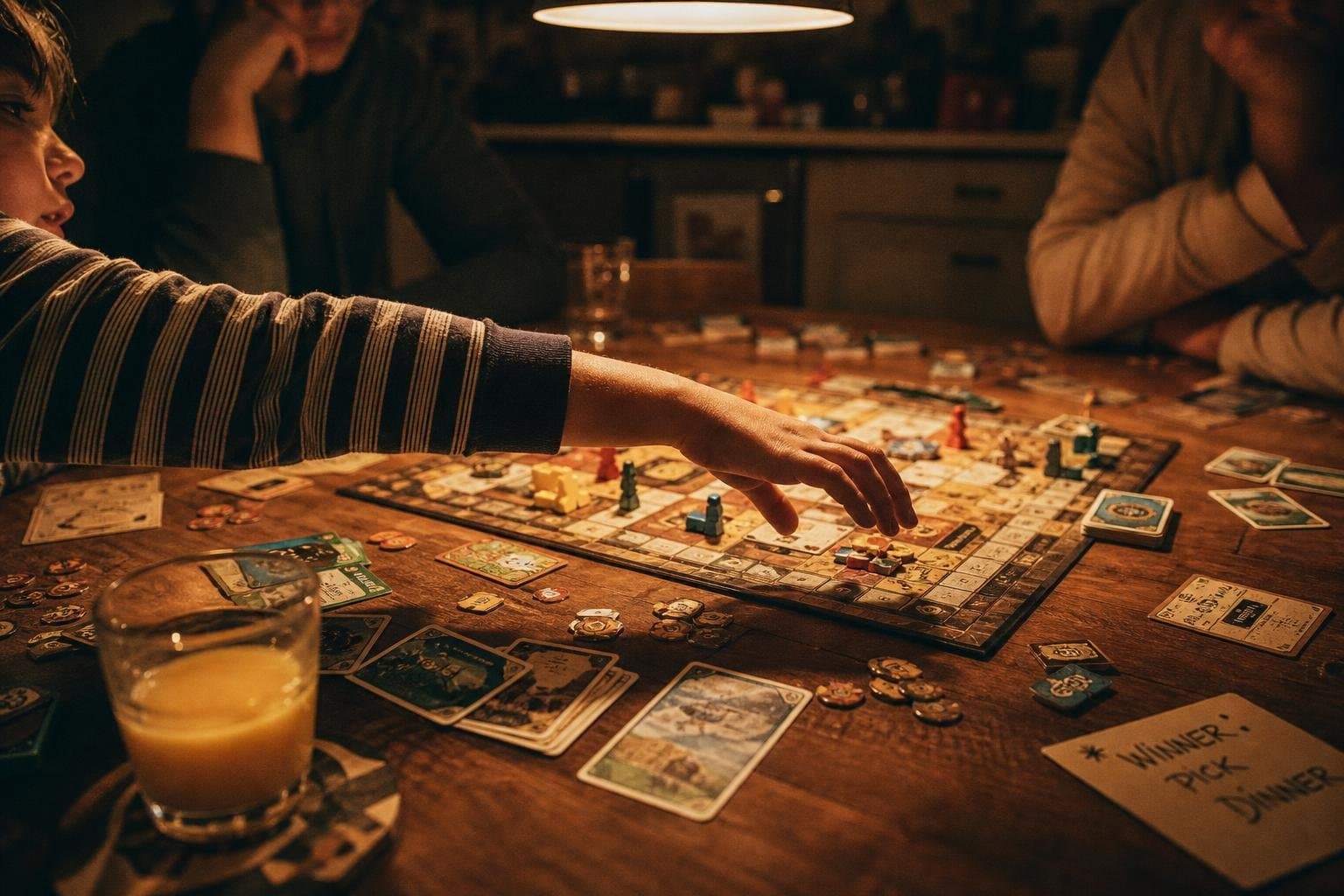

My youngest has a tell. Around minute thirty-five of any game, she starts reorganizing her pieces. Not because she's planning anything — she's just done. Her brain has left the table even if her body hasn't. What follows is predictable: a yawn, a complaint about the rules, and then the slow-motion collapse of everyone else's fun.
The fix isn't better parenting. It's better game selection. Specifically, games designed to end before that window closes.
This sounds obvious until you realize how many games are designed with no real concept of pacing — they just run until someone wins, however long that takes. The best family games treat ending as a feature, not an accident.
Short Games Are Engineered, Not Accidental
There's a difference between a game that happens to be quick and a game built around the constraint of being quick. Boardgame.tips puts it plainly: "Board games don't always have to take up an entire afternoon. With these games, you don't have to worry about a teammate dropping out because they got bored." That's not a marketing line — it's a design philosophy.
Games like SCOUT and Sushi Go! are built around hand management mechanics that create natural stopping points — you run through the cards, the round ends, you score. There's no sprawling board state to maintain, no negotiation phase that can stretch indefinitely. The structure itself enforces a finish line.
Compare that to something like Monopoly, which parents.com notes has stayed popular partly because it's "simple, engaging, and adaptable" — but which has no real mechanism to end. It just continues until someone quits or someone wins by attrition. That's a recipe for exactly the kind of table collapse you were trying to avoid.
The Tension Problem (and Why It Matters More Than Length)
Here's the thing that pure play-time numbers miss: a 45-minute game can feel shorter than a 20-minute game if the tension is distributed correctly.
Newy with Kids describes Jenga this way: "As the tower gets taller and wobblier, the tension builds beautifully. Requires a steady hand, some strategy, and quite a bit of luck. The collapse at the end is always spectacular." That collapse is the payoff — and everyone at the table knows it's coming. The anticipation keeps kids engaged even when it's not their turn, which is the real enemy of the long game: dead time.
Games that manage tension well give every player something to watch even when they're not acting. KLASK, described as combining "elements of air hockey and foosball," keeps everyone's attention because the action is continuous and visible. Dobble — listed by Mumsnet as their best family card game — works similarly: the whole table is scanning simultaneously, so there's no waiting for your turn to matter.
Dead time is where boredom lives. Games that eliminate it run longer without feeling longer.
What "Quick and Easy" Actually Requires
Mumsnet's roundup flags "P for Pizza" as their best quick and easy family game, and the framing is telling: quick and easy. Those two things are related but not the same. A game can be fast because it's simple (Candyland — parents.com notes a three-year-old can play it once they understand "follow the color on the card"). Or it can be fast because its mechanics are efficient even when the decisions are interesting.
The games that work best on a weeknight tend to hit both: low rule overhead at the start, meaningful decisions during play, and a clear ending condition that everyone can see coming. Exploding Kittens is a good example — the premise is immediately legible (don't draw the exploding kitten), the rounds move fast, and the game ends the moment one player is eliminated. No ambiguity about when it's over.
That last part matters more than people admit. Games with fuzzy endings — where you're not sure if you're ten minutes from done or forty — are harder to commit to on a school night. Kids can feel that uncertainty too, and it makes them less willing to start.
The Real Metric: Did They Ask to Play Again?
I wrote back in June about games that earn their setup time, and the same logic applies here in reverse: a game that ends cleanly and leaves everyone wanting more has done something genuinely hard. It managed the pacing so well that nobody noticed they were being managed.
That's the design goal worth chasing. Not "short" as a category, but "ends before someone checks out" as a standard. The games that hit it tend to share a few things: visible tension, minimal dead time, and an ending condition everyone can see from the middle of the game.
When my youngest starts reorganizing her pieces, I want the game to already be wrapping up — not because I cut it short, but because someone designed it that way on purpose.


