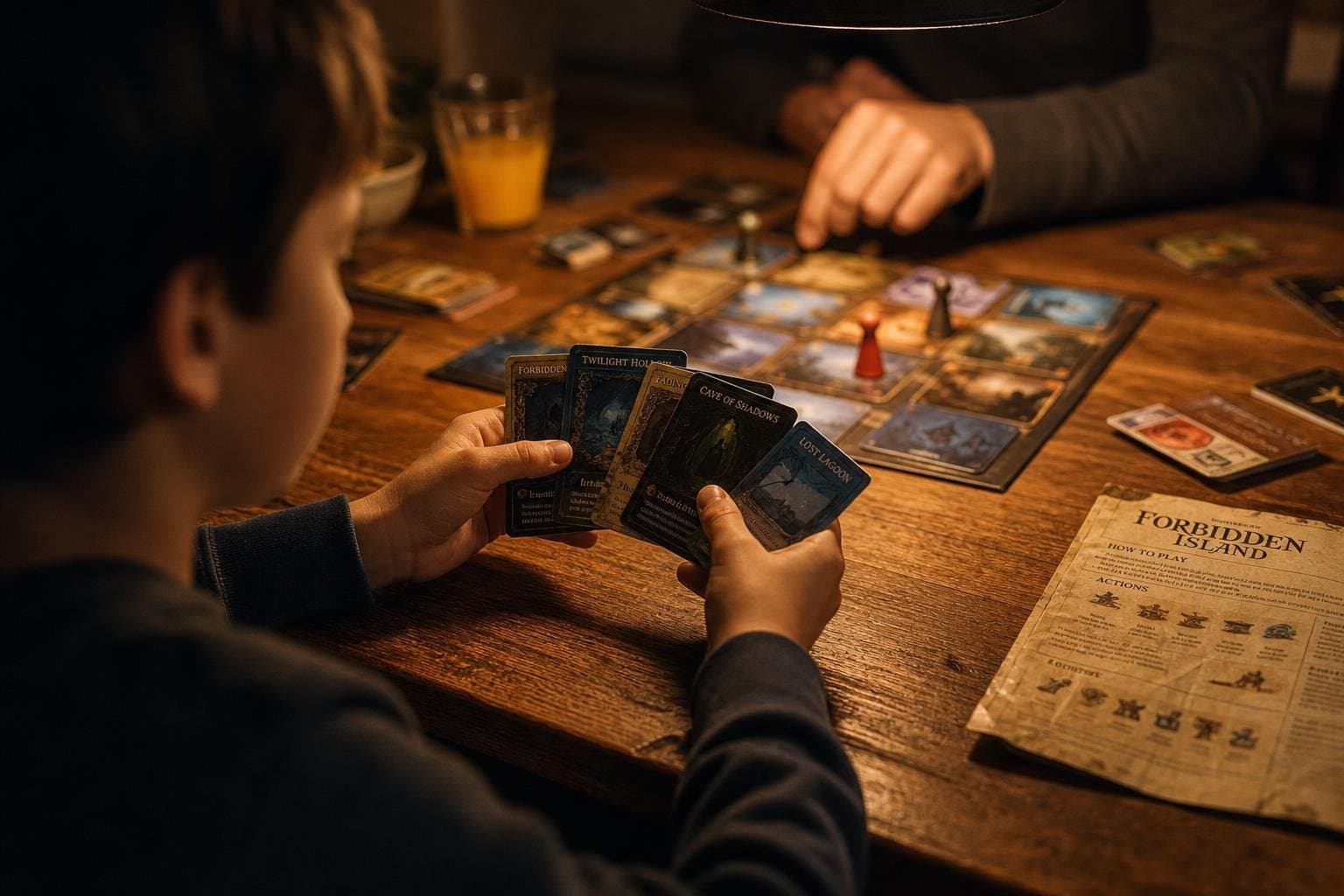

My son is ten. He has played enough cooperative games to develop a very specific complaint: "You're just telling me what to do." He's not wrong. I was. And the game let me.
This is the alpha player problem, and if you've played cooperative board games with your family, you've either been the alpha or you've been managed by one. Winorm describes it precisely: one player — usually the most experienced, most anxious about losing, or most controlling by temperament — starts calling everyone's moves. They're not trying to ruin the game. They genuinely think they're helping. But the rest of the table quietly becomes an audience, and the kids who most needed to feel like real participants are the first ones to check out.
The thing is, this isn't a character flaw you can parent your way out of. It's a design problem. And the games that solve it do so structurally, not by hoping everyone behaves.
Why Most Co-ops Accidentally Create This Problem
The alpha player dynamic is a predictable outcome of a specific design choice: fully shared information with collective outcomes. When everyone can see the whole board and the goal is to win together, the person most confident in their reasoning has a gravitational pull toward directing the group. Coopboardgames.com puts it plainly: "It is not a flaw in the players. It is a predictable outcome of any game where all information is shared and outcomes are collective."
This matters enormously at a family table with mixed ages. A twelve-year-old who's played Pandemic three times will naturally start optimizing for the group. A seven-year-old who can't track the full board state will naturally defer. The game hasn't done anything wrong, exactly — but it hasn't done anything to protect the younger player's experience either.
The games worth buying are the ones that do.
The Mechanic That Actually Fixes It: Hidden Information
The most reliable design solution is also the most elegant: give each player private information that nobody else can see. Coopboardgames.com traces this pattern through games like Hanabi and The Crew — both of which make it structurally impossible for one person to calculate the full picture, because no single player has access to it.
This changes the entire social dynamic at the table. The experienced player can't boss the younger one because they literally don't know what's in the younger one's hand. Everyone has to communicate, infer, and trust — which is exactly the kind of collaboration that makes a cooperative game feel like a cooperative game rather than a guided tour.
Bomb Busters, which won the Spiel des Jahres, works on exactly this principle. Each player holds hidden wire tiles; the team uses clues and deduction to defuse a bomb without seeing each other's information. The reviewer at Wakasm describes the table experience as "a shared puzzle brain" where "everyone starts laughing when the obvious thing was sitting there the whole time" — which is the opposite of one person narrating the solution while everyone else nods. The game spans 66 missions with escalating complexity, which means it has genuine replay depth, but the core mechanic that prevents alpha behavior is baked in from mission one.
Hanabi works the same way and costs less — findswetrust.com lists it as the best value per player among cooperative games, and it's genuinely playable with kids who are old enough to hold a hand of cards and follow simple communication rules.
What to Look For (and What to Skip)
When you're evaluating a cooperative game for family play, the question to ask is: does this game structurally require everyone's participation, or does it just hope for it?
Games with fully open boards and no player-specific constraints are the ones most likely to produce alpha behavior. Warpzen.com notes that cooperative games work best for mixed-age groups when the design ensures "everyone feels like they've contributed to the victory" — but that feeling has to be built into the mechanics, not just the spirit.
Hidden information is the clearest signal. Rotating leadership — where a different player makes the final call each round — is another. Real-time pressure (everyone acting simultaneously) is a third, because it makes it physically impossible for one person to direct everyone else's moves before the clock runs out.
What doesn't work: games that add "unique powers" to each player but still allow open discussion of optimal moves. The powers feel like they should prevent alpha behavior, but they don't — the experienced player just incorporates everyone's powers into their calculations and tells each person what to do with theirs. I've written about this specific design trap before, and it keeps showing up in otherwise solid games.
The Real Test Is Whether Your Kid Asks to Play Again
Readthetale.com's family game night guide makes a point that sounds obvious but is easy to forget: the goal isn't a perfect game night, it's a repeatable one. Kids who felt like passengers the first time don't ask to play again. Kids who felt like they mattered — whose hidden information turned out to be the key, whose clue cracked the puzzle — do.
That's the whole test. Not whether the game is clever, not whether it has good reviews, not whether it scales to six players. Did your kid want to play it again? If the answer is yes, the design did its job.


