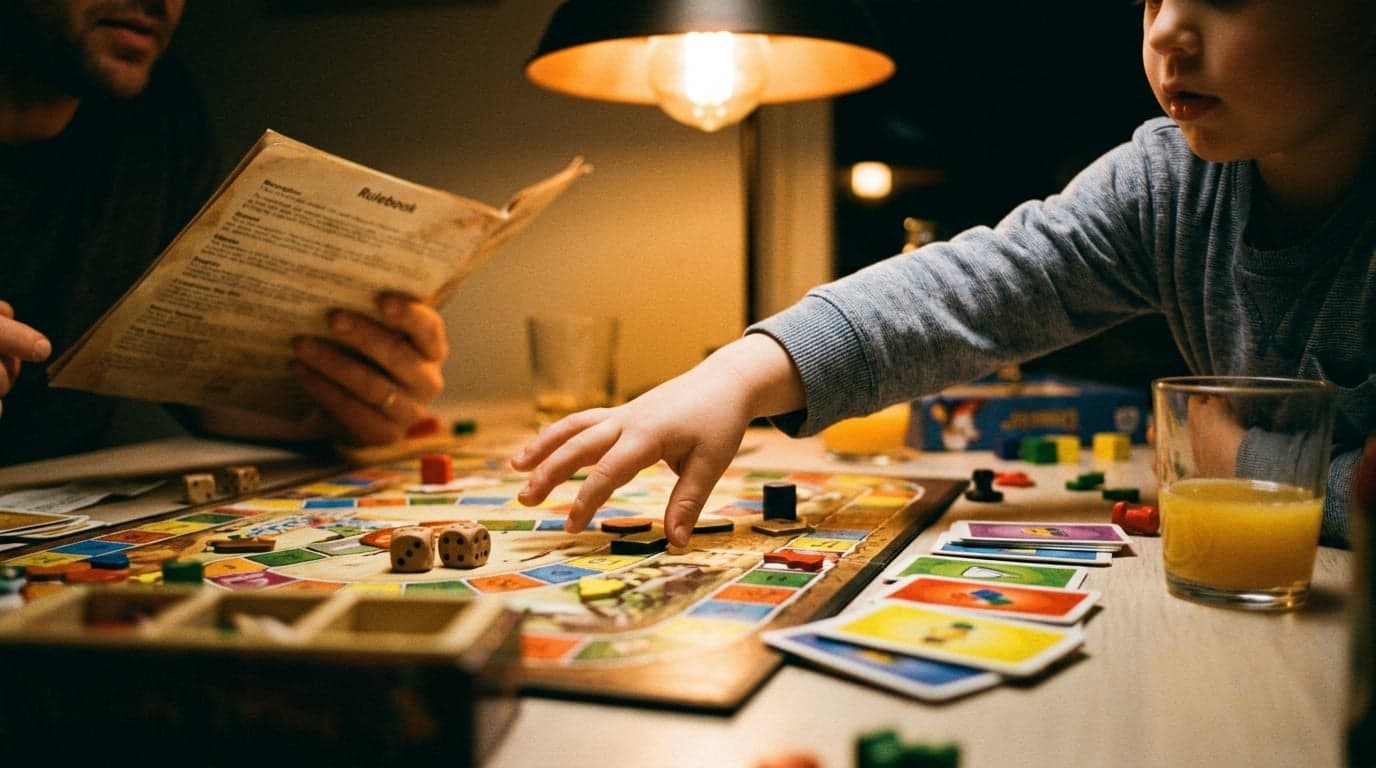

Here's the thing about most cooperative board games: they're cooperative in theory and parental in practice. One adult sees the whole board, understands the stakes, and starts quietly steering everyone's turns. The kids are technically playing. They're also technically just doing what they're told.
I wrote about the alpha player problem back in June, mostly in the context of competitive games. But cooperative games have a version of this problem that's sneakier and harder to fix, because the bossy player isn't being competitive — they're being helpful. And helpful is much harder to push back on at 7:30 on a Tuesday night.
The question worth asking isn't "is this game cooperative?" It's "does the design actually force my kid to make their own decisions?"
Why Most Co-ops Let Kids Off the Hook (and Not in a Good Way)
The standard cooperative structure goes like this: everyone sees the same board, everyone discusses what to do, and then the person with the clearest picture of the game state starts suggesting moves. For adults, that's strategy. For kids, it's a fast path to just executing instructions while feeling vaguely involved.
Warpzen's breakdown of cooperative game dynamics puts it charitably — cooperative games encourage everyone to "pool their brainpower." True. But pooling brainpower with a ten-year-old and a forty-year-old usually means the forty-year-old's brain does most of the heavy lifting, and the ten-year-old learns to wait for direction.
This isn't a parenting failure. It's a design gap. The games that actually solve it do something structural to prevent the runaway-advisor problem — they don't just hope everyone plays nicely.
The Design Move That Actually Works: Take Away the Talking
Hexagamers' roundup of recent cooperative releases makes a point worth sitting with: the games they consider best at fighting the quarterback problem are "mostly by not letting you talk." Their lead example is Sky Team, a two-player game where a pilot and co-pilot each roll dice behind individual screens and place them in silence — no communicating what you rolled, no suggesting where your partner should put theirs.
That silence is load-bearing. When you can't tell your kid what to do, they have to figure it out. When they can't ask you, they have to commit. The tension in the game comes from reading each other, not from one person managing the other's turn. Hexagamers notes that Sky Team won the 2024 Spiel des Jahres — the hobby's biggest award — and that setup takes about a minute with games running fifteen.
Fifteen minutes. One minute of setup. No talking. That's a weeknight game.
The silence mechanic is the most reliable design solution I've seen to the "helpful adult" problem, because it removes the mechanism entirely. You can't quarterback what you can't communicate.
What to Look for When You Don't Have a Silence Rule
Not every cooperative game uses hidden information or communication restrictions, and plenty of good ones don't. So what separates the games where kids actually contribute from the ones where they're just along for the ride?
A few things I've noticed matter more than the box description suggests:
Individual roles with real consequences. When each player controls something the others can't touch, kids have genuine ownership. Roxtoys' family cooperative roundup highlights Forbidden Island specifically for its card-trading and role mechanics — the game forces communication because players have different abilities and different hands, not because the rulebook says "work together."
Decisions that can't be undone. Games where you can always course-correct invite the adult to wait and fix things. Games with real consequences for each turn — tiles that sink, clocks that advance, resources that don't come back — make every player's decision matter in the moment.
Enough chaos that nobody has the full picture. When the game state is genuinely uncertain, the adult's advantage shrinks. Boardgame.tips' cooperative game list includes MicroMacro: Crime City, a detective game built around a shared map where the puzzle is distributed across the whole table — nobody can see everything at once, which means nobody can run everyone else's investigation.
The Real Test Is Whether They Ask to Play Again
All of this matters for one reason: kids who are actually making decisions have more fun. Not "educational fun" or "learning teamwork" fun — just the regular kind, where you feel like what you did mattered.
The games that pass the weeknight test in my experience are the ones where my kids come away with a specific thing they did. Not "we won" but "I put the die on the engine at the last second" or "I found the clue nobody else saw." That specificity is the tell. It means they were actually in the game, not just present for it.
A cooperative game where your kid is just taking turns is a competitive game with extra steps and worse stakes. The design has to do the work — and the good news is that more designers are building games where it actually does.


