


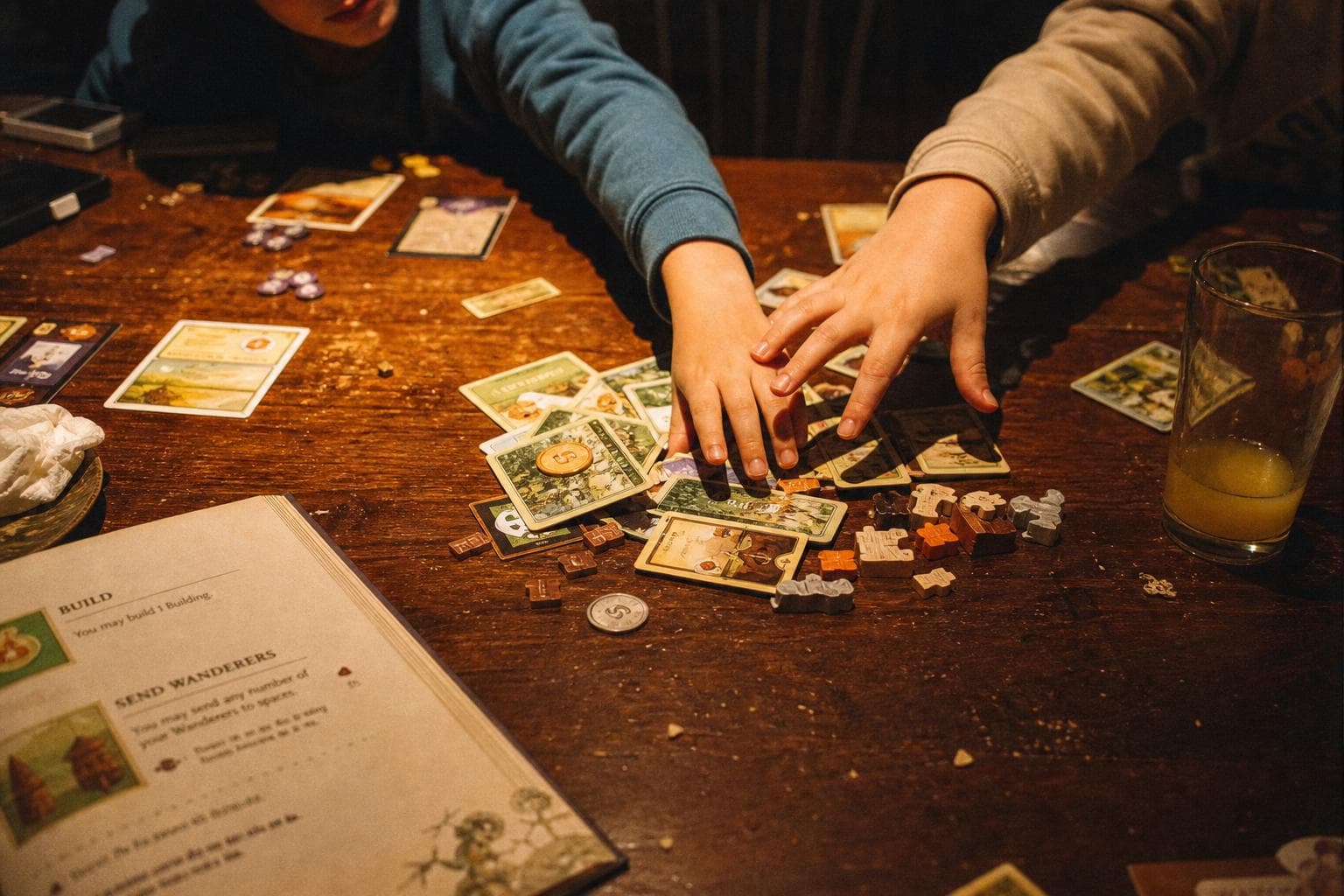

Here's the thing nobody tells you about cooperative board games: they can fail in exactly the same way competitive games fail, just with better optics. Instead of one kid dominating by winning, one kid dominates by deciding. Everyone else moves pieces when told. The game ends, and half the table wasn't really there.
The answer, it turns out, is mostly structural.
The Games That Accidentally Sideline Kids
The cooperative format is genuinely good. A recent roundup from a parent who tested over thirty games makes the case well: games like Forbidden Island turn your family into a team, and there's something real about watching a six-year-old and a forty-year-old high-five after a shared win. That doesn't happen in Monopoly.
But the cooperative format only delivers on that promise if every player has something meaningful to contribute — not just a turn to take. The failure mode is subtle. A game can be fully cooperative on paper while still routing all actual decision-making through whoever is oldest, most experienced, or loudest. Kids participate in the sense that they're present. They're not participating in the sense that their ideas shaped anything.
This is especially true with games that have a lot of moving parts. When the cognitive load is high, the natural tendency is for the most capable player to start managing everyone else's turns. It feels helpful. It's not.
What Structural Solutions Actually Look Like
The games that avoid this problem tend to share a few design features — and they're worth knowing before you buy.
Hidden information. When each player holds cards or resources that only they can see, the alpha player literally cannot make decisions for the group. They don't know what you have. This forces real consultation rather than instruction. Forbidden Island uses this partially; games that lean into it harder make it nearly impossible for one person to run the table.
Role asymmetry. When each player has a unique ability that others don't, kids stop being interchangeable pieces. The eight-year-old isn't just "another player" — they're the one who can do the thing nobody else can do. That changes how they're treated at the table, and it changes how they feel about being there.
Simultaneous pressure. Games that create time pressure or simultaneous decisions leave less room for one person to deliberate on behalf of everyone. When things are moving fast, kids often thrive — they're less inhibited, quicker to act, and less likely to defer.
Ravensburger's Minecraft JR: Builders & Biomes is a recent example aimed at younger players (ages 5+) that leans on the cooperative teamwork angle specifically — the familiar Minecraft characters help with buy-in, and the farm-building structure gives younger kids concrete, understandable goals rather than abstract strategy. It's not going to challenge a ten-year-old, but for the 5-8 crowd, it's worth noting that the design intent is genuine collaboration rather than just shared presence.
For older kids, Ravensburger's Horrified: Dungeons & Dragons – Ravenloft — just announced and set in the gothic horror domain of Barovia — uses the Horrified series' established cooperative structure, where players choose heroes with distinct abilities and work together against specific monsters. The Horrified series has a strong track record of giving each player a defined role that matters, which is exactly the structural feature that keeps kids in the game rather than watching it.
The Test That Actually Matters
Before you buy any cooperative game, ask one question: can a younger player make a decision that changes the outcome, without an older player having approved it first?
If the answer is yes — if the game is designed so that a kid's idea, a kid's move, a kid's read of the situation can genuinely matter — you have a real cooperative game. If the answer is "technically yes, but in practice the older players will redirect anything suboptimal," you have a competitive game wearing cooperative clothes.
The best cooperative games don't just let kids help. They make it structurally difficult not to need them.