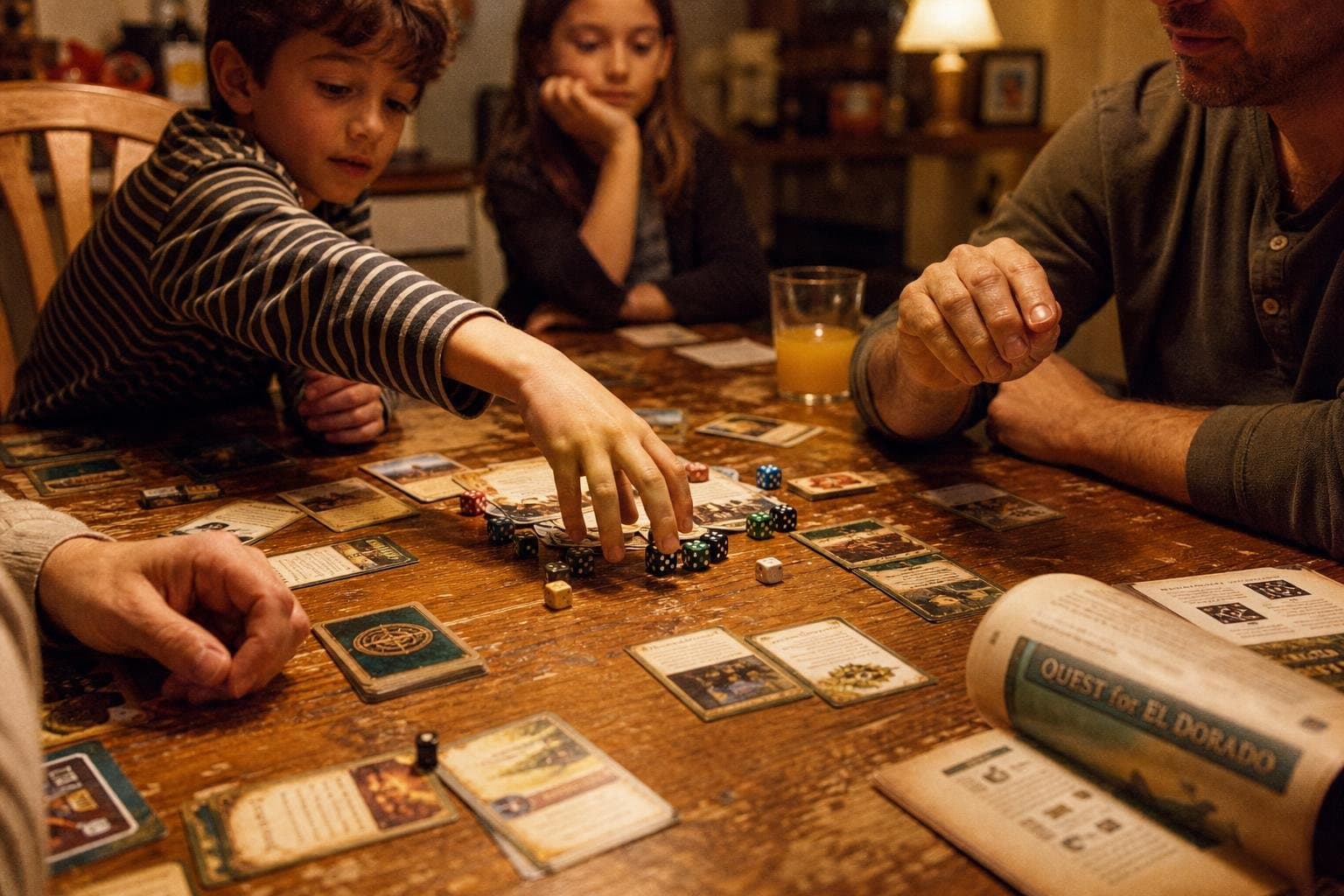

My seven-year-old has a finely tuned radar for being patronized. She can tell within about thirty seconds whether she's actually playing a game or being managed through one. The moment she suspects the latter, she's done — not dramatically, just quietly done, suddenly very interested in the dog.
This is the real design problem with games for mixed-age families. It's not just "can a younger kid follow the rules?" It's whether the game gives them genuine agency — real moments where their choices matter and their wins feel earned. A game that hands younger kids victories through pure luck isn't much better than one that crushes them with complexity. Both leave them feeling like passengers.
The good news is that some games solve this without resorting to either approach.
Luck That Doesn't Feel Like Charity
The cleanest solution is a game where luck is the primary mechanism for everyone — so younger kids aren't at a disadvantage, but nobody feels like the outcome was engineered for them.
Spidey and His Amazing Friends Yahtzee Jr. is a good example of how this works at the youngest end of the age range. Instead of matching numbers, players roll dice featuring characters and match them to pictures on a scoreboard — which means a four-year-old is operating on exactly the same footing as an adult. The luck is real, the matching is within reach, and crucially, the kid is actually playing rather than being shepherded. As one parent noted, her son "asks to play it" — which is the only metric that actually matters.
The key distinction here is that luck-based games only work when the luck is genuinely shared and the decisions are within the younger player's reach. A game where a six-year-old can technically participate but can't meaningfully choose is still a game where they're losing in slow motion.
Cooperative Games Shift the Whole Question
Cooperative games reframe winning entirely — which is why they're worth considering separately. When everyone wins or loses together, the age-gap problem changes shape. A younger kid's contribution matters differently when the goal is collective survival rather than individual victory.
Outfoxed! (ages 5+) gets specifically recommended for this: it's a deduction game simple enough for kindergartners, quick enough that nobody melts down, and genuinely cooperative rather than one player running the show while others watch. The catch with co-op games — and it's a real one — is the alpha gamer problem. When a parent or older sibling starts directing everyone's turns, younger kids aren't actually playing anymore. They're complying. One rule that helps: no advice on someone else's turn unless they ask. That single constraint, as the Yakety Pack piece notes, fixes most of the problem.
Castle Panic (ages 8+) works similarly — it's cooperative tower defense where an adult can help a younger child think through their turn without taking it over. The structure invites collaboration without demanding it.
The Mechanics That Actually Create Genuine Wins
The most elegant solution isn't luck-based games or cooperative games — it's games where the rules themselves create natural catch-up mechanisms or where younger players have a genuine path to victory that doesn't require adult intervention.
Love Letter is worth singling out here. As one parent describes it, the mechanic is simple enough to reduce to a single instruction: "One to Play; One to Keep." There's almost no wrong answer on any given turn, which means a young child can participate meaningfully without needing to be steered. The game plays up to four players in the base version, and because the rounds are short and reset frequently, a younger kid who loses a round isn't stuck watching for the next forty minutes — they're back in immediately.
Tokaido takes a different approach: it's a calm, journey-based game where one parent describes offering a young child choices between two options ("Do you want to take a bath or paint a painting?") rather than the full strategic picture. The child is still making real decisions; they're just working with a simplified version of the decision space. That's a meaningful distinction from an adult simply moving pieces for them.
What These Games Have in Common
None of them manufacture wins for younger players. What they do instead is design the decision space so that a younger player's choices are real choices — not choices that are obviously wrong, not choices that require adult correction, not choices that only matter if an older player approves them.
The PapZone guide to family game night makes a point worth holding onto: for the youngest players, "the name of the game is simple mechanics" — not because young kids can't handle complexity, but because complexity that exceeds their reach turns them into spectators. The goal is a game where everyone at the table is actually playing.
My seven-year-old doesn't want to be given a win. She wants to earn one. The games that understand that are the ones she asks for again.


