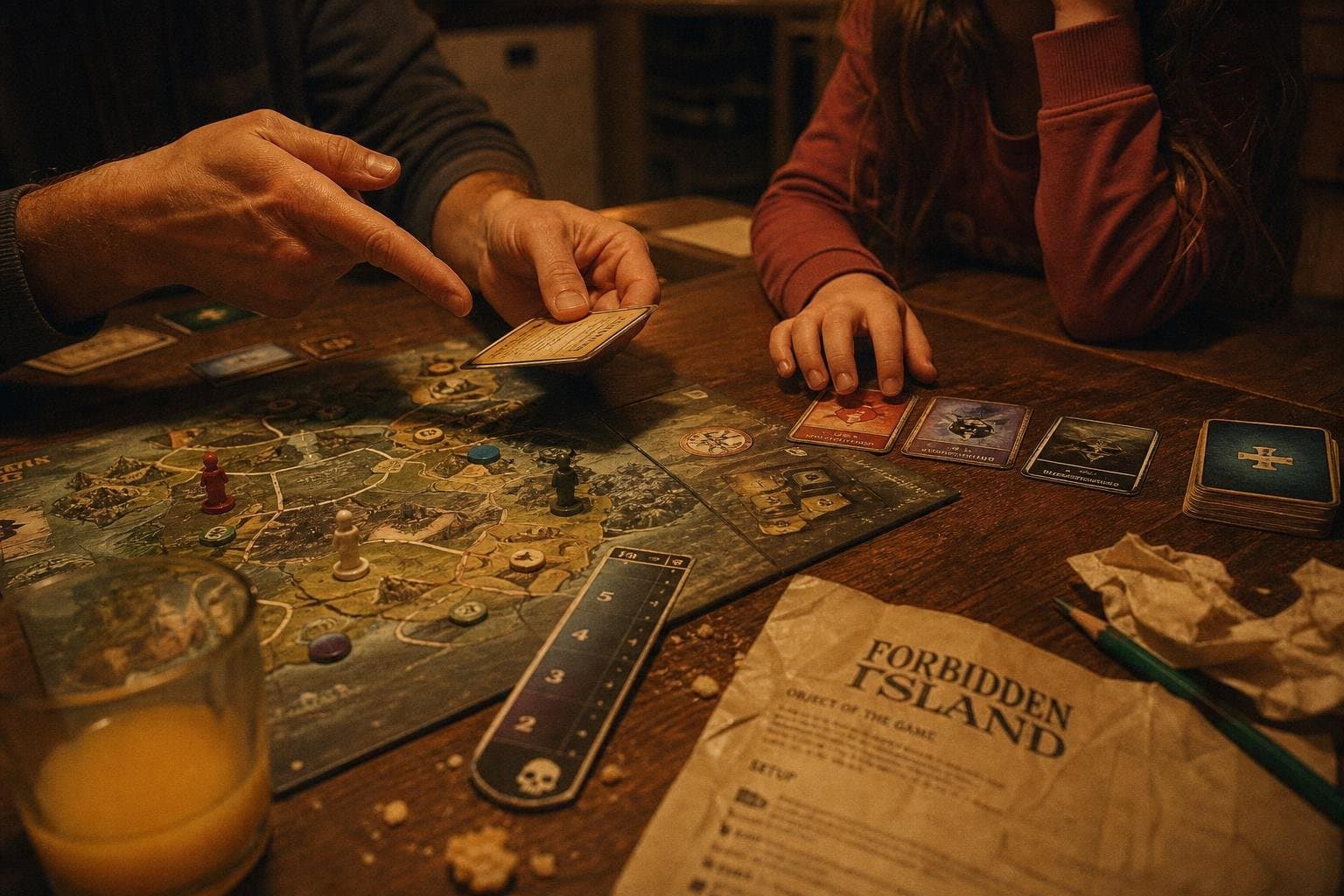

My son is nine. My daughter is twelve. When we sit down to play a cooperative game, she has already read the rulebook, memorized the card interactions, and quietly decided what everyone should do on their turn before the first piece hits the table.
She's not being mean. She's being twelve.
This is the cooperative game problem I wrote about back in May — the one where the game is technically cooperative but the experience isn't, because one player has effectively become the game's CPU. What I didn't get into then is why so many games fail to solve it, and what the ones that actually work are doing differently.
Turns out, game designers have been wrestling with this exact question. And the honest answer is a little uncomfortable.
Why the Obvious Fix Doesn't Work
The first thing designers try when they notice one player taking over is to give everyone unique powers. Aragorn fights monsters. Legolas draws extra cards. Surely that distributes the decision-making?
It doesn't. As game designer Justin Gary explains from his own playtesting experience, unique powers don't change the information state of the game. The dominant player can still see every card, every option, every power — and now they just have more variables to optimize across. Fixed roles can actually make quarterbacking easier, because each player's power telegraphs their "correct" move to anyone paying attention.
Gary calls this the Quarterback Problem: one player figures out the optimal play and starts directing everyone else, turning the other players into "hands holding cards on behalf of a single brain." He's candid that for some groups, this is fine — when he plays cooperative games with his mom or with kids, having someone take charge keeps the game moving. But when your table has a mix of ages and experience levels, and one player's presence feels interchangeable with an empty chair, you have a design failure.
The second fix designers reach for is hidden information. If players can't see each other's cards, the quarterback can't optimize across everyone's hand. Winorm's breakdown of Alpha Player Syndrome points to this as one of the more reliable structural solutions — when you genuinely don't know what your teammate is holding, you can advise but you can't dictate. The game forces real collaboration because no single player has the full picture.
The third lever is time pressure. When a game moves fast enough that there's no time to consult, players have to act on their own judgment. This works, but it has a cost: it can overwhelm younger or less experienced players, which is exactly the opposite of what you want on a weeknight with a nine-year-old.
What This Means at Your Kitchen Table
Here's the practical translation for mixed-age family play: the games that survive the alpha player problem aren't necessarily the ones with the cleverest mechanics. They're the ones where the structure makes it genuinely hard for one person to run the whole show.
Coopboardgames.com notes that modern designers have addressed this specifically through hidden information and time pressure — and the games that combine both tend to hold up best when age gaps are wide. The 2026 Spiel des Jahres nominations offer a useful data point here: Boss Fighters QR, a cooperative monster-brawling game nominated for the Kennerspiel, is designed for 2–4 players ages 10 and up — a range that suggests the designers were thinking about mixed-experience tables, not just hardcore strategists.
But the nomination list also reveals something worth sitting with: most of the games that made the cut for family play aren't cooperative at all. Ticket to Ride, Dobble, Catan — Mumsnet's roundup of real-family-tested games skews heavily competitive. Which suggests that for a lot of families, the alpha player problem isn't solved by better cooperative design. It's avoided entirely by choosing a game where everyone's competing on their own terms.
The Actual Question to Ask Before You Buy
Before you pick a cooperative game for a mixed-age table, Gary's framework gives you the right diagnostic: who is this game for? If it's for the strategic player who wants ownership over their own decisions, the game needs structural protection against quarterbacking — hidden information, simultaneous action, or real time pressure. If it's for a group where one person guiding the others is actually fine (younger kids who want to feel included, a first-timer who needs scaffolding), then the quarterback dynamic is a feature.
The mistake is buying a cooperative game without knowing which table you have. My daughter running the show works great when my son is learning a new game. It stops working the moment he knows it well enough to have his own ideas — and the game doesn't give him anywhere to put them.
That's the moment a cooperative game either earns its place in the rotation or gets quietly moved to the back of the shelf.


