


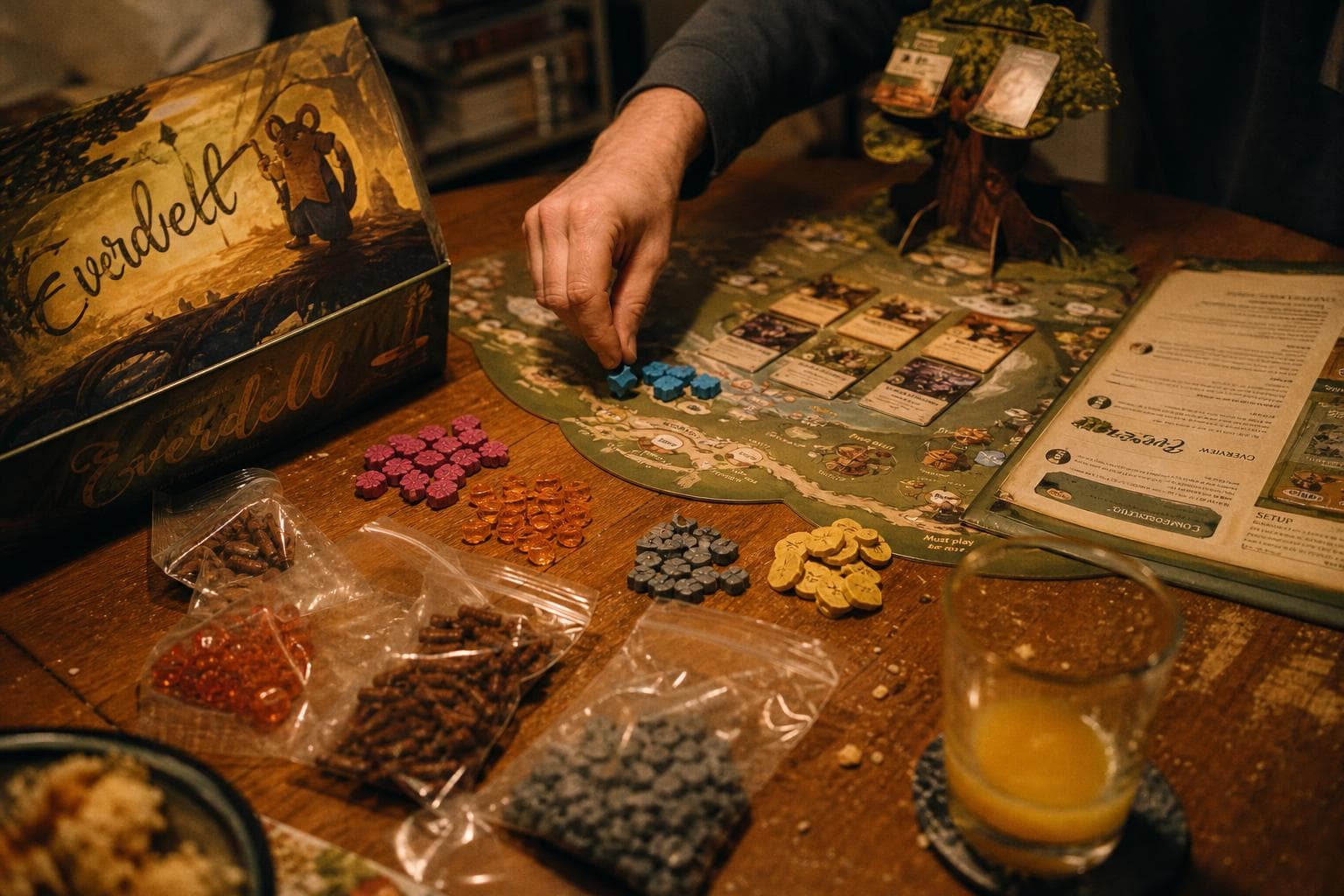

There's a game in my closet that I genuinely love. Gorgeous components, satisfying decisions, the kind of arc where someone always ends up doing something they'll talk about for weeks. It has also been played exactly twice in the last year, because getting it to the table requires sorting roughly 200 tokens by type, reading a half-page setup guide, and making peace with the fact that you're now committed to the next two hours whether the kids cooperate or not.
That game is not a weeknight game. And for a long time, I kept trying to make it one.
Here's what I've learned: the question isn't whether a 15-minute setup is too long. It's whether the payoff justifies the investment — and whether you're being honest with yourself about what "15 minutes" actually means in your house.
Setup Time Is a Lie (In Both Directions)
Letsplaygames.uk makes a point worth tattooing somewhere: a game that claims a five-minute setup on the box usually means five minutes for someone who owns it and has played it fifteen times. First-time setup is almost always longer. This is the kind of truth that game reviewers skip over because they've played everything a hundred times and forgotten what it's like to squint at a rulebook at 7:30 p.m. while a kid asks if we can just watch TV instead.
The flip side is also true. A game you know well, with components you've kept sorted, can set up faster than the box claims. Letsplaygames.uk notes that keeping components organized between plays — a divided insert, a few small bags — adds about thirty seconds to teardown and saves several minutes next time. That's not a tip, that's a philosophy. The games that actually hit our table on weeknights are the ones where past-me did the work so present-me doesn't have to.
So when I talk about "15-minute prep," I mean: fifteen minutes for a game you've played before, with components you've kept in order. If you're still learning the game, add ten minutes and a glass of wine.
When the Setup Is Actually Worth It
The games worth a longer setup share one characteristic: they create a different kind of play session. Not just more game, but a different texture of evening.
A Medium piece by Steve Mayne takes this to its logical conclusion — there are games he loves enough that he sets them up the night before, just so they're ready to go. That's a person who has made peace with the setup-to-payoff math and decided it works. I respect that. It's also a useful diagnostic: if you wouldn't set a game up the night before, you probably won't set it up at 7 p.m. on a Tuesday either.
The weeknight games that justify real prep time tend to be the ones where kids have genuine agency — not just "take a card, pass left" but actual decisions that feel meaningful to a nine-year-old. Those games usually have more components, which means more setup. The tradeoff is real. But so is the difference between a kid who's going through the motions and a kid who's in it.
The Honest Calculus
Here's how I actually think about it now. Before pulling anything off the shelf on a weeknight, I run three questions:
Is everyone already at the table? If yes, you can absorb five to eight minutes of setup without losing the room. If you have to gather people first, that's already five minutes gone before you've touched a box.
Do I know this game cold? Not "I've read the rules" — cold, meaning I can set it up while talking about something else. If I have to concentrate on setup, the kids are already drifting.
What's the energy level? A tired, restless group needs a game that's running within three minutes. A genuinely engaged group — the rare weeknight where everyone actually wants to play — can handle more. Read the room before you read the box.
The games that earn longer setup windows in our house are the ones I've played enough to set up on autopilot, with kids who've bought in before the first piece hits the table. That combination is rarer than game night optimists admit. But when it lands, fifteen minutes of prep for ninety minutes of genuine play is one of the better investments a weeknight offers.
The games that don't earn it — the ones where setup is a negotiation and the kids are already half-checked-out — those go back on the shelf. Not because they're bad games. Because the math doesn't work on a Tuesday.
Save those for Saturday, when you have time to set up the night before.