


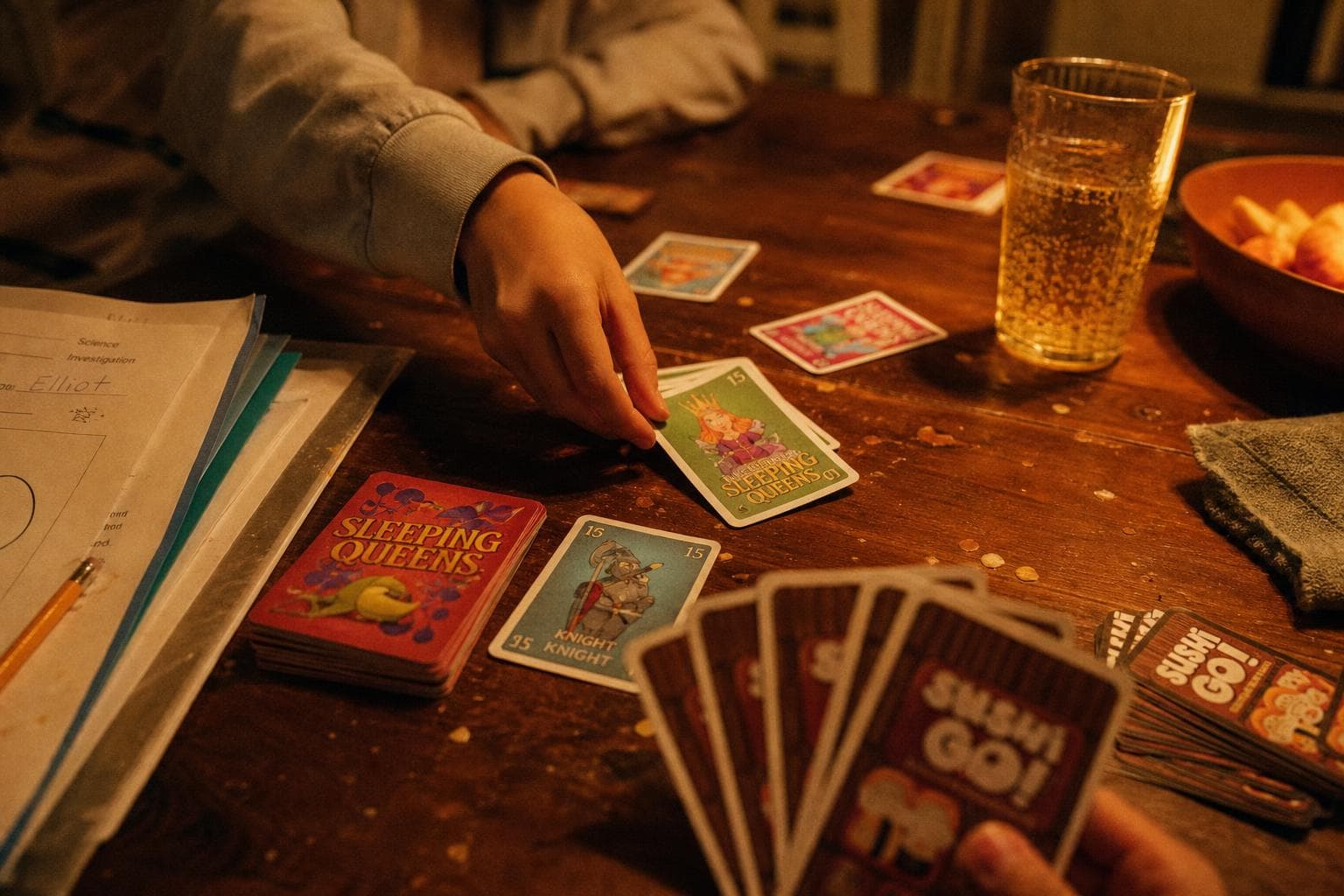

There's a specific kind of optimism that happens at 7:45 on a Tuesday. Homework is done, dinner is cleared, and someone says "can we play a game?" You have maybe twenty minutes before the whole thing collapses into tired arguments and someone crying about the rules. You need something that sets up fast, plays fast, and still feels like you actually did something together.
The problem is that most "quick game" recommendations are written by people who don't have kids. Thirty to forty-five minutes is not quick on a school night. That's a commitment. What you actually need is fifteen minutes — and not fifteen minutes of chaos that leaves everyone vaguely annoyed. Fifteen minutes that feel complete.
Here's what I've found separates the real fifteen-minute winners from the games that just claim to be fast.
The Setup Tax Is Where Most Games Lose
A game that plays in fifteen minutes but takes eight to set up is not a school-night game. It's a weekend game with a misleading box. The setup tax is the first filter I apply to anything claiming to be quick.
The games that survive this test share a common trait: the components are simple enough that setup is almost incidental. Spot It (Dobble) is the extreme version of this — it's a single deck of cards, you shuffle and deal, you're playing in under two minutes. Sleeping Queens is another one that clears this bar: lay out the queens face-down, deal cards, done. No sorting, no board assembly, no reading a setup diagram while a seven-year-old bounces next to you.
Sushi Go Party is a little more involved — you're selecting which cards go into the menu for that game — but once your family knows the game, that configuration step takes maybe three minutes and the kids can do it themselves. That's the other thing worth noting: setup gets faster the more you play. A game with a five-minute setup on night one might be a two-minute setup by week three.
What "Substantial" Actually Means at 7:45 PM
I'd argue that a fifteen-minute game feels substantial when it has a clear arc — a beginning where something is at stake, a middle where choices matter, and an end where someone wins in a way that feels earned rather than arbitrary.
Fast-paced games with simple rules but high intensity can deliver this. The key is that the game's tension has to come from something real — a decision, a risk, a moment of recognition — not just from speed for its own sake. Taco Cat Goat Cheese Pizza is fast, but the satisfaction is mostly reflexive. That's fine sometimes. It's not what I mean by substantial.
Sleeping Queens threads this better than it has any right to. You're managing a hand of cards, making small decisions about when to wake queens versus when to block your opponent, and the game has enough variance that it doesn't feel predetermined. My kids have played it probably forty times and still argue about strategy. That's the bar.
Sushi Go Party hits it too, in a different way. The card-drafting mechanic means every hand you pass is a small act of sabotage or generosity, and kids figure that out fast. The rounds are short, the scoring is immediate, and there's always a moment where someone realizes they've been feeding their sibling exactly what they needed. That moment — that groan — is what makes it feel like more than just killing time.
The Age Gap Problem (and Which Games Solve It)
The hardest version of the school-night game is when you've got a six-year-old and a ten-year-old at the same table. Too simple and the older kid is bored. Too complex and the younger one is lost and upset.
Spot It is genuinely age-agnostic in a way that's almost unfair — younger kids sometimes beat older ones because the pattern recognition doesn't favor experience. Sleeping Queens works across a wider age range than you'd expect because the card math is simple enough for younger players but the hand management gives older kids something to think about.
What doesn't work: games where the age gap creates a skill gap that's obvious and demoralizing. If a ten-year-old is going to win every single time, the six-year-old will know it, and you'll spend more time managing feelings than playing.
The Real Test
The question I always come back to: did anyone ask to play again the next night? Not "did they tolerate it" or "did they finish without a meltdown." Did they ask for it?
That's the only metric that matters on a school night. The games that pass it tend to be the ones that are fast enough to feel low-stakes, but have just enough decision-making to feel like something actually happened. Setup under three minutes, play under twenty, and at least one moment where someone cares about the outcome.
That's not a long list. But it's a real one.