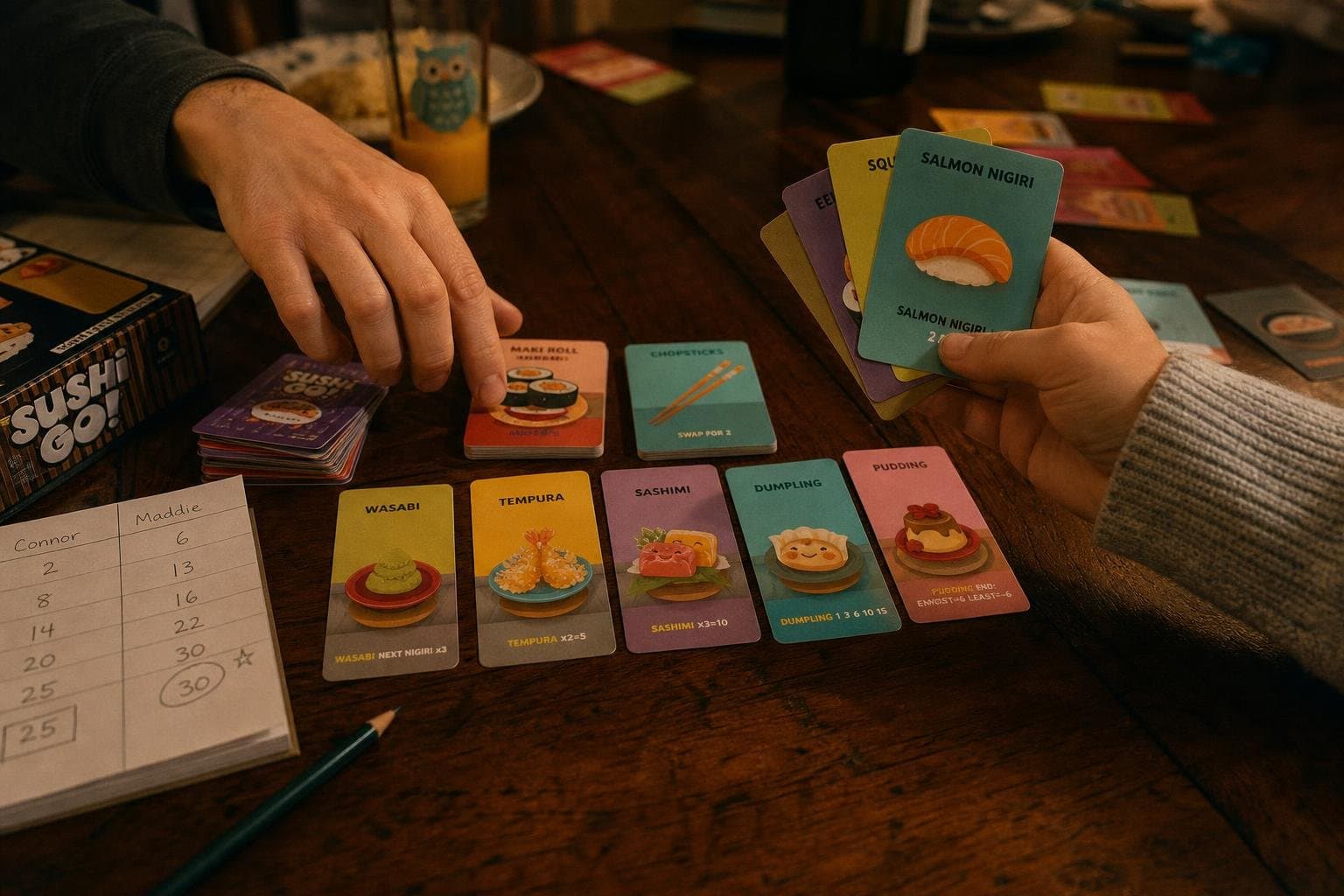

My seven-year-old once cried because we ran out of time to play a second game of Sushi Go Party!. My ten-year-old spent the drive home explaining why the eel card is a trap. These are good signs.
But here's the honest version: the game works with kids not because it's fun in some theoretical sense, but because the core mechanic — pick one card, pass the rest — takes about forty-five seconds to explain and creates immediate, visible consequences. You watch your hand shrink. You watch your neighbor's face. You make a decision. That loop is tight enough that even a distracted kid stays inside it.
The Mechanic That Actually Works at the Kitchen Table
Card drafting sounds like a strategy-game concept, but it's really just structured taking. Everyone holds a hand, picks one card simultaneously, and passes the rest left. The whole structure of the game is contained in that sentence, which means you spend zero time re-explaining rules mid-round.
What makes this particularly good for mixed ages is that younger kids can play legally and meaningfully without understanding the full scoring picture. A six-year-old can pick the card with the most fish on it and have a fine time. A ten-year-old is simultaneously calculating whether chasing a sashimi set is worth committing to across the next four passes. They're playing different games inside the same game, and neither is wrong.
The scoring has some real texture once you dig in. Sashimi pays 10 points for a set of three, nothing for one or two; tempura pays 5 for a pair, nothing for a single; dumplings escalate from 1 point up to 15 for five or more. These aren't arbitrary — each one creates a different risk profile and a different reason to watch what's circulating around the table. The dumpling math in particular is something kids figure out and then feel clever about. That's good game design.
What "Party!" Actually Adds (and Why It Matters)
The original Sushi Go! is a fixed deck. Sushi Go Party! gives you 22 menu tiles across five categories — rolls, nigiri, appetizers, specials, and desserts — and you build the game's card mix before you play. Four preset menus come in the box if you want training wheels, including one called "My First Meal" that's dialed back for newer players.
This sounds like a complexity upgrade, but in practice it's the opposite of what you'd expect: it's the feature that makes the game last. Without it, a family that's played Sushi Go! thirty times has a solved puzzle. With the Party! version, swapping in two different appetizers genuinely changes what's worth chasing, which means returning players are actually thinking again instead of running their memorized optimal strategy.
The box also seats up to eight players, which is the real reason to upgrade if you've outgrown the original. Five players is described as the sweet spot — big enough that passing the hand around the table creates meaningful tension, small enough that you can still track what's circulating. With three players, the math gets thin. With eight, chaos creeps in, but a different kind of chaos than a five-year-old knocking over pieces — more the "I had no idea that was coming back around" kind, which is usually fine.
Where It Gets Complicated on a Tuesday Night
The weakness with kids isn't the rules. The weakness is the scoring. Dumplings are the card most people misread — kids see five dumplings and think "five points," not "fifteen." Maki rolls require counting icons across all players to determine first and second place, which takes a minute at the end of each round. None of this is hard, but with a seven-year-old who's tired and a ten-year-old who's competitive, "let me add up everyone's maki roll icons" is exactly the moment where someone starts arguing.
The practical fix: designate one person as the scorer before you start, keep a scratch pad nearby, and resign yourself to two minutes of administration at the end of each round. This is not a fatal flaw. It's just the tax you pay for a game with actual depth.
The play time of 20–30 minutes is real, which is one of Sushi Go Party!'s most underrated qualities. It ends before the meltdown. It ends while everyone is still enjoying themselves. And because the menu changes game to game, "one more round" is a genuine offer rather than a resigned replay of the same experience.
The Verdict
If you've never owned any version of Sushi Go!, the Party! edition is the one to get. It plays more people, it lasts longer in the collection, and the menu system creates genuine variety across dozens of plays. If you already own the original and regularly play with five or more people, the upgrade is worth it. If you play mostly with two or three, the math works against you either way.
The thing to watch: whether younger kids ask for it again. The first game teaches the mechanic. The second game is where you find out if there's actually something there. In my experience, there is.


