


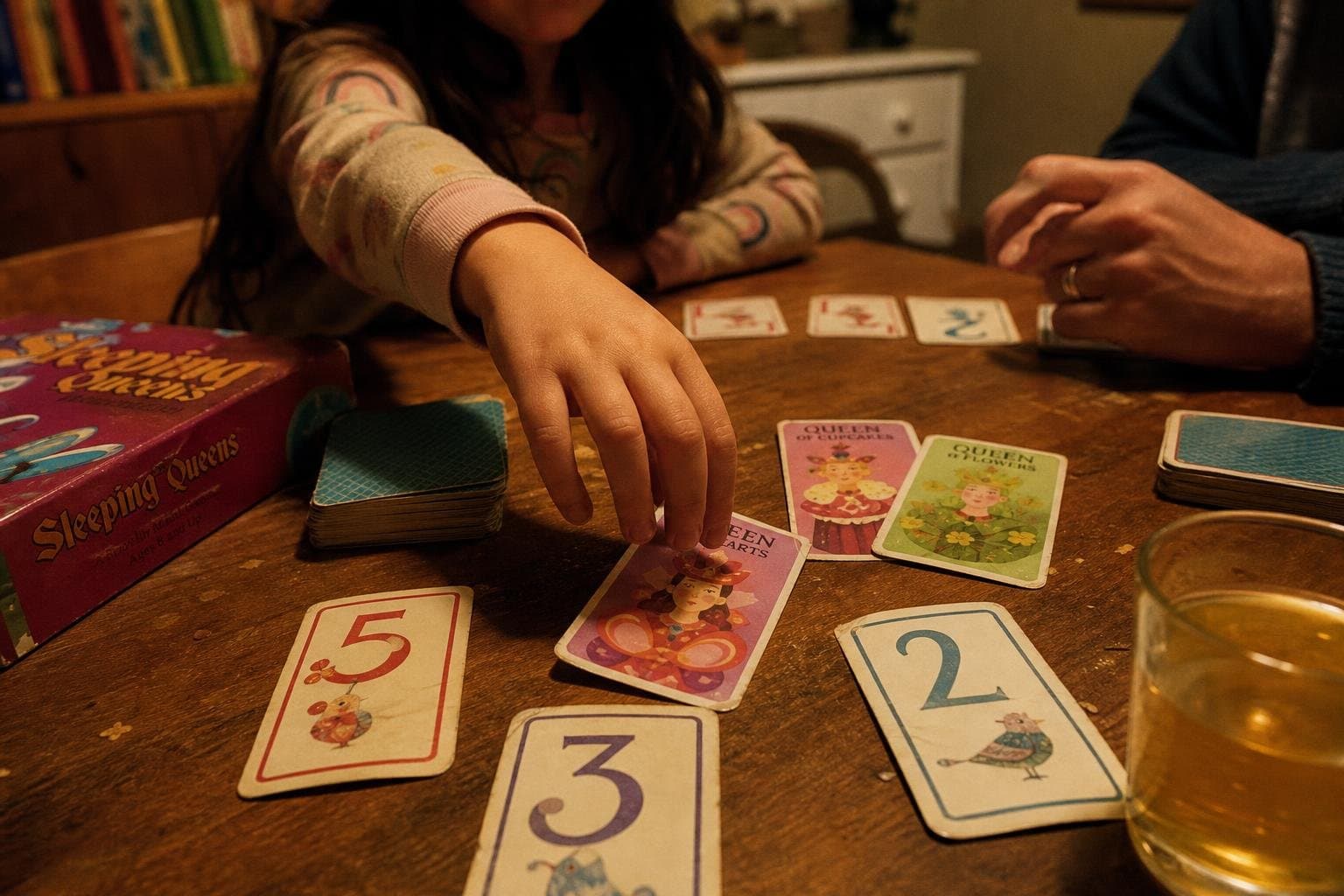

The box for Sleeping Queens lists an age range like every other game box does, and like every other game box does, it tells you almost nothing about what happens at your actual table. One parent who's played the game for years reports her newly-six-year-old picked it up without trouble, and she suspects five-year-olds could manage too, despite the manufacturer suggesting 8 and up. That gap between the printed number and the lived reality is the whole story of this game, and it's the same gap that sinks so many other "family" games on a Tuesday night — age ranges on the box tell you about reading level and choking hazards, not whether a six-year-old and a grown adult will actually enjoy playing together (Lilach Bullock).
The Math Is Hiding Inside the Fun Part
Sleeping Queens plays like a mashup of memory game and light strategy: players wake queens using king cards, steal them with knights, and protect themselves with potions and wands, all while trading number cards to refill their hand. That last mechanic is where the quiet magic happens. To exchange cards, a player has to make an equation — say, a 2, a 3, and a 5, declared out loud as 2+3=5 — before swapping them out for new ones from the draw pile. It's addition practice dressed up as a turn mechanic, not a flashcard app with a cartoon mascot bolted on, which is the difference between a kid tolerating a game and a kid asking for it again.
One family that's logged real hours with the game extended this on their own: once their older kids learned multiplication and division, the house rule shifted to require those operations instead, while the younger sibling kept using addition and subtraction, and everyone used equivalency tricks like 6+4=8+2 to dump four cards at once when the game was dragging (via the Game of the Month writeup). That's the kind of self-correcting difficulty curve I'm always hunting for in a mixed-age game — one ruleset that quietly scales per player instead of forcing everyone onto the same math level or making the youngest kid sit out the thinking part entirely. It's also the kind of flexibility that holds up better over the years than flashier new releases, even as the card game aisle keeps getting more crowded with shiny 2026 arrivals each holiday season (Days With Grey).
Play for Queens, Not Points, If You Want Fewer Tears
The scoring in Sleeping Queens can run two ways: collect a set number of queen cards, or hit a target point total based on each queen's assigned value. Families who've actually run both modes with kids report the point-value version gets considerably more cutthroat, since a single high-value queen stolen late in the game can flip the outcome, while counting straight queens keeps the competition lower-stakes (per the same parent review). That's a small rule choice with an outsized effect on whether game night ends in high-fives or a meltdown over a stolen queen, and it's the sort of detail that never makes it onto a box or into a five-star review headline.
It also lines up with a broader pattern worth remembering when you're building a shelf of family games rather than chasing one perfect title: the games that actually work tend to be the ones you can bend around your youngest player, not the ones engineered around an age printed in a corner. As one breakdown of family game picks argues, the right choice depends on your youngest player far more than your oldest, and buying the thing that "looks impressive" rather than the thing that fits your actual kids is a mistake parents make for their own nostalgia, not for their children's benefit (Lilach Bullock). Sleeping Queens earns its keep precisely because it doesn't need the box's suggested age to be right — the math difficulty is adjustable by house rule, and the scoring mode is adjustable by how much drama your family can stomach on a school night.
What This Means for Your Shelf
If you've got a kid who's still shaky on basic addition and an older sibling who's bored by it, Sleeping Queens is one of the rare card games that lets both play the same hand of cards without one of them faking enthusiasm. It's quick to teach, it packs into a box that doesn't eat your whole table, and the actual math work is invisible enough that nobody complains about it being "a learning game." The honest caveat: it still depends on your table agreeing to use the house rules that make it sing, because the stock rulebook alone won't do that adjusting for you. Decide before you deal whether you're playing for queens or points, and whether your six-year-old needs a cheat sheet of sums taped to the table. Those two five-second decisions are the difference between a repeat request and a box back on the shelf by Thursday.