


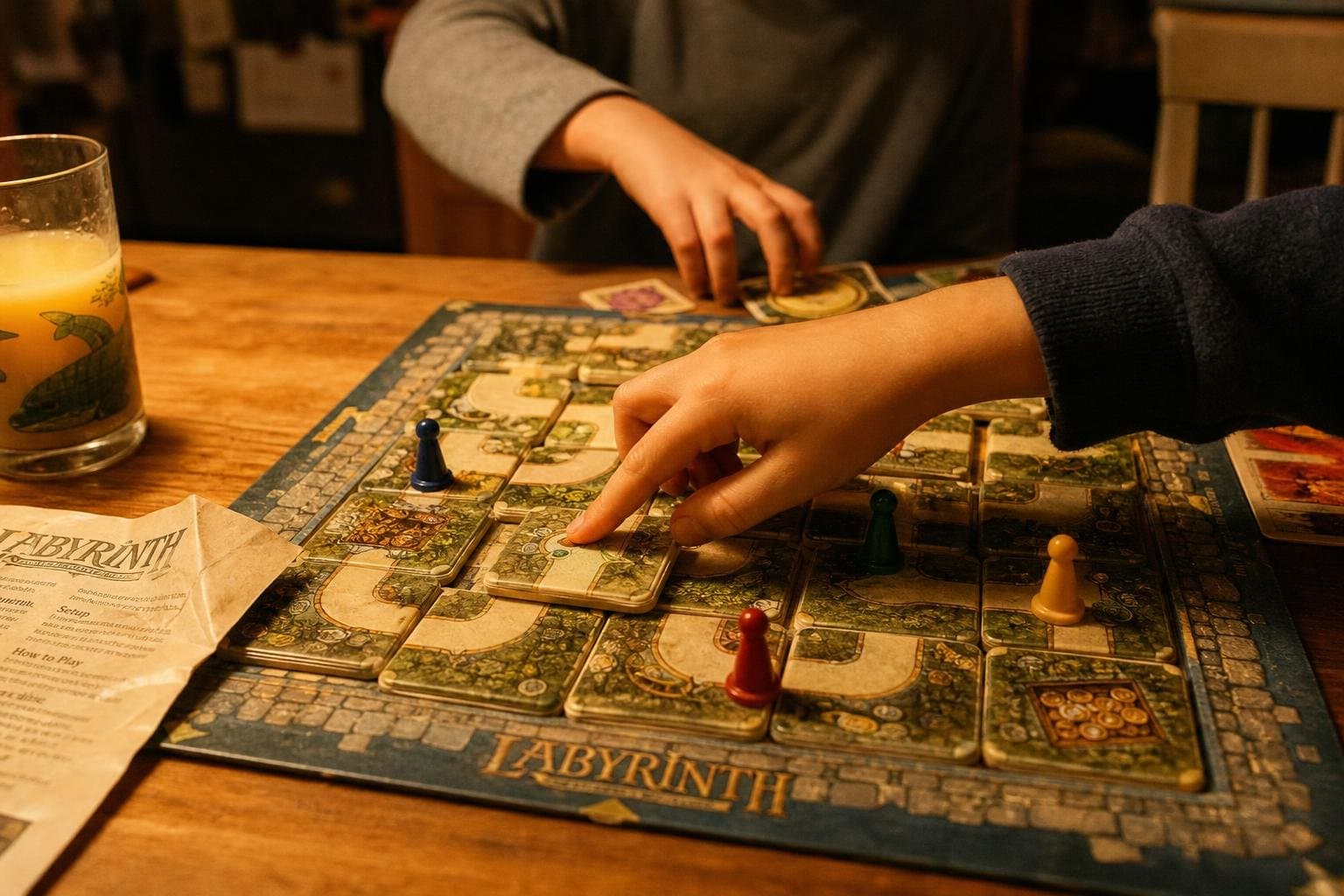

My kids have been pushing plastic maze tiles around a cardboard grid since before they could read the treasure cards, and it has never once caused a meltdown. That's rare enough in this house that it's worth asking why — and worth asking what happens to that reliability when a design gets the premium-reboot treatment, which is exactly what's happening to Labyrinth this year.
The base game earns its spot because it asks almost nothing of you
Labyrinth's whole trick is that pushing a maze tile is satisfying in a way that doesn't require strategy to enjoy. You shove a wall, the whole board shifts, and suddenly there's a path to your treasure that wasn't there a second ago — or someone else's path closes. A six-year-old gets that instantly. A twelve-year-old can start planning two pushes ahead. Mumsnet's UK family-games roundup, built from actual household testing rather than press copy, names the classic edition "Best classic family board game" and prices it around £11 (Mumsnet) — which tells you something by itself. A game that's been on shelves for decades doesn't stay on a "still worth buying" list because of nostalgia marketing. It stays there because it keeps winning the Tuesday-night test: low setup, clear turns, a puzzle simple enough that nobody needs the rules re-explained after the snack break.
Labyrinth: Chronicles is a different commitment entirely
This year Awaken Realms and Ravensburger released Labyrinth: Chronicles, a 3D co-op campaign reimagining of the original where you're rebuilding a village and unlocking new abilities as you go, rather than racing opponents to treasures (BoardGameGeek). It carries a complexity rating north of the original — 1.81 out of 5, which doesn't sound steep until you remember base Labyrinth barely registers on that scale at all (BoardGameGeek) — and it's built around sustained story progression, not a single sitting.
Little Board Gamers, reviewing it after actually playing through the early chapters with family, is candid about what you're buying: an "ultra-premium" version of a simple game, running around £130, that's genuinely lovely if you already like Labyrinth but won't convert anyone who doesn't (Little Board Gamers). That's an honest verdict, and it matters for weeknight purposes because a campaign game isn't a thing you break out between dinner and bath time. It's a thing you schedule, like a season of a show you're watching together. Fine for a Saturday ritual. Wrong tool for a Wednesday when everyone's running on fumes.
Carcassonne Labyrinth adds a second game on top of the first
The other 2026 release worth knowing about takes a stranger path: instead of dressing up the maze mechanic, it bolts a full Carcassonne scoring game onto it. You push tiles toward treasures the way you always have, but the tile you push out becomes a piece of your own expanding Carcassonne map, and the actual goal shifts to collecting the most cardboard through completed cities and roads (Little Board Gamers). It's a clever piece of design — effectively two games running in parallel — but that cleverness comes at the cost of the thing that makes base Labyrinth a weeknight staple: you can no longer just push a tile and move. Now you're tracking a second scoring system while you do it, which is a heavier cognitive lift for a seven-year-old than the original ever asked for.
If you want the maze feeling fast, look sideways instead of up
If what you actually want on a Tuesday is a labyrinth without the baggage, Magic Maze is worth remembering even though it's not a Labyrinth product at all — it's a cooperative real-time game where everyone silently navigates a shopping-mall maze together under a three-minute sand timer (BoardGameGeek). It's chaotic in its own way — the no-talking rule tends to produce a different kind of chaos than tile-pushing ever did — but it delivers the maze thrill in a genuinely short sitting, which neither of this year's Labyrinth reboots is trying to do.
So here's where I've landed: keep the £11 original on the shelf for weeknights, because nothing this year replaces what it does well. Save Chronicles for a weekend you've actually planned around it. And if the maze itch hits on a random Tuesday, Magic Maze might scratch it faster than anything with the Labyrinth name on the box.