


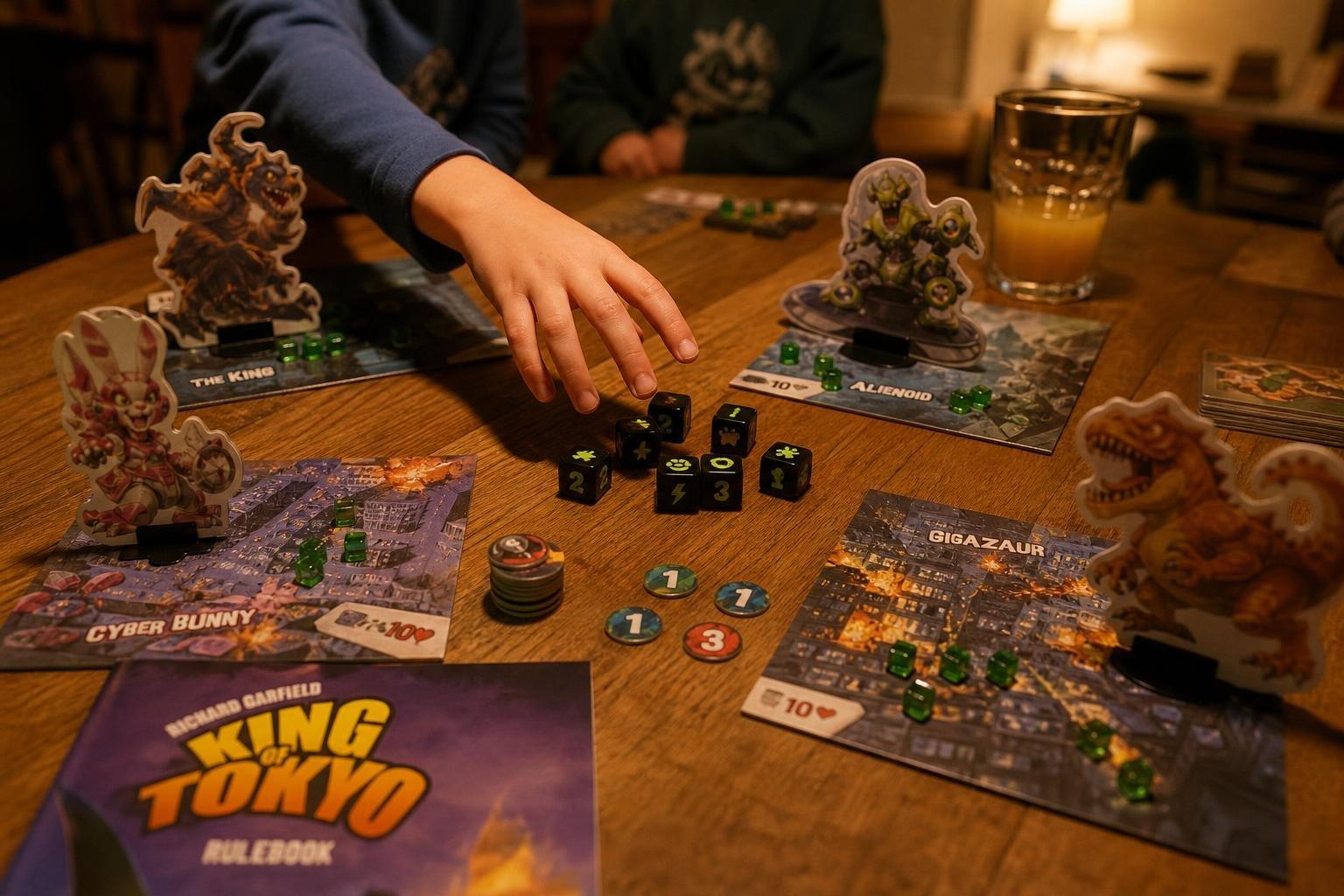

My younger kid picked up a fistful of black dice, rolled three claws in a row, and the whole table — two adults, a ten-year-old, and a six-year-old — leaned in at once. Nobody was even in Tokyo yet. That's the trick of King of Tokyo: everyone cares about everyone's turn, not just their own. That's rare in a dice game, and it's the reason this one has stuck around family shelves since 2011 while so many "roll and move" games gathered dust.
The Whole Game Is One Decision, Repeated
Strip away the monster theme and King of Tokyo is Yahtzee with teeth. You roll six dice up to three times, keeping what you want between rolls: numbers for victory points, hearts to heal, lightning for energy, claws to smash your neighbors — as the rules lay out on BoardGameGeek. There's no reading, no strategy card to memorize, no setup beyond handing out a monster board and setting a dial to 10. That's precisely why it teaches fast; one review describes getting an 8-year-old playing in about five minutes, and I buy that completely. My kids needed one demo roll, not a rulebook read-aloud.
The entire game hinges on one repeatable tension: do you stay in Tokyo and rack up points while everyone else aims their claws at you, or do you run and give up the lead? That reviewer calls it the only real decision in the game, and it's somehow tense on turn two and turn twenty. A six-year-old understands "stay and get hit" versus "leave and lose points" instantly. That's the kind of decision that works across an age gap — no hidden math, just a gut call everyone at the table can evaluate out loud.
The Catch Nobody Puts on the Box: Someone Gets Knocked Out
Here's where weeknight reality creeps in. King of Tokyo has player elimination, and that's a real cost with kids. If a monster's health hits zero, they're out — watching, not playing — for however long the rest of the game takes. One reviewer flags this directly as the game's biggest weakness, and it matches what I've seen: my six-year-old lasted eight minutes once before three claws in a row ended her night, and the sulking lasted longer than the game did.
Player count matters more here than the box lets on. BoardGameGeek's community rates the sweet spot at 4-5 players, and that tracks — with more monsters on the board, attacks spread out, nobody gets singled out early, and the Tokyo standoff actually has stakes because multiple people are circling. Play it with just two and the push-your-luck tension flattens; the same review notes the two-player game loses most of its bite. If your weeknight table is you and one kid, this isn't the game — Blue Orange's dedicated two-player spinoff, King of Tokyo: Duel, exists specifically because the base game doesn't scale down well.
The 2026 Reskin Doesn't Fix the Thing That Needed Fixing
IELLO released King of Tokyo: Godzilla this year, swapping generic monsters for licensed Toho kaiju and adding Event cards that hit the whole table at once. One reviewer calls the rules "largely unchanged" from the original, and a parent who tested it with a Godzilla-obsessed four-year-old agreed the new art gives it "a really strong and vibrant table presence" but doesn't actually touch the elimination problem or the player-count dependency — calling the licensing a missed opportunity to add anything new mechanically. If your kid is already a kaiju fan, the theme upgrade is worth something on its own. If you're hoping the new edition smooths out the rough edges of the original, it doesn't.
Where This Leaves Your Tuesday Night
King of Tokyo earns its spot on a weeknight shelf when you've got four or five players and nobody's precious about losing early — the dice drama really is that good, and the setup really is that fast. It stumbles the moment your table is two kids with a competitive streak and a short fuse for being knocked out early. Before you buy the Godzilla edition for the theme, check whether your actual problem is player count, because no amount of licensed monster art fixes that.