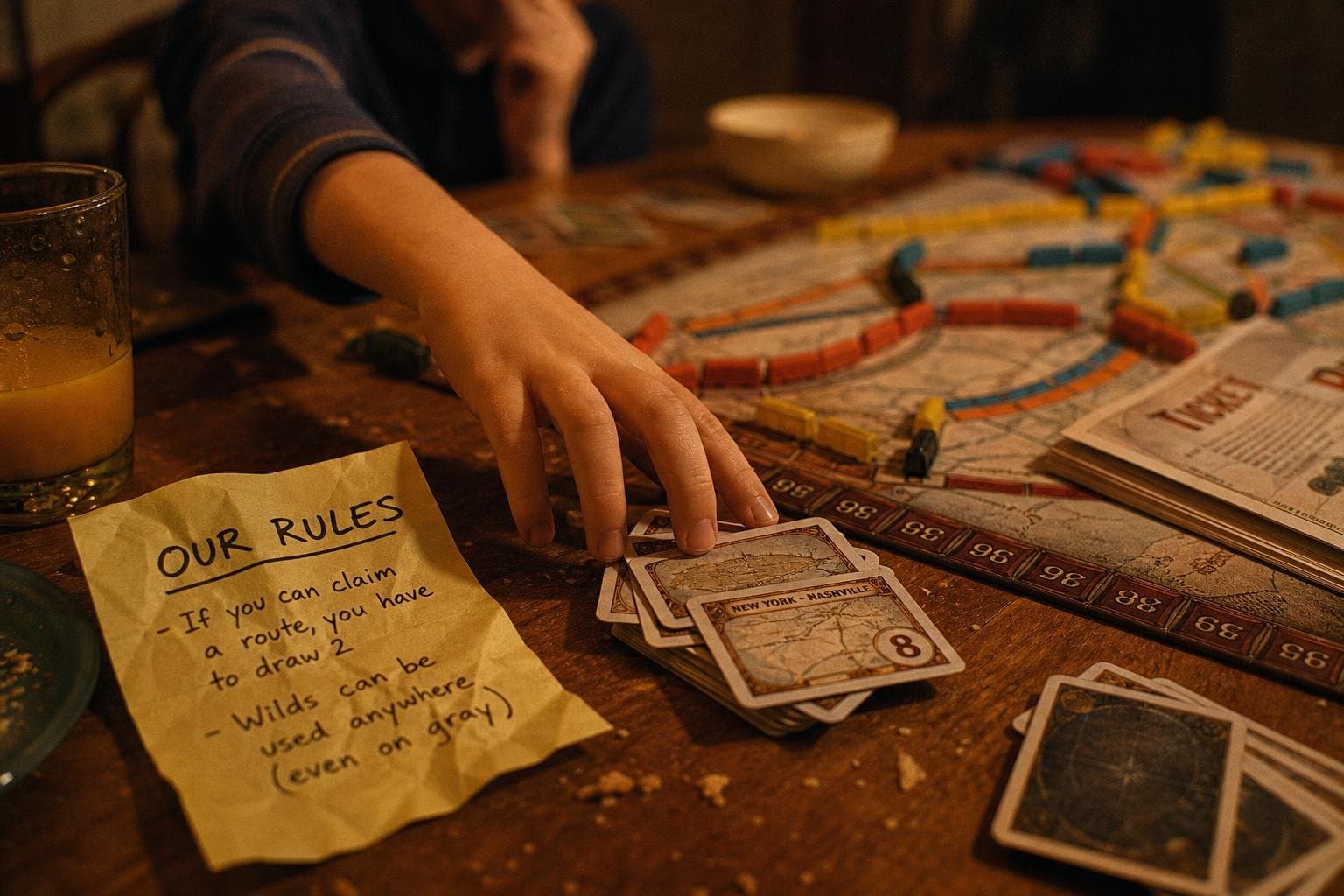

My kids have a house rule for Ticket to Ride: if you're losing badly enough that you've started narrating your own downfall in a sad announcer voice, you get one free route card. We invented this approximately forty-five minutes into a game where my eight-year-old had been blocked out of every route she needed and was beginning to spiral. Did it break the game? Technically. Did it save the evening? Absolutely.
House rules get treated like a dirty secret in board gaming circles — something you whisper about, as if the designer is listening. But the families who actually keep playing games long-term aren't the ones who follow every rule perfectly. They're the ones who figured out what the game needed to work in their house, with their kids, on a Tuesday night when everyone is slightly too tired.
The Game Is a Starting Point, Not a Contract
Here's the thing about published rules: they're written for a hypothetical average player, not for your specific seven-year-old who loses interest the moment she falls behind, or your competitive twelve-year-old who will absolutely rules-lawyer his way through a cooperative game.
The Tabletop Family, who tested games with seven kids across multiple ages, found that the games that kept coming back to the table were the ones that created genuine engagement — not necessarily the ones played exactly as written. The pattern holds: a game that gets modified and played again beats a game played perfectly once and shelved.
Ice Cream n Sticky Fingers makes the same point from a different angle — flexibility matters more than rigid plans when you're managing different attention spans and energy levels at the same table. The goal is connection, not compliance.
So when does a house rule actually help? There are three situations where I've found them genuinely worth building in.
When Someone Is So Far Behind They've Mentally Left the Game
This is the most common failure mode in competitive games with mixed ages. One player falls behind early, decides the game is over, and either checks out completely or starts playing chaotically because they have nothing to lose. Neither is fun for anyone.
The fix isn't always a catch-up mechanic — sometimes it's just a gentler floor. In our house, we've added a "consolation draw" in card games: if you've had three bad turns in a row, you can swap one card from your hand without penalty. It doesn't guarantee a comeback. It just keeps everyone at the table feeling like they still have options.
Wirecutter's board game guide notes that the best kids' games are designed to keep players engaged over multiple rounds — but even well-designed games can hit rough patches with specific age combinations. A small house rule can patch the gap without redesigning the whole experience.
When the Setup Is Killing the Momentum
Some games have rules that are genuinely important for experienced players and genuinely irrelevant for a first or second play. The house rule here isn't about making the game easier — it's about making it startable.
We skip the full scoring explanation in most games until the last round. Kids don't need to know every way points can be earned before they've touched a single piece. Explain the core action, start playing, introduce the scoring nuance when it actually comes up. Teach Beside Me suggests starting small — even thirty minutes counts — which is exactly the right instinct. A game that launches in five minutes and runs forty beats a game that takes twenty minutes to explain and gets abandoned at the halfway point.
When the Age Gap Is Just Too Wide
This is the one I wrote about back in June — the six-year-old and the twelve-year-old problem. The house rule version of that solution is giving younger players a small structural advantage that doesn't feel like charity.
In practice: the youngest player goes first every round (not just first overall). The youngest player gets one "take-back" per game, no questions asked. The youngest player's score gets a small multiplier in the final count. None of these are in any rulebook. All of them have saved game nights in my house.
The key is framing. Don't announce it as "we're making it easier for you." Announce it as "this is how we play it." Kids accept house rules as legitimate when they're presented as the family's version of the game, not as a concession to their limitations.
The Rule Worth Keeping
The best house rule isn't a specific mechanic — it's a principle: the game serves the evening, not the other way around. If a rule is creating misery and removing it creates fun, remove it. If an addition would make everyone more invested, add it.
New York Magazine's Strategist highlights games with high replay value as the gold standard — games kids ask to play again. House rules are one of the underrated ways to get there. A game your family has made their own, with their own modifications and their own traditions, has more staying power than any game played by the book once and forgotten.
The sad announcer voice rule is still in effect at our table. My daughter invoked it last week. She came back and won.


