


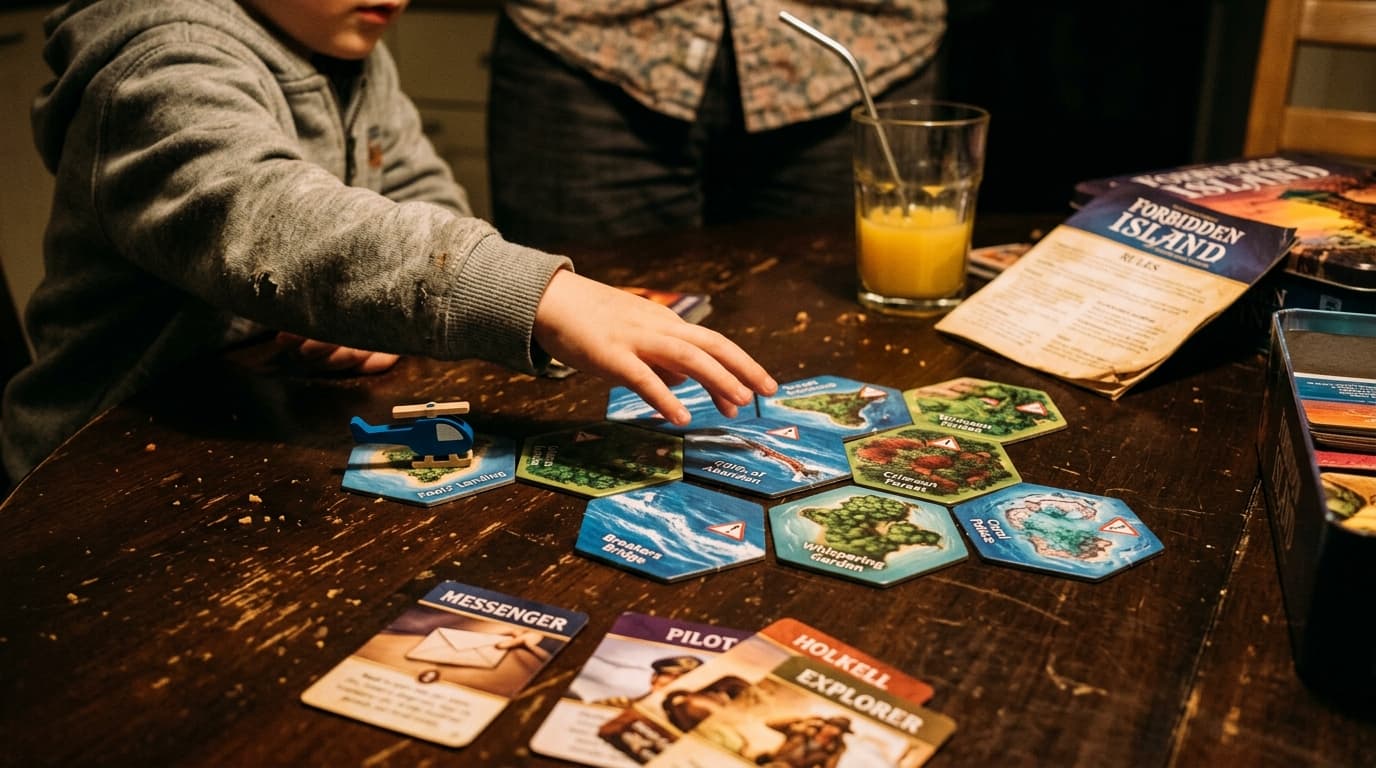

There's a specific kind of family game night failure that doesn't get talked about enough: the game where one person — usually the most experienced player, often a parent — ends up quietly running everyone else's turns. The kids are technically playing. Nobody's fighting. But nobody's really in it either. You finish the game, put it away, and nobody asks to play again.
That's the homework problem with cooperative games. And it's not a flaw in the genre — it's a design problem that the best co-ops solve in very specific ways.
The "Alpha Player" Trap Is Real, and It Kills the Fun
Wirecutter's cooperative game guide — built from 58 hours of play across 18 games with 10 different testers — makes a point worth sitting with: cooperative games are especially good for less-experienced players because veterans can show them the ropes. That's true. It's also exactly how you end up with one adult narrating the entire game while a nine-year-old stares at the ceiling.
The games that avoid this share a structural feature: they make it genuinely hard for any one player to see the whole board at once. Forbidden Island does this through simultaneous pressure — the island is sinking right now, in multiple places, and there's no clean optimal move. The situation changes every turn in ways that require everyone to re-evaluate. A ten-year-old watching the Coral Palace tile flood has information the adult across the table doesn't have time to process. That's not an accident. That's the design working.
The cooperative games that feel like homework tend to have the opposite structure: a clear optimal path that a sufficiently experienced player can calculate, and a group dynamic that quietly defers to whoever calculated it first.
What Actually Makes a Co-op Work on a Weeknight
I'd argue there are three things that separate the co-ops worth owning from the ones that look great on a shelf:
Setup that doesn't require a tutorial. Forbidden Island sets up in under five minutes. The tile layout is randomized, the flood deck goes here, the treasure deck goes there, everyone picks a role card. You can explain the win condition — get all four treasures, get everyone to Fool's Landing, escape by helicopter — before anyone's gotten bored. Games that require fifteen minutes of rules explanation before the first turn are asking a lot of a Tuesday night.
Decisions that belong to specific players. The role cards in Forbidden Island aren't just flavor. The Navigator moves other players. The Explorer moves diagonally. The Pilot can fly anywhere once per turn. These aren't interchangeable abilities — they create moments where only the kid holding the Explorer card can solve the problem in front of the group. That's the opposite of homework. That's ownership.
Failure that feels fair. This one's underrated. When a cooperative game ends in a loss, the question kids ask is: whose fault was it? The best co-ops make that question genuinely hard to answer, because the loss came from accumulated pressure rather than one bad decision. Forbidden Island's sinking mechanic does this well — you can usually see the disaster coming two or three turns before it arrives, which means the loss feels earned rather than arbitrary.
The "Friends" Worth Knowing
Forbidden Island is the obvious entry point — it's widely available, runs around $15-20, and the 45-minute play time is honest. But the design DNA shows up in other games worth knowing.
Wirecutter's list highlights Castle Panic as a strong pick in this space — it's a tower-defense co-op where monsters march toward the center and players have to coordinate card play to stop them. The spatial element gives younger kids something concrete to track, and the escalating pressure creates the same "everyone's actually paying attention" dynamic that makes Forbidden Island work.
BombBusters also appears on that list as a lighter option — faster, simpler, built for the lower end of the age range. I'd treat it as a gateway rather than a destination, but for families with kids under eight, it's worth knowing it exists.
The Test That Actually Matters
Here's the only metric I trust for cooperative games: after you finish, does anyone say "can we play again?" Not "that was fun" — kids say that about a lot of things. The specific ask to replay, immediately, is the signal.
Forbidden Island gets that ask. The randomized tile layout means no two games feel identical, the roles rotate, and the difficulty scales with how many tiles you pull before starting. You can make it harder as kids get better. That's a game that grows with your family rather than aging out of it.
The co-ops that feel like homework don't get asked back. The ones that give every player a real job — and then make that job matter — do.