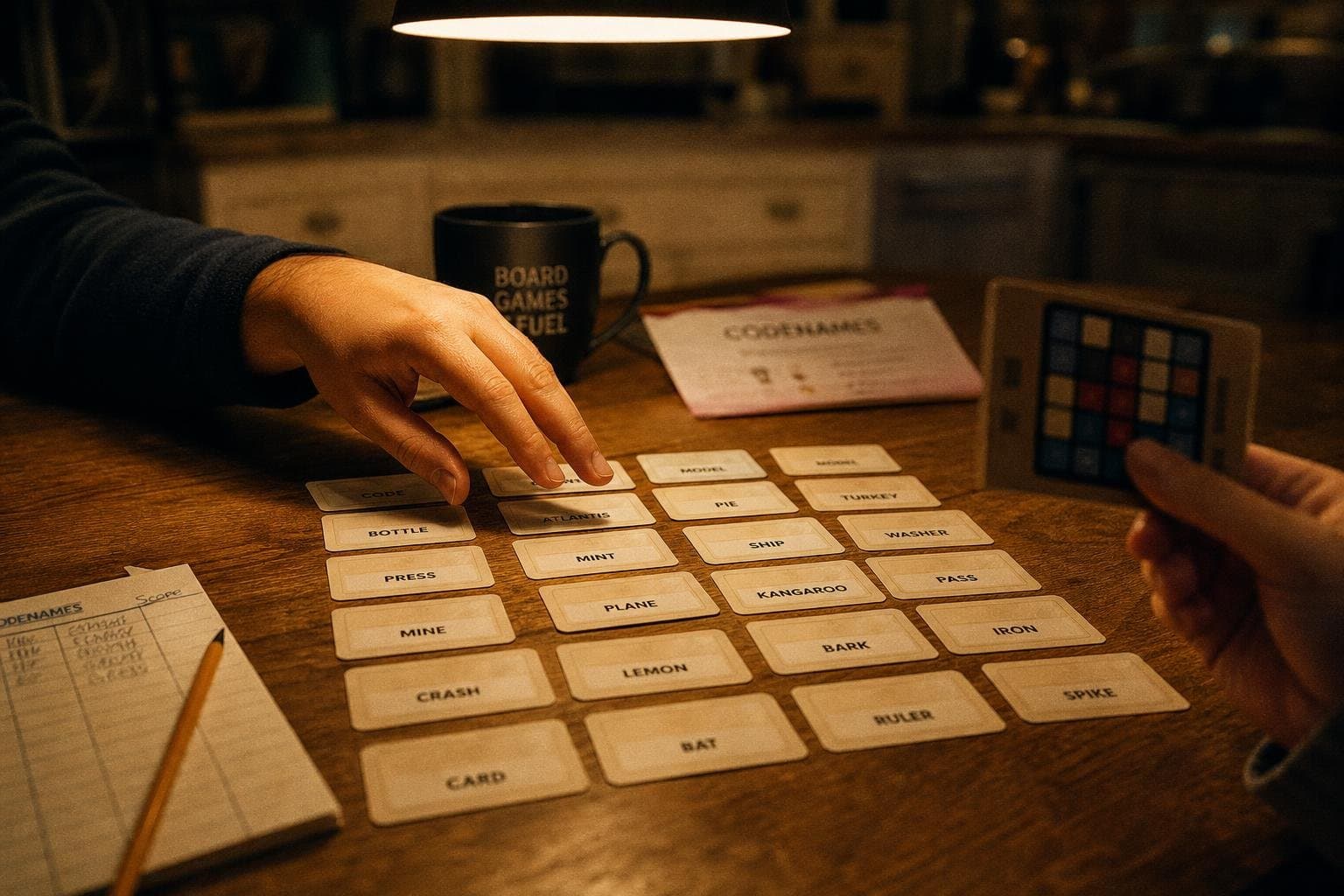

I almost bought Codenames: Duet for family night, because every list of "best two-player games" puts it near the top, and I figured a cooperative word game sounded like exactly the low-conflict, everyone-wins format my household needed on a Tuesday. Then I actually read what the box is built for, and realized I was about to buy a couples game and hand it to a kid.
That's worth untangling, because the sourcing on this one is unusually clear about who it's for.
What's actually in the box
Codenames: Duet strips the party-game original down to two players and flips the dynamic: instead of competing teams racing to find their agents, you and one partner are working together to clear a shared 5x5 grid before you run out of guesses. Each of you sees a different half of the key card, so you know which words your partner needs to avoid, and they know which ones you do — you're each steering the other toward words neither of you can fully see at once (The Dice Drop). One comparison guide puts it even more bluntly: it's "the Codenames to buy if you mostly play as a couple," since both players are clue-giver and guesser at once, and BoardGameGeek's own player-count poll recommends it at exactly two players and no other count (CurioRank).
Czech Games Edition lists it at 15 minutes, ages 11+, 200 cards carrying 400 words, and standalone — built around the two-player experience even though the box technically allows more (Table for Duo). That BGG weight of 1.36 and a 7.40 rating tell you it's light and well-liked across a sizable review base (The Dice Drop).
The thing that makes it good is the thing that makes it narrow
The mechanic everyone loves — one-word clues that have to account for what your partner can and can't see — only works if the two of you already think in roughly the same register. One review frames this bluntly: the game assumes "a shared mental map," where a word you say lands somewhere close to what you meant it to. Couples who've lived together for years are "startlingly good at this." Pairs who think differently "find the gap funny once and grinding by the fourth game" (Table for Duo).
That's a precise way of describing what happens when you drop this game between a parent and a nine-year-old. You don't have years of shared shorthand with a nine-year-old. You have a kid whose vocabulary, references, and associative leaps are still forming, which means every clue is a guessing game about what they know, not a fun shared puzzle. A general date-night guide for two-player games makes the same point from the other direction — it recommends choosing a game where "a loss feels entertaining rather than personal," which depends on both players sharing a sense of what counts as a fair or funny miss (Mind Games), something a wide age gap tends to undercut.
It's also worth saying plainly: the publisher puts the age floor at 11+ (Table for Duo). That's not an arbitrary number. A ten-and-under crowd simply doesn't have the vocabulary density the clue system assumes — a gap that matters more here than in the original base game, where the rules explicitly put teammates in open discussion together rather than asking one person to infer a partner's private half of the key card alone (BoardGame Archive).
Where it does belong on a weeknight
If you've got exactly one older kid — eleven, twelve, a teenager — and you're looking for a low-stakes ritual that's just the two of you, Duet is a legitimately good fit. Fifteen minutes, one-word rules explanation, and a loss costs you nothing but the quarter hour (Table for Duo). That's a real use case in a house with multiple kids of different ages: the one-on-one slot while the younger sibling is doing something else.
But if what you actually need is a word game for the whole table — mixed ages, maybe a kid who isn't reading fluently yet — the sourcing points you somewhere else entirely. Codenames: Pictures swaps words for images, needs no in-game text, and is suggested from age eight, which makes it the version built for a table that spans kids and adults (CurioRank). And if you want the classic team-based chaos — bigger groups, more voices, the fun of a bad clue blowing up in your team's face — base Codenames still rates highest of the three at 7.52 across more than 105,000 ratings, and its player-count poll names six and eight as the best counts, not two (CurioRank). For households who want to stay inside the Codenames universe but need something built for a group rather than a pair, there's also a fully cooperative campaign version with a game-master role and leveling characters — a different animal entirely from Duet's two-person format (BoardGameGeek).
The lesson isn't that Duet is overrated. It's that "two-player" and "family" aren't the same category, and a box that says one often gets bought for the other. If what sold you was the idea of a cooperative word game for your household, start by asking who's actually sitting at the table — and let that answer pick the edition, not the shelf label.


