


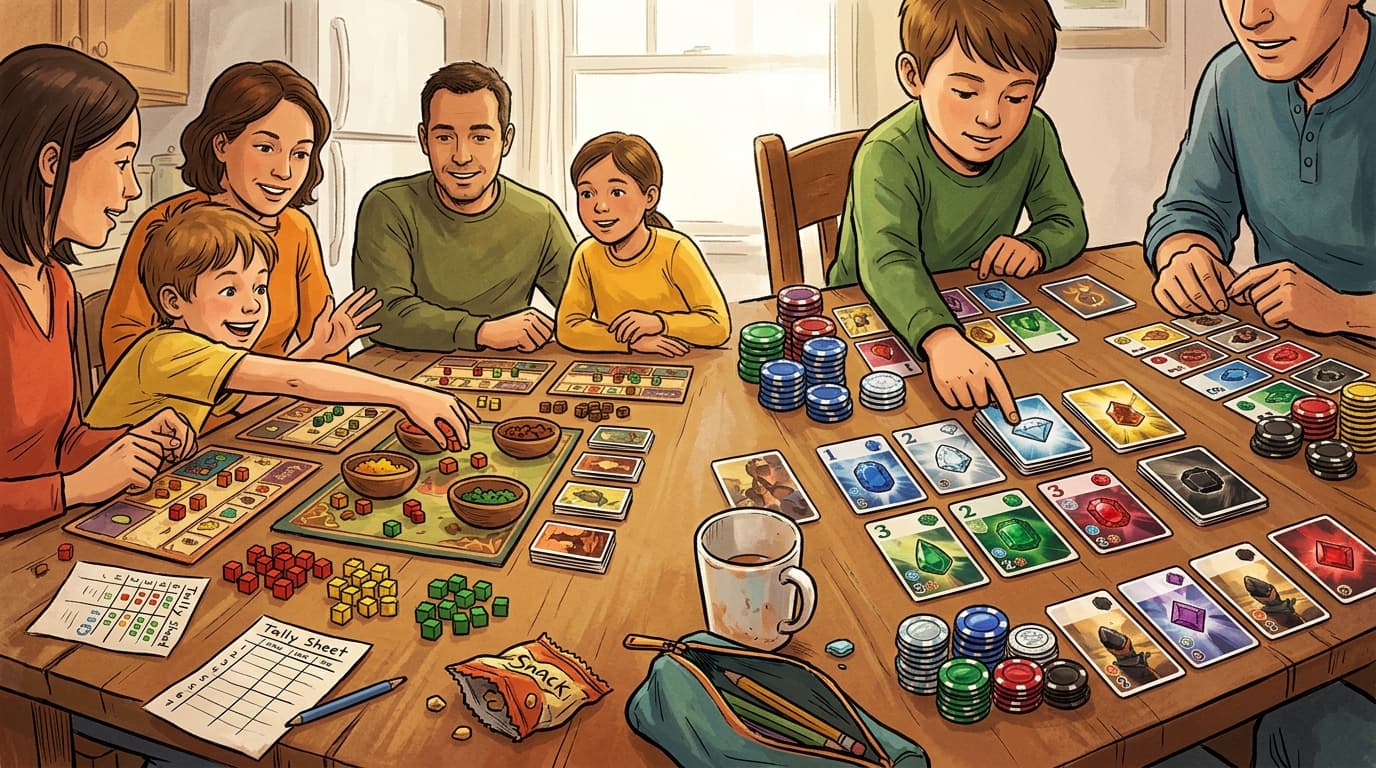

Both games sit in the same corner of the hobby: collect resources, convert them into better resources, cash in for points. Both are genuinely good. But if you're trying to figure out which one earns shelf space in a house with kids, the answer isn't really about which game is better designed — it's about which one survives contact with an actual Tuesday evening.
Splendor Is the Cleaner Machine
Splendor's core loop is elegant to the point of being almost frictionless. You take gems, spend gems to buy cards, and those cards give you permanent gem discounts that let you buy better cards. The engine metaphor is almost too literal — you can watch it click into gear in real time, which is satisfying in a way that's hard to explain until you've felt it.
That clarity is also what makes it work across age gaps. Roll to Review's 2026 engine-builder roundup highlights Splendor specifically for its accessibility within the genre — it's one of the few engine builders where the core mechanism is graspable on the first turn rather than the third game. A nine-year-old can understand "I need three blue gems to buy this card, and this card gives me a permanent blue gem" without any adult translation.
Setup is fast. The table footprint is small. Turns are short enough that nobody zones out waiting. These aren't small things when you're playing at 7:30 on a school night.
The problem — and it's a real one — is that Splendor can feel a little cold. The competition is mostly indirect (blocking a card your opponent wanted), and for kids who want something more tactile or thematic, the abstract gem tokens and card grid don't give them much to hold onto emotionally. It's a game that rewards patience and forward planning, which is either a feature or a bug depending on who's sitting across from you.
Century Spice Road Has More Texture, More Chaos
Century Spice Road runs on a similar engine-building skeleton, but the resource conversion is more involved. You're building a hand of caravan cards that transform one type of spice into another, and the combinations you can chain together are genuinely fun to discover. There's more of a puzzle feel — more "wait, if I play this card first, then that one..." — which some kids find deeply satisfying and others find completely overwhelming.
The Reddit family gaming community lists both Splendor and Century: Spice Road as regular plays, which tracks — these are games that keep showing up on tables because they're replayable without being punishing. But the Century crowd tends to skew toward players who've already clicked with Splendor and want something with a bit more going on.
That "bit more" is the issue for family night. Century's card hand management adds a layer of decision-making that works beautifully with engaged players and falls apart with distracted ones. If your kid is the type who agonizes over every turn anyway, Century gives that energy somewhere to go. If you've got a player who's already mentally halfway to the snack cabinet, the extra complexity is just friction.
The Actual Verdict
I'd argue Splendor is the better first engine builder for families — cleaner rules, faster turns, easier to teach across a four-year age gap. It's the game you pull out when you have 45 minutes and mixed enthusiasm around the table.
Century Spice Road earns its place once the family has played Splendor enough to want more texture. It's not harder in a way that's discouraging — it's harder in a way that feels rewarding once you're ready for it. Think of it as the natural next step rather than a replacement.
If you're buying one: start with Splendor. If you already own Splendor and your kids are asking for something with more to chew on, Century Spice Road is exactly that. Both are worth the shelf space. Just not necessarily at the same time.