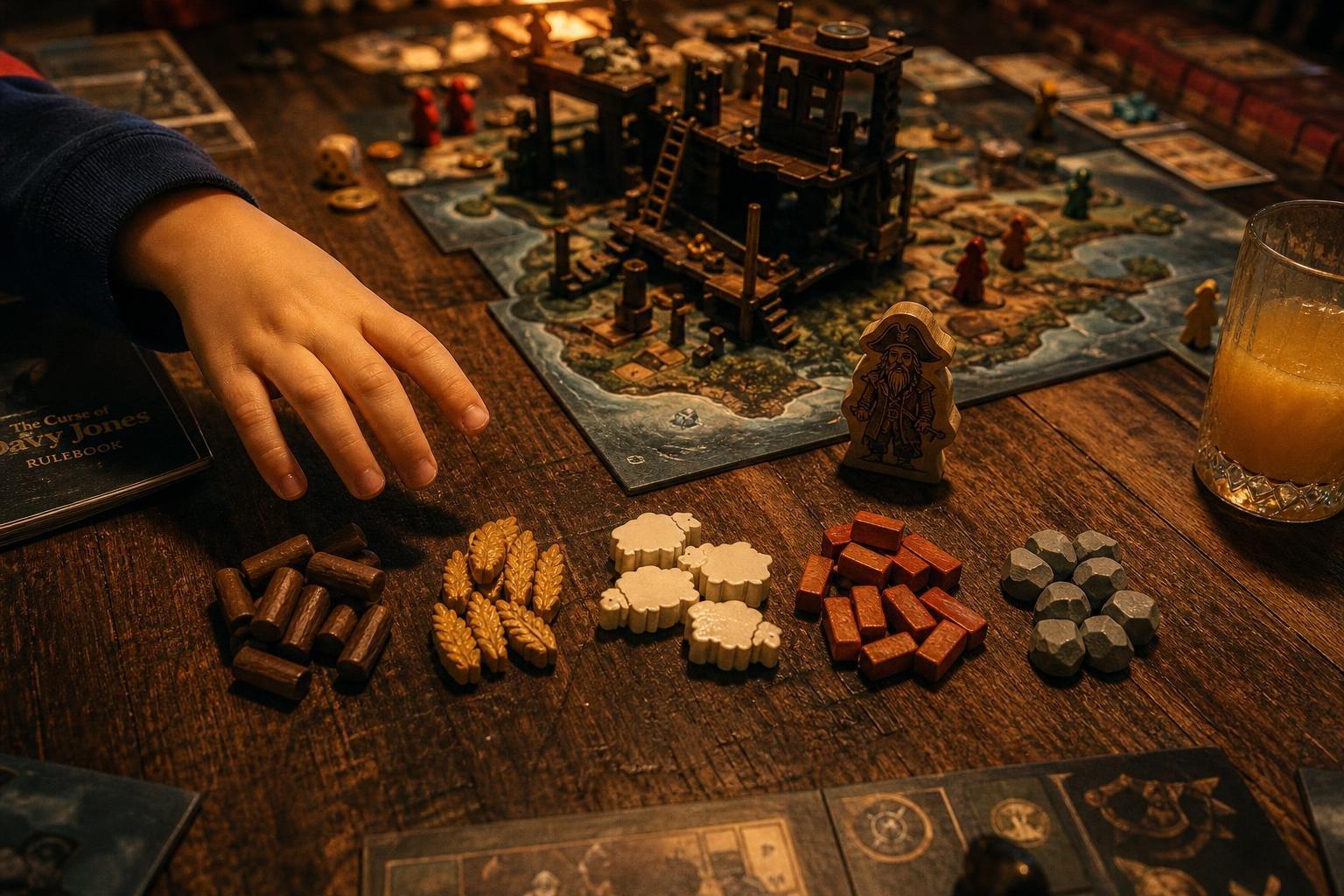

My kid's reaction to regular Catan was reasonable: "Why do I need two kinds of brick just to build one road?" She was seven. The negotiation phase alone — where adults mutter about ore-for-wheat ratios like it's a farmers market — made her want to go watch TV instead. So when I pulled out Catan Junior, I expected a watered-down cousin that would bore everyone by round three. It didn't.
The theme swap isn't cosmetic — it changes what kids understand
Catan Junior ditches settlers and roads for pirate crews sailing ships between islands to build "lairs," with a Ghost Captain wandering the board and occasionally blocking production instead of the standard Robber. The win condition is blunt: be first to build all seven lairs (boardgamearchive.com). That's the whole design philosophy in one sentence — a seven-year-old can count to seven and watch the gap close, which is a completely different cognitive task than tracking an abstract ten-point victory total.
The trading system backs this up. Instead of open negotiation, resources move through a fixed marketplace with five booths, one per resource type, refreshed from stockpiles as the game runs (officialgamerules.org). There's no haggling, no "I'll give you two sheep if you throw in a development card" back-and-forth that leaves a six-year-old staring blankly while two adults work out fair value. You look at what's on the dock, you decide if you want it, done.
Who it's actually for, and who it's not
The publisher lists two to four players, ages six and up, with a 30-to-40-minute runtime (boardgamearchive.com), and a separate age-by-age breakdown pins Junior Catan squarely at ages six and seven before kids typically outgrow it and move to house-ruled base Catan around eight (settlersboard.com). That tracks with what I've seen at my table — my daughter played it hard for about a year and a half, then started asking why she couldn't build roads like the "real" game.
That window matters for weeknight planning. This isn't a game you buy expecting five years of mileage out of one kid. It's a bridge, and the bridge is clearly marked at both ends: too abstract for most four- and five-year-olds, quickly outgrown once a kid starts wanting the negotiation and bigger board that base Catan offers (settlersboard.com). If you're shopping with a mixed-age group — a six-year-old and a ten-year-old — know going in that the ten-year-old will likely find it thin. Save it for siblings closer in age, or for the six-year-old's turn to pick the game.
Does it survive an actual tired weeknight?
Setup is the real test for me, not rules complexity. Sort five resource piles, seed the marketplace with one tile each, shuffle the Coco tiles, place the Ghost Captain on Spooky Island (officialgamerules.org) — that's a five-minute job, not the fifteen-minute sorting slog that sinks a lot of "family strategy" games after dinner. The board itself is double-sided depending on player count, which is a small but real convenience when it's just you and one kid on a Tuesday versus a full table on Saturday (boardgamearchive.com).
The game does hold up as something adults don't have to grit their teeth through, either — it was designed by Klaus Teuber, the same designer behind the original, rather than farmed out as a licensed kids' cash-in (settlersboard.com). That lineage shows. It's not deep, but it's not empty calories either; there's a real decision loop of where to build versus what you can afford to trade for, which is more than I can say for a lot of dice-and-move games marketed at this age.
Compare that to the gateway games built for even younger kids — something like a cooperative pick-and-match game aimed at preschoolers, where the entire point is just learning to take a turn (NYT Wirecutter) — and you can see exactly where Catan Junior sits on the shelf. It's the step after that, not a replacement for it.
What to watch
Catan's 2026 lineup has been busy — a new card-based On the Road version promises a complete game in as little as 15 minutes (BoardGameGeek), which raises an obvious question for parents of kids aging out of Junior: does a faster base-game format close the gap between the pirate version and full Catan more gently than jumping straight to the 10+ box? I haven't gotten that one to the table yet, but it's next on the list once the pirate hideouts start gathering dust.


