



You know the moment. Someone suggests Catan. Half the table groans. The other half is already arguing about port placement before the pieces are out of the box. And somewhere in the middle of turn three, a seven-year-old has lost interest entirely because nothing has happened to them yet.
Catan is a genuinely good game. It's also a genuinely difficult game to sell to a mixed-age family on a Tuesday night. The setup takes a while, the trading phase rewards confident negotiators (which eliminates most kids under ten), and the robber mechanic has ended more than a few friendships.
The good news: the design ideas that make Catan interesting — resource collection, building toward a goal, a little tension between players — exist in games that don't require a law degree to teach and don't punish a distracted eight-year-old for existing.
Here are three that actually work.
Ticket to Ride: The Gateway That Earns the Name
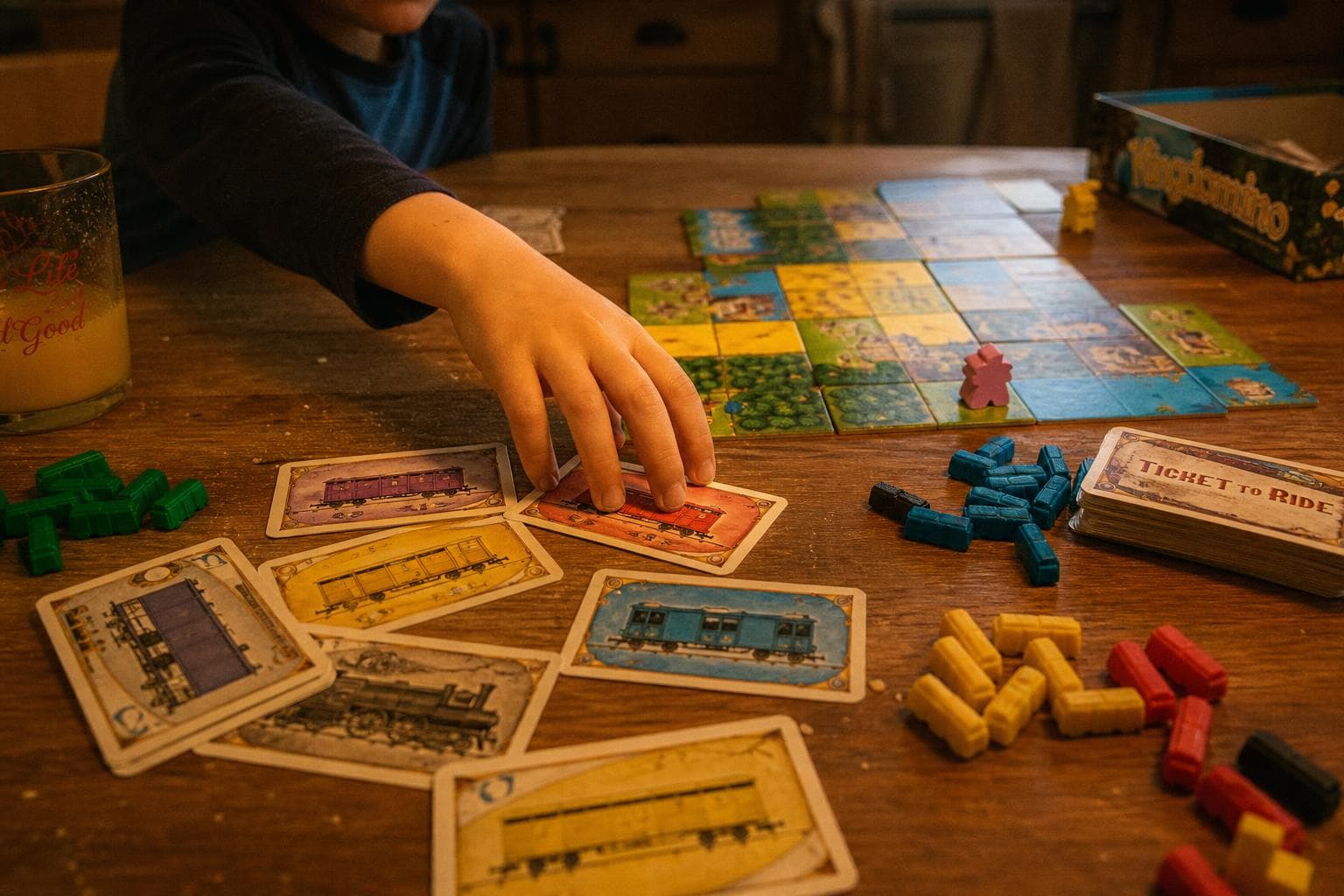
Every "gateway game" list includes Ticket to Ride, and for once, the consensus is right. According to Meredith Plays, it suits ages 8 and up, plays in 30 to 60 minutes with 2 to 5 players, and the core mechanic — collect colored cards, claim train routes, complete destination tickets — is explainable in about four minutes.
What makes it work with kids is the same thing that makes Catan frustrating with them: interaction. In Ticket to Ride, someone can block your route, but it's not personal in the way a robber stealing your cards feels personal. The sting is gentler. Kids can lose gracefully because the map is visual and the scoring is transparent — they can see exactly why they lost, which means they want to try again.
The First Journey edition drops the age floor to 6 with shorter routes and a simplified win condition. Worth knowing if you've got a younger sibling at the table.
Kingdomino: Fifteen Minutes, Zero Chaos
If Ticket to Ride is the gateway, Kingdomino is the game you pull out when you have even less time and even less patience. Designed by Bruno Cathala and published by Blue Orange, it won the Spiel des Jahres in 2017 and plays in 15 to 20 minutes. BoardGameGeek rates its complexity at 1.3 out of 5 — which, in practical terms, means you can teach it while setting it up.
The mechanic is elegant: draft domino-style terrain tiles, build a 5×5 kingdom grid, score points for connected terrain regions multiplied by crown symbols. The tension comes from tile selection — take the high-value tile now and lose your pick order next round, or grab a lesser tile and go first. That's a real strategic decision that a ten-year-old can grasp and an adult can appreciate simultaneously.
The box is compact, the setup is minimal, and the scoring pad is the only weak component (it runs out faster than expected — just use a notepad). For a weeknight game that doesn't require clearing the entire table, this is hard to beat.
Catan: On the Road — For When They Actually Want Catan
Here's the twist: if your family genuinely likes the idea of Catan but not the two-hour commitment, Catan: On the Road exists and retails for under $10. Developed by Benjamin Teuber, it strips the board entirely — resources draw from a card deck, buildings stack toward a seven-point win condition, and the robber appears via event cards rather than dice rolls.
It's faster, cheaper, and easier to teach than the original. The tradeoff is that without the map, some of the spatial drama disappears. But for a family that keeps bouncing off full Catan, this is a reasonable way to find out whether it's the game they don't like or just the setup.
The Pattern Worth Noticing
What these three games share isn't just accessibility — it's that the interaction between players feels proportionate. Nobody gets completely shut out. Nobody loses because of one bad dice roll at the wrong moment. The strategy is visible enough that kids can follow their own logic, and the play time is short enough that a bad game doesn't ruin the night.
That's the actual bar for a weeknight gateway game. Not "teaches resource management" or "builds strategic thinking." Just: does everyone at the table still want to be there when it's over?
These three pass that test. Catan, bless its heart, often doesn't.