


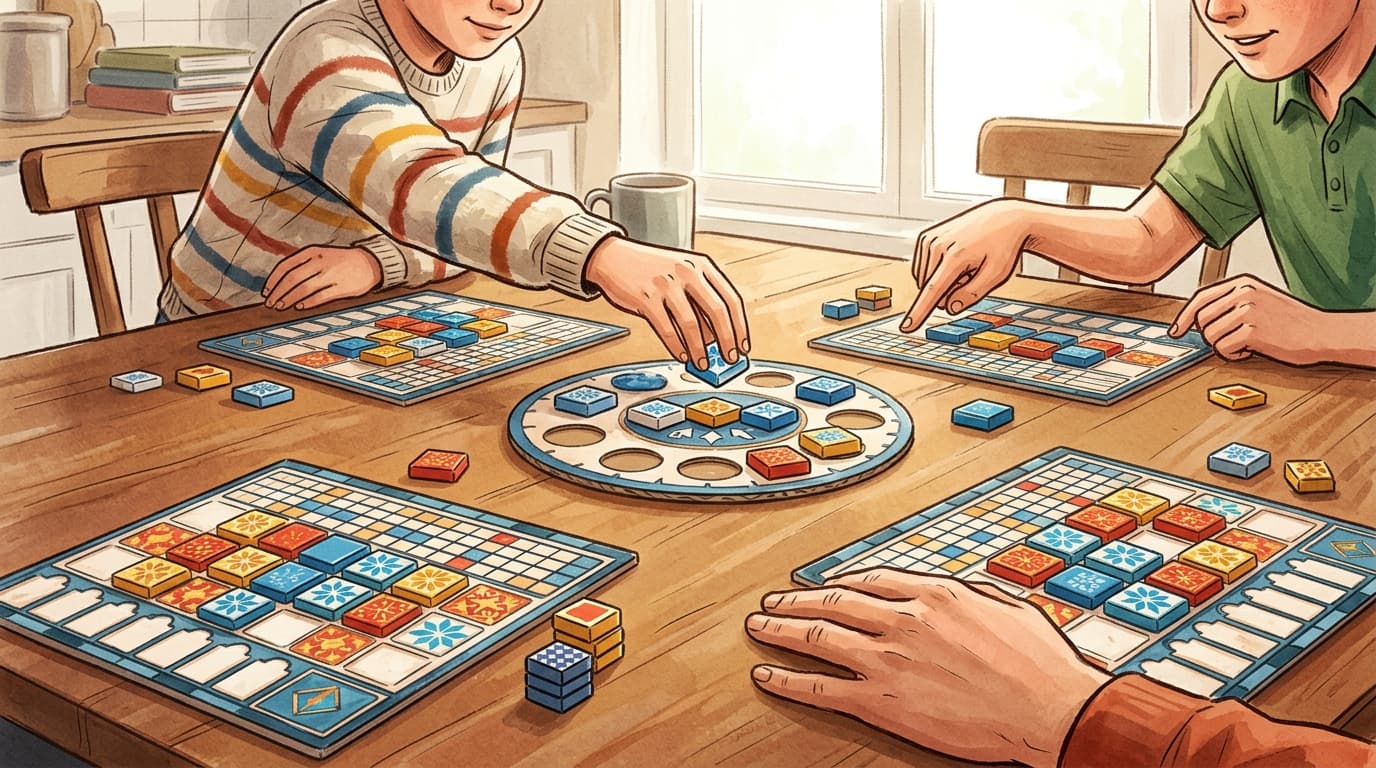

My seven-year-old once spent ten minutes just sorting the tiles before we started playing. My eleven-year-old called her out for stalling. They were both right, and somehow that argument was the most engaged either of them had been all evening.
That's Azul in a nutshell.
The Pieces Do Half the Work
Let's start where every real game night starts: the moment you open the box. Azul's tiles are chunky, smooth, satisfying resin pieces that feel genuinely good to handle. This is not a small thing. When kids can't stop touching the components, they stay at the table. When they stay at the table, the game actually happens.
The mechanic underneath those beautiful tiles is a drafting system — players take turns pulling colored tiles from shared factory displays and placing them on their individual player boards, scoring points for completed rows and patterns. Extra tiles left over after scoring count against you, which is the kind of elegant tension that makes a game feel fair rather than arbitrary.
The Age Gap Problem, Solved (Mostly)
Mixed-age family games fail in one of two ways: they're too simple for older kids, or too complex for younger ones. Azul threads this needle better than most. BGG rates the complexity at roughly 1.8 out of 5 — accessible enough for a tired Tuesday night, but with enough strategic depth that a ten-year-old can genuinely outplay an adult who isn't paying attention.
A six-year-old can participate meaningfully by focusing on color matching and filling rows. A twelve-year-old can start thinking two rounds ahead, watching what opponents are drafting, deliberately starving them of a color they need. Same game, different depths. That's the design doing real work.
It Won the Right Award for the Right Reasons
Azul won the 2018 Spiel des Jahres — the German game of the year award that specifically targets accessible, well-designed family games. That's not a "best strategy game" trophy or a "most innovative mechanic" prize. It's the award that asks: does this work for real people at a real table? The answer, apparently, was yes.
It's remained a perennial recommendation for both two-player and four-player setups in the years since — which matters practically. A game that only works with exactly four players is a game that sits on the shelf most nights.
The One Real Caveat
Setup is fast. Rules explanation takes about five minutes if you don't overthink it. But the end-game scoring — calculating bonuses for completed rows, columns, and color sets — can slow things down if you're playing with a kid who needs to verify every point individually. Budget an extra ten minutes the first few times. After that, it's smooth.
If your kids are in the 7-12 range and you don't already own this one, it belongs in the rotation. The tiles alone will buy you five minutes of peace before the game even starts.