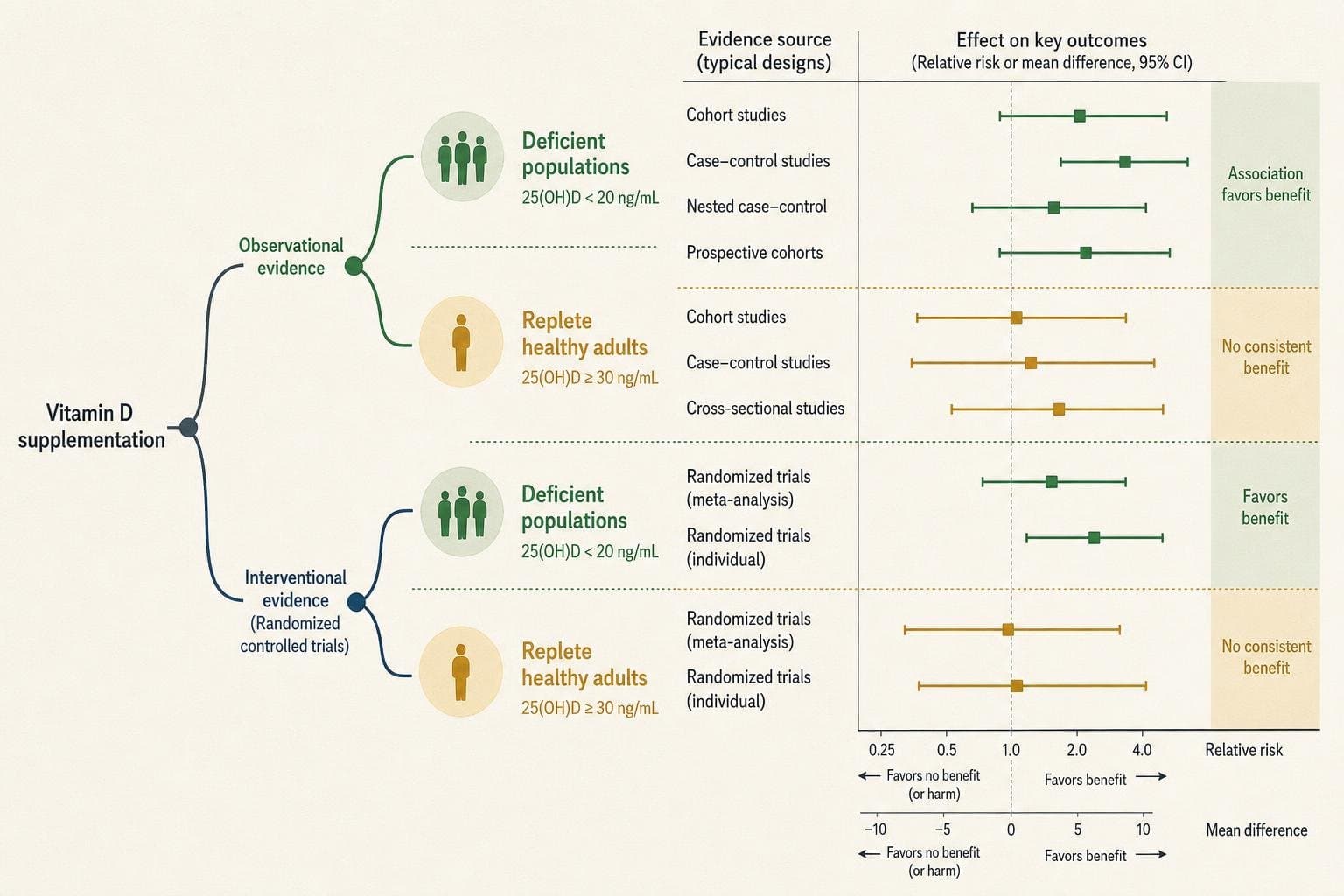

I've covered this territory twice before — in June on bone health, and in July on respiratory infections specifically. The short version from that last piece: the evidence was conditional. Baseline deficiency status mattered enormously. Healthy, replete adults weren't seeing meaningful benefits. What's changed since then is that the clinical framing has sharpened considerably — and the "healthy adult" question has a cleaner answer than it used to.
The Observational Evidence Was Never the Problem
The story of vitamin D and respiratory infections follows a pattern that should be familiar to anyone who's watched a promising nutrient hypothesis collapse under RCT scrutiny. Observational data looked compelling: people with lower 25(OH)D concentrations got sick more often. Vitamin D receptors show up in immune cells. The biological plausibility was there.
The problem, as a recent review in Current Nutrition Reports lays out carefully, is that randomized controlled trials have "largely failed to confirm many of these associations." The review identifies why: major trials enrolled vitamin D–replete populations, background supplementation muddied the intervention signal, and the dose-response relationship turns out to be nonlinear in ways that make simple "more is better" assumptions wrong. When you give a supplement to people who aren't deficient, you're not testing whether vitamin D helps — you're testing whether excess vitamin D helps. Those are different questions, and the answer to the second one is generally no.
This is the core methodological trap that's distorted public understanding for years. The observational signal was real. The inference — that supplementing healthy adults would reduce infections — was not justified by it.
What the Evidence Actually Supports
The NIH Office of Dietary Supplements is careful here, and its caution is worth taking seriously. The fact sheet for health professionals distinguishes between correcting deficiency (where there are established benefits) and supplementing replete populations (where the evidence is thin to nonexistent for most outcomes).
The Current Nutrition Reports review is more specific about where benefits do appear: mortality reduction in adults aged 75 and older, modest reduction in cancer mortality, and reduced progression to diabetes in high-risk prediabetes populations. Respiratory infection prevention in healthy adults doesn't make that list. The 2024 Endocrine Society guideline, cited in the same review, "recommends empiric supplementation for selected groups and discourages routine screening in healthy adults" — which is a fairly direct statement about where the evidence lands.
There's also a dosing wrinkle that often gets lost in the popular coverage. The review flags that intermittent high-dose regimens — the kind of bolus supplementation that sounds appealingly efficient — are actually linked to a higher fall risk (relative risk 1.08, 95% CI 1.03–1.14). Daily or weekly dosing is preferred. The supplement that's supposed to protect you can, under certain dosing patterns, make things worse. That's the kind of detail that doesn't make it onto the wellness blog.
The Deficiency Exception Is Real, But It's Not You (Probably)
None of this means vitamin D is inert for respiratory health. The conditional evidence that I wrote about in July holds: if you're genuinely deficient, correcting that deficiency likely matters. The immune system does use vitamin D. The receptors are real. The biology isn't invented.
But "genuinely deficient" is a clinical threshold, not a vague sense that you don't get enough sun. The NIH fact sheet notes that measurement accuracy has improved through standardization initiatives, but inter-method variability in 25(OH)D assays persists — which means the number on your lab report carries more uncertainty than most patients realize. The Current Nutrition Reports review goes further, noting that genetic polymorphisms in several genes affect how individuals respond to supplementation, making population-level recommendations a blunt instrument.
The honest clinical picture, then: vitamin D supplementation for respiratory infection prevention in healthy, replete adults is not well-supported by the RCT evidence. The observational associations that drove the hypothesis don't survive the methodological scrutiny of interventional trials. Correcting genuine deficiency is a different matter — but that's a targeted intervention based on a measured deficit, not a prophylactic strategy for the general population.
What to Watch
The precision-nutrition framing in the Current Nutrition Reports review is where this field is actually heading. Genetic variation in vitamin D metabolism genes means that population-average RCT results may obscure real responder subgroups. If researchers can identify who actually benefits from supplementation — by baseline status, genetics, age, or comorbidity profile — the "healthy adult" question might eventually get a more granular answer. Until then, the 2024 Endocrine Society guidance is the most defensible position: targeted supplementation for people with documented deficiency or specific risk factors, not routine supplementation for everyone who's worried about cold season.
The supplement aisle will continue to suggest otherwise. That's not new information.


