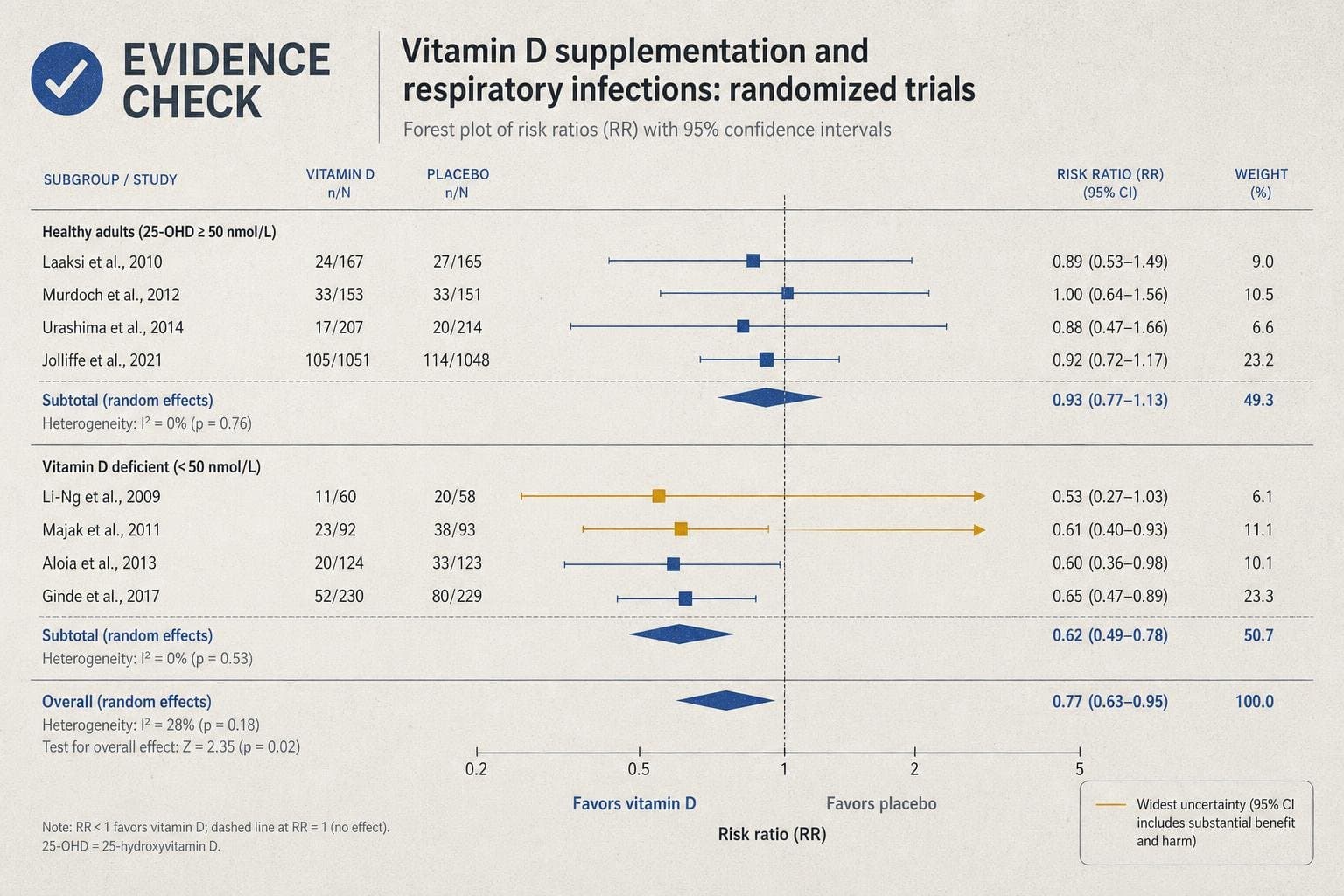

I've now covered this territory three times — in July, again in late July, and here we are again. Each time, the story has been essentially the same: the observational data looks promising, the randomized controlled trial data disappoints, and the gap between those two things is where most of the popular belief lives. The source pool this week doesn't change that story — but it does sharpen one specific part of it worth examining directly.
The Correlation Is Real. The Causation Is the Problem.
Start with what's genuinely established. The NIH's Office of Dietary Supplements documents that vitamin D plays a meaningful role in immune function — it's not a fringe claim. Vitamin D receptors are present on immune cells, and the vitamin influences both innate and adaptive immune responses. The biology is plausible.
The observational picture is also consistent: people with lower vitamin D levels tend to get more respiratory infections. That pattern has shown up across enough studies that it's not noise. But "tends to correlate with" is doing enormous work in that sentence, and the wellness industry has been quietly upgrading it to "causes" for years.
The problem is that low vitamin D status is also a marker for a dozen other things — less time outdoors, lower income, poorer baseline health, obesity, older age — all of which independently predict worse respiratory outcomes. Separating vitamin D's contribution from everything it travels with is genuinely hard, and most observational studies haven't done it cleanly. The CDC's respiratory illness surveillance data is a useful reminder of how many distinct pathogens drive respiratory illness burden — influenza, COVID-19, RSV, parainfluenza, adenoviruses — which makes attributing protection to any single supplement even more complicated.
What Randomized Trials Actually Show
This is where the story gets uncomfortable for the supplement case. Infection Control Today's September 2025 review of COVID-19 misinformation puts it plainly: although vitamin D deficiency may correlate with increased susceptibility to respiratory infections, randomized controlled trials have not shown that supplementation prevents COVID-19. The WHO, cited in the same piece, has repeatedly emphasized that no supplement replaces vaccination or public health measures in preventing respiratory illness.
That's specifically about COVID-19, but the pattern holds more broadly. The NIH's vitamin D fact sheet — a document that synthesizes the research rather than advocating for any particular outcome — stops well short of endorsing supplementation for respiratory infection prevention in healthy adults. The language is careful and conditional throughout.
There's a structural reason for this. As I noted in the July 22 issue, the trials that do show benefit tend to cluster around specific populations: people with frank deficiency, older adults in institutional settings, people with particular underlying conditions. When you run the same trial in generally healthy adults with adequate baseline vitamin D levels, the effect shrinks toward zero. The "healthy adult" caveat isn't a footnote — it's load-bearing.
A related methodological wrinkle: a BMJ rapid response on a major vitamin D RCT raised concerns about how baseline vitamin D status was measured in large trials — specifically, that predicted serum levels (derived from models rather than direct measurement) may not accurately reflect actual status, with area-under-the-curve values in the range of 0.66 to 0.71. That's not a great predictive model. If we can't cleanly sort participants by actual deficiency at baseline, we can't cleanly interpret who benefits from supplementation — and that uncertainty runs through a lot of the trial literature.
What This Means for the Supplement Question
The honest answer remains: it depends heavily on your baseline status and your risk profile.
If you're genuinely deficient — confirmed by a blood test, not inferred from the fact that you work indoors — there's reasonable evidence that correcting that deficiency supports immune function. That's a different claim than "taking vitamin D supplements prevents respiratory infections in adults generally," which is what the popular version of this belief asserts.
For healthy adults with adequate levels, the evidence for supplementation as respiratory protection is thin. Not zero, but thin — and the studies that show benefit are often the ones with the most methodological caveats. The NIH's immune function supplement fact sheet reflects this by treating vitamin D's immune role as established biology while remaining cautious about translating that into supplementation recommendations for the general population. It's worth noting that CDC surveillance tracks respiratory adenoviruses and parainfluenza as currently elevated nationally — pathogens for which no vaccine exists and for which the vitamin D supplementation literature is essentially silent.
The gap between "vitamin D matters for immunity" and "therefore take vitamin D supplements to avoid getting sick" is where most of the misinformation lives. The first statement is well-supported. The second requires a chain of evidence that the RCT literature hasn't consistently provided.
Watch for whether any large, well-powered trials with directly measured baseline serum levels (rather than modeled estimates) report out in the next year. That's the methodological fix the field actually needs — and until it arrives, the honest position is conditional, not confident.


