


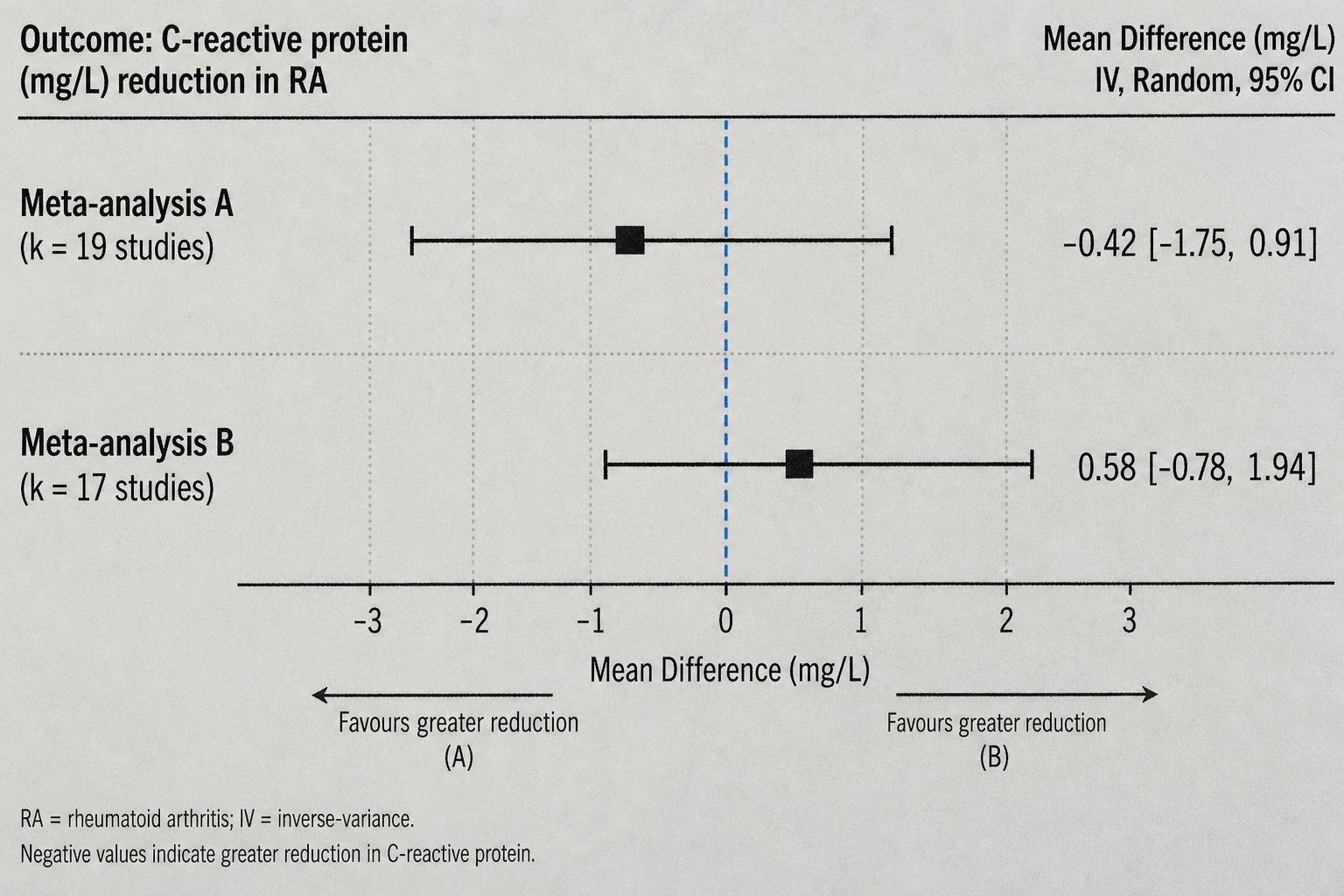

Here's an uncomfortable fact for the turmeric aisle: two meta-analyses looking at curcumin's effect on inflammation in the exact same patient population reached opposite conclusions within months of each other. One, published in Medicine in late 2025, pooled seven randomized trials in rheumatoid arthritis and reported curcumin significantly lowered C-reactive protein, erythrocyte sedimentation rate, and disease activity scores — calling the results "clinically relevant" and curcumin a "promising adjunctive therapeutic strategy" (PubMed). The other, a 2026 systematic review in Inflammation Research covering rheumatoid arthritis and lupus, pooled seven trials and found no significant effect on CRP, ESR, or disease activity at all — with heterogeneity so severe (I² above 90% across every outcome) that the authors called the evidence "limited and inconsistent" (Springer).
Same condition, same rough trial count, same era of literature. Different answer. That contradiction is the real story here, not whether turmeric is magic or useless.
Why Two Reviews of the Same Trials Disagree
The honest answer is that curcumin research is a mess of formulations, doses, and durations, and small meta-analyses amplify that mess instead of resolving it. When I² — the statistic measuring how much variation between trials can't be explained by chance — sits above 90%, a pooled effect size is close to meaningless. You're not measuring "curcumin's effect." You're averaging together trials using different curcuminoid extracts, different absorption enhancers, different doses, and different disease severities, and reporting the average as if it were a single coherent signal.
This isn't unique to the rheumatoid arthritis literature. A 2026 meta-analysis in Nutrients on curcumin in type 2 diabetes found a modest reduction in hs-CRP (about 1 mg/L) and a larger standardized effect on TNF-α, but flagged I² of 85% for the TNF-α pooling and warned that "sensitivity analyses involving unit-ambiguous or statistically reconstructed data increased uncertainty" (Nutrients). Translation: some of the underlying trial data had to be reconstructed or guessed at because the original papers didn't report it cleanly. That's not a minor footnote — it's a reason to discount the headline number.
The Signal Gets Stronger Only When You Lower Your Standards
A 2026 systematic review in Frontiers in Nutrition looked at curcumin combined with piperine (the black pepper compound that boosts absorption) across 20 trials spanning inflammation, metabolic, and cardiovascular outcomes, and reported that 15 of 20 showed significant reductions in CRP, hs-CRP, or IL-6 (Frontiers). That sounds more convincing — until you notice it's vote-counting (how many trials hit significance) rather than a pooled effect size, and the trials ranged from 8 to 117 participants over 1 to 12 weeks. Vote-counting is a weaker form of evidence than meta-analytic pooling precisely because it ignores effect magnitude and lets a handful of small, underpowered trials carry equal weight with larger ones.
The pattern holds in obesity research too. A late-2026 Nutrients meta-analysis comparing curcumin against green tea extract, resveratrol, and omega-3 in overweight and obese adults found curcumin was the only compound to significantly improve insulin resistance (HOMA-IR), but it did not significantly reduce CRP — the inflammation marker itself (PubMed). That's an important split: curcumin's best-supported effect in that population is metabolic, not anti-inflammatory, even though the two are often marketed as the same thing.
What's Actually Defensible to Say
Pulled together, the evidence supports a narrow, hedged claim: curcumin supplementation shows a modest, inconsistent association with lower inflammatory markers in some populations — type 2 diabetes most clearly, rheumatoid arthritis ambiguously, lupus barely studied at all — but the effect size shrinks or disappears depending on which trials get included and how heterogeneity gets handled. No meta-analysis in this pool reaches the kind of low-heterogeneity, large-sample confidence that would let anyone say "curcumin reduces inflammation" without an asterisk.
What would move this from ambiguous to answered isn't another small trial with a different curcumin brand — it's a large, multi-center RCT using a standardized, bioavailability-verified formulation, with pre-registered inflammatory endpoints, run long enough to see whether early CRP drops hold up. Until that exists, the fairest summary is that turmeric's anti-inflammatory reputation is outrunning the consistency of its evidence, and the next meta-analysis on the pile is as likely to contradict the last one as confirm it.