
For years, cardiologists were the people most likely to tell you to cut back on coffee. Arrhythmias, blood pressure, downstream stroke risk — the concerns were real enough that the field stayed cautious even as the observational data kept piling up in coffee's favor. That caution has now officially shifted. The American Heart Association recently published a major scientific statement in Circulation coming out firmly in favor of coffee's cardiovascular profile — a meaningful institutional signal from an organization not known for enthusiasm about stimulants.
But "the AHA likes coffee" is a simpler story than the evidence warrants. The details matter, and a few of them might surprise you.
The Dose-Response Curve Is Real — and Has a Ceiling
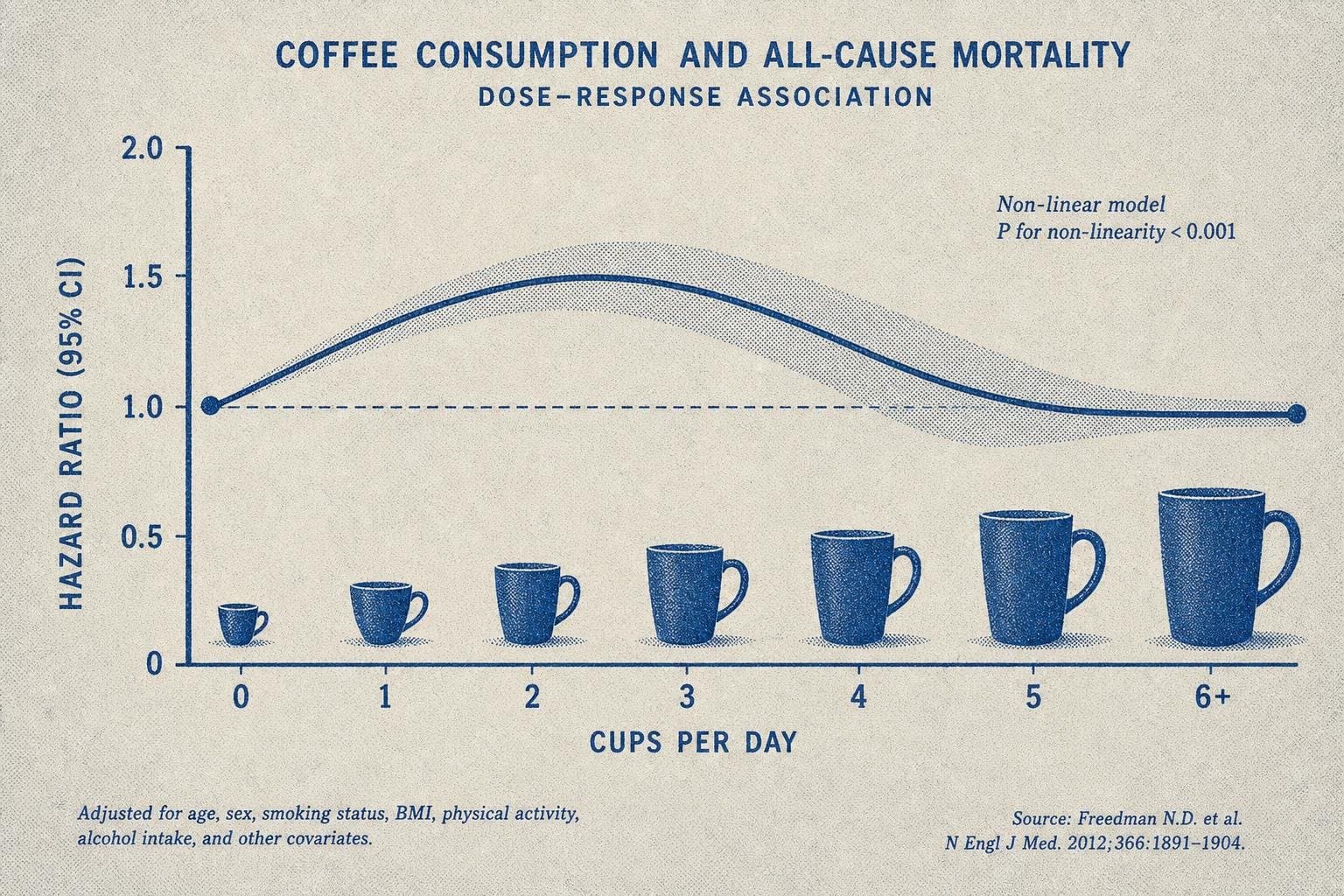
The most consistent finding across decades of research is that coffee's relationship with cardiovascular disease follows a curve, not a line. Moderate consumption is associated with lower risk; very high consumption loses that benefit.
A large prospective cohort study published in the European Journal of Nutrition — following 167,142 UK Biobank participants over a median of 11.1 years — found that unsweetened coffee at intakes between zero and five cups per day was associated with lower CVD risk. The hazard ratios were meaningful: around 0.81 for two to three cups per day, compared to non-drinkers. But above five cups per day, the protective association disappeared entirely — the hazard ratio returned to roughly 1.0.
This tracks with what a 2017 BMJ umbrella review found across 201 meta-analyses of observational research: the largest relative risk reduction appeared at three to four cups per day versus none, including for all-cause mortality, cardiovascular mortality, and cardiovascular disease overall. The curve flattens and then levels off. More is not better past a certain point; it just stops being protective.
The Confounder Problem Nobody Wants to Talk About
Here's where the honest version of this story gets complicated. As Medscape's coverage of the AHA statement notes — via Dr. F. Perry Wilson of Yale School of Medicine — almost everything we know about caffeine's cardiovascular effects in humans comes from observational studies of people drinking coffee and tea. That's a significant limitation.
The "healthy user effect" is a genuine confound: moderate coffee drinkers may simply have more organized, healthier lives than people who abstain entirely (sometimes for medical reasons) or those who are consuming caffeine primarily through energy drinks. When you observe that three-cups-a-day coffee drinkers have better cardiovascular outcomes, you can't cleanly separate the coffee from everything else that correlates with being a moderate coffee drinker. The AHA statement acknowledges this directly, and it's worth holding onto — the association is robust, but the mechanism and causality are harder to pin down than the headlines suggest.
What You Put in It Changes the Equation
The UK Biobank study adds a wrinkle that most coffee coverage ignores entirely: sweetened coffee showed no protective association at any intake level, while unsweetened coffee showed the U-shaped protective curve described above. The same pattern held for tea — unsweetened tea was associated with lower CVD risk, while high sweetened tea intake was associated with higher risk.
This is a finding that should probably get more attention than it does. The research literature on coffee and cardiovascular health has historically treated "coffee" as a single exposure, without accounting for what people actually put in it. If the protective association is specific to unsweetened consumption, then studies that lump all coffee drinkers together may be underestimating the benefit for black-coffee drinkers and overestimating it for people who treat coffee as a sugar-delivery vehicle.
The BMJ umbrella review also flagged pregnancy and women at increased risk of fracture as populations where the usual safety profile doesn't apply — a reminder that population-level associations don't automatically translate to individual recommendations.
What the AHA Endorsement Actually Means
The AHA's scientific statement represents a synthesis of this evidence base, not a discovery of new mechanisms. It's the field's institutions catching up to what the observational data has been suggesting for years. That's worth something — institutional caution has real costs when it leads clinicians to discourage a habit that the evidence consistently shows is neutral-to-beneficial for most adults.
But "the AHA endorses coffee" shouldn't become the new oversimplification. The evidence supports moderate unsweetened coffee consumption as part of a reasonable diet for most healthy adults. It doesn't support the idea that more coffee is better, that coffee is protective for everyone, or that the mechanism is well understood. The honest summary is that three or four cups of black coffee a day is probably fine and possibly beneficial — and that's a more useful conclusion than either the old cardiologist caution or the new wellness-culture triumphalism about coffee as a health food.
The research is genuinely reassuring. It just requires reading past the headline.


