
Fair. Let's go there.
The Claim: The Right Supplements Strengthen Your Defenses
The pitch is intuitive. Your immune system fights infection. Certain nutrients are involved in immune function. Therefore, taking those nutrients — in concentrated pill form, ideally at the first sign of a sniffle — should make your immune system work better.
Walk into any pharmacy and you'll find an entire aisle built on this logic. Elderberry gummies. Zinc lozenges. Vitamin C megadoses. Vitamin D softgels. The marketing language is consistent: immune support, immune defense, immune boost. The implication is that your immune system is a dial, and supplements turn it up.
The Appeal: It Feels Like Doing Something
Part of what makes this belief so sticky is that it's not entirely wrong — it's just wrong in a specific, important way that the supplement industry has no financial incentive to clarify.
The NIH's Office of Dietary Supplements is direct about this: consuming adequate amounts of vitamins A, C, D, E, selenium, and zinc is genuinely important for proper immune function. Clinical deficiencies of these nutrients do weaken immunity and can increase susceptibility to infection. That's real. That's established.
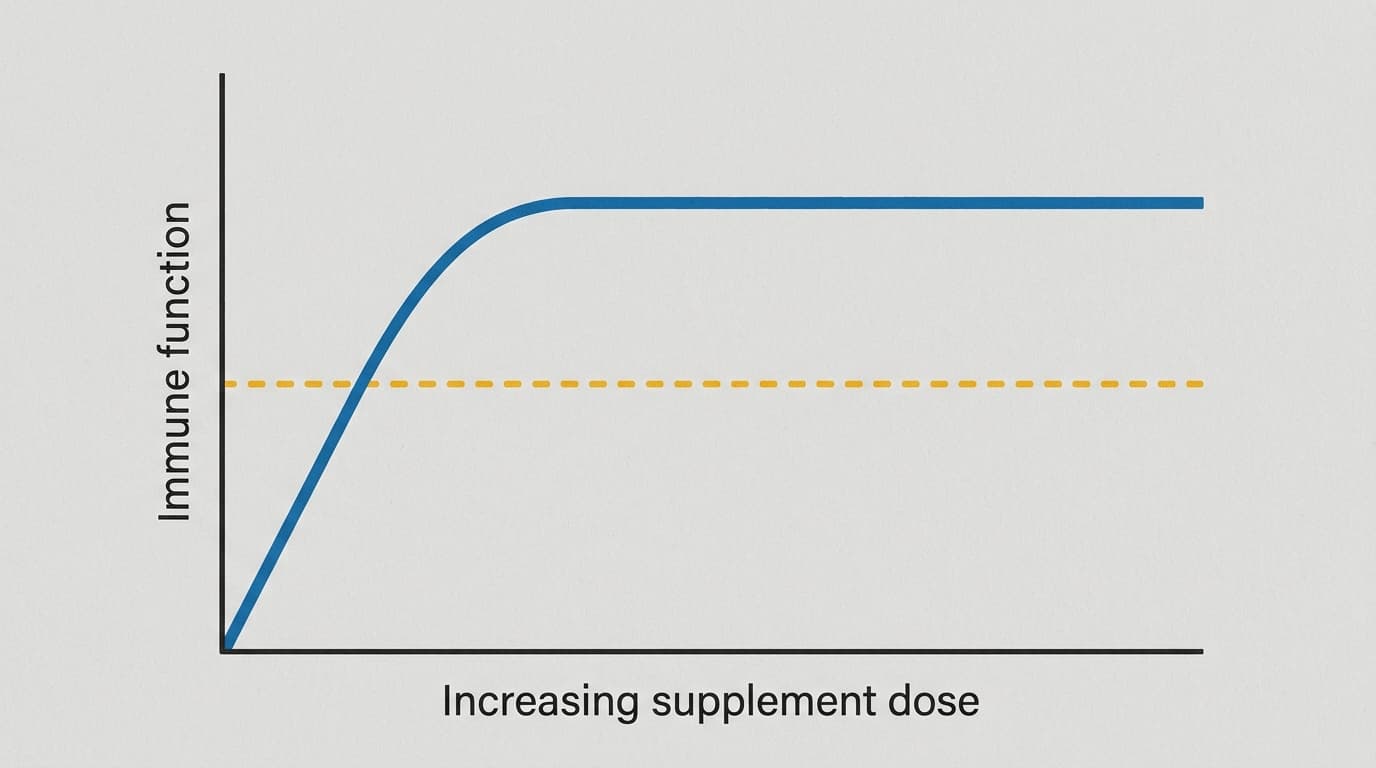
The problem is the leap from "deficiency impairs immunity" to "supplementation beyond sufficiency enhances it." Those are not the same claim, and the evidence does not support the second one.
There's also a timing issue that Fred Hutch dietitian Laura Martinell flags directly: taking vitamins when you're already sick doesn't work. The body prefers a steady stream of nutrients maintained over time — not an emergency infusion once symptoms appear. The supplement aisle is largely selling you a response to a problem that's already past the point where it can help.
The Evidence: Adequate Is the Ceiling, Not the Floor
Take vitamin C, the most iconic of the immune supplements. It functions as an antioxidant inside neutrophils — cells in the innate immune system — protecting them from damage while they work. But as Martinell notes, vitamin C is water-soluble. Your cells take what they need; the rest exits in your urine. Megadosing doesn't supercharge your neutrophils. It just makes expensive urine.
Zinc and vitamin D follow a similar pattern. The Cleveland Clinic Journal of Medicine reviewed the evidence on these supplements in the context of COVID-19 — a moment when the question was unusually urgent — and found theoretical biological plausibility but no high-quality clinical evidence supporting supplementation for prevention or treatment in people who weren't already deficient. Biologically plausible is not the same as clinically demonstrated.
Vitamin D is the most nuanced case. A recent meta-analysis in Inflammopharmacology examined D3 supplementation across autoimmune conditions and found effects on inflammatory markers — but this is research on people with autoimmune disease, not healthy adults looking to ward off a cold. Extrapolating from that population to general immune "boosting" is exactly the kind of evidence cherry-picking that makes supplement marketing so misleading.
And then there's the deeper structural problem, which this newsletter covered two weeks ago: the immune system isn't a single dial. It's two interlocking systems — innate and adaptive — with different mechanisms, timelines, and targets. As Fred Hutch explains, genuinely "boosting" the innate immune system would mean sending it into overdrive — attacking friend and foe alike. That's not health. That's the mechanism behind autoimmune disease.
What to Actually Do With This
The evidence points toward a boring but defensible conclusion: nutritional adequacy matters, and supplementation corrects deficiency. Beyond that, the returns flatten out — and in some cases, the concept of "more" becomes actively incoherent.
If you're eating a varied diet and not in a high-risk group for deficiency (older adults, people with limited sun exposure, and those with certain absorption conditions have legitimate reasons to discuss vitamin D with a doctor), the supplement aisle is mostly selling you reassurance.
That's not nothing — reassurance has psychological value. But it's worth knowing what you're actually buying.
The practical takeaway: get bloodwork if you're concerned about deficiency. Eat enough protein, vegetables, and varied whole foods consistently — not just when you feel a cold coming. And treat any supplement that promises to "boost" your immune system as a marketing claim, not a medical one. The biology doesn't support the verb.


