
The phrase landed with the satisfying thud of a public health revelation. Sitting is the new smoking. It spread from wellness blogs to corporate wellness programs to standing desk marketing copy, and now it's basically ambient background noise in any conversation about office health. The problem with ambient background noise is that nobody examines it very carefully.
So let's examine it.
The Claim: Prolonged Sitting Is Quietly Killing You
The core concern is legitimate. Growing evidence links extended sedentary time to cardiovascular disease, type 2 diabetes, and early death — and the mechanisms aren't mysterious. When skeletal muscle stays inactive for long stretches, the body's ability to absorb glucose from the blood declines. Fat metabolism slows. Blood flow becomes less efficient, impairing vascular function and contributing to elevated blood pressure over time. These aren't speculative pathways; they're fairly well-characterized metabolic responses to prolonged stillness.
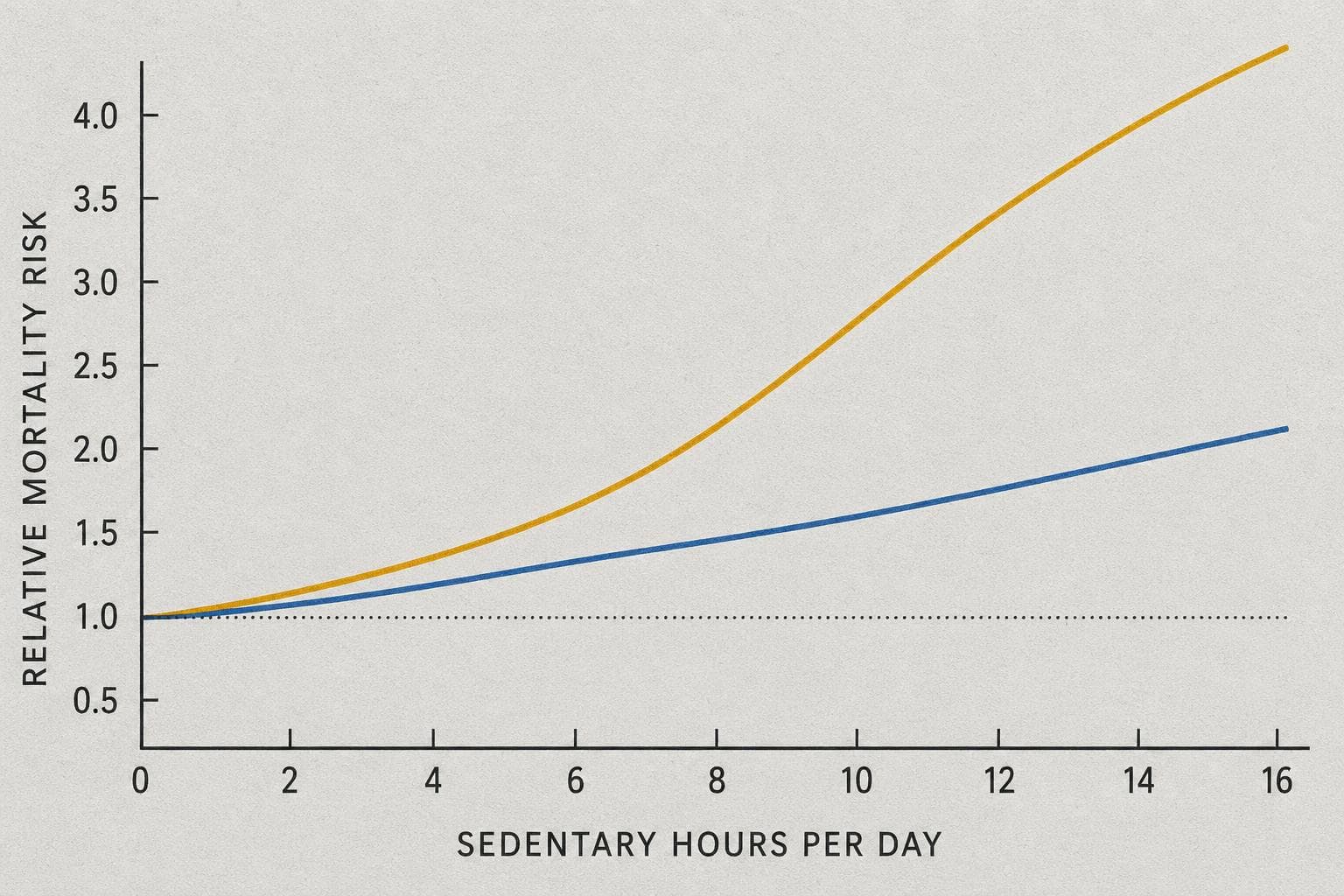
The more counterintuitive finding — and the one that gave the "new smoking" framing its punch — is that these risks don't disappear if you exercise. A person can meet the recommended 150 minutes of moderate weekly activity and still face elevated health risks if they spend most of the day seated. Sedentary behavior and physical inactivity are distinct constructs. The morning run doesn't fully offset eight hours at a desk. That's a genuinely important public health message, and it's supported by evidence.
The Appeal: Why "New Smoking" Stuck
The smoking comparison is rhetorically brilliant and epidemiologically sloppy, which is exactly why it spread.
Smoking gave public health a clean villain: a discrete, avoidable behavior with a dose-response relationship and a mountain of causal evidence accumulated over decades. "Sitting is the new smoking" borrows that moral clarity and applies it to something far more complicated — a behavior that exists on a continuum, is often structurally unavoidable, and whose risks are substantially more modest and context-dependent than tobacco.
The framing also flatters a particular kind of health-conscious professional. If sitting is the new smoking, then your standing desk is a form of virtue. The wellness industry understood this immediately. Standing desks, under-desk treadmills, and "movement snack" apps all benefit from a framing that makes sedentary behavior feel like a moral failing rather than a structural feature of modern work.
The Evidence: Real Risks, Overstated Comparison
The research on sedentary behavior is real, but it doesn't support the smoking equivalence.
Long-term physical inactivity carries serious mortality risk. A large Norwegian cohort study found that people who remained inactive across two surveys spanning roughly 22 years had approximately twice the risk of all-cause death and nearly three times the cardiovascular mortality risk compared to those who stayed consistently active. That's a meaningful signal. It also reflects sustained inactivity over two decades — not a few years of desk work.
The picture gets more complicated in populations with existing conditions. Research from the Lolland-Falster Health Study found that sedentary behavior increases disease and mortality risk even in physically active individuals with chronic conditions — suggesting the interaction between sedentary time and underlying health status matters considerably. Similarly, patients with peripheral arterial disease show particularly high sedentary behavior levels, contributing to declining mobility and cardiovascular risk. The risks aren't uniform across populations.
What the evidence doesn't show is the clean dose-response relationship that made smoking so damnable. Smoking has no safe level. Sitting does — the question is how much, broken up how often, in what context. That's a very different kind of risk profile, and collapsing the distinction does readers a disservice.
I'd also flag that much of the sedentary behavior research is observational. Establishing that people who sit more tend to have worse health outcomes is not the same as establishing that the sitting itself is the primary driver, independent of other factors that correlate with sedentary lifestyles.
What to Actually Do With This
The practical takeaway is narrower than the slogan suggests, but it's still worth acting on.
Breaking up sitting time matters — not just adding exercise to an otherwise sedentary day. Short movement breaks distributed through the day appear to have metabolic benefits that a single exercise session doesn't fully replicate. If your job involves extended sitting, the intervention isn't necessarily a standing desk; it's interruption frequency.
The smoking comparison, though, should be retired. It served its purpose in getting people to take sedentary behavior seriously. Now it mostly serves standing desk vendors and makes people feel guilty about something that is, for many workers, structurally constrained rather than freely chosen. The evidence says: sit less, move more often, and don't assume your evening run has fully covered your tab. That's a useful message. It doesn't need the melodrama.


