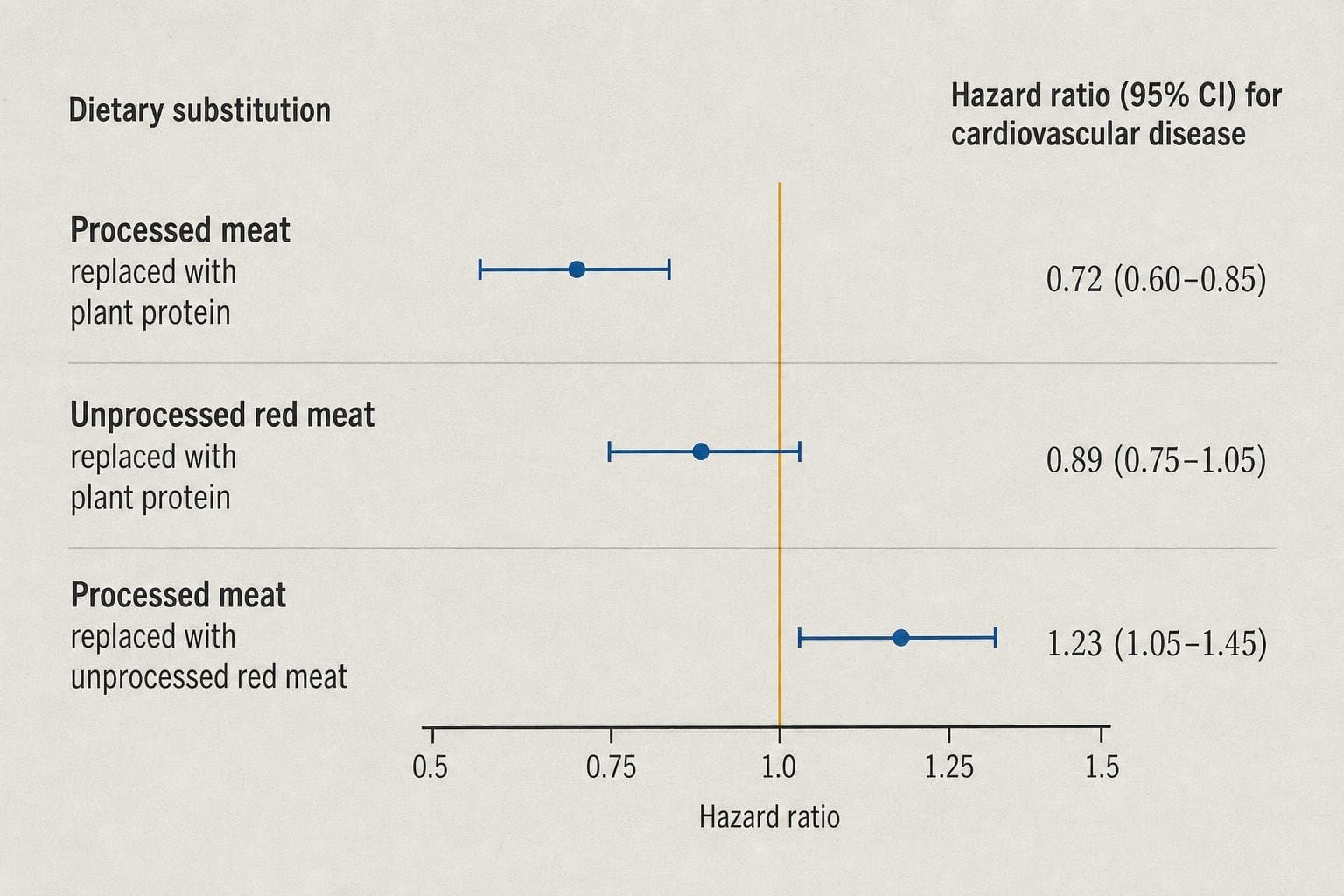

Here's a question that should make you suspicious of every red meat headline you've ever read: when researchers find that people who eat more red meat have higher rates of heart disease, do they know what else those people were eating? What they weighed? Whether they smoked? How much they exercised? In most of the studies that built the conventional wisdom on red meat and cardiovascular risk, the honest answer is: sort of, imperfectly, not really.
The red meat–heart disease link is one of the most cited findings in nutrition epidemiology. It's also one of the most methodologically fraught.
The Observational Evidence Is Real — and Really Hard to Interpret
The studies associating red meat with cardiovascular disease are almost entirely observational. They track what people report eating and whether they later develop heart disease. The problem is that dietary patterns cluster. People who eat a lot of red meat in Western populations also tend to eat more processed food, exercise less, and smoke more. Disentangling red meat from everything else it travels with is genuinely difficult.
This isn't a fringe objection. A 2019 meta-analysis of randomized controlled trials published in Circulation, led by researchers at Harvard T.H. Chan School of Public Health and Purdue University, found something that should have gotten more attention: when diets high in red meat were compared against all other diets combined, there were no significant differences in total cholesterol, lipoproteins, or blood pressure. The only exception was triglycerides, which ran slightly higher in the red meat groups.
That's a notably different picture than the one most people carry around. The lead author put it plainly: "Asking 'Is red meat good or bad?' is useless. It has to be 'Compared to what?'"
The Comparison Diet Is Doing Most of the Work
That framing matters enormously. The same meta-analysis found that when red meat was specifically compared to high-quality plant proteins — legumes, soy, nuts — LDL cholesterol dropped meaningfully in the plant-protein groups. So there is a signal. But the signal is about what you eat instead, not just about red meat in isolation.
A BMJ rapid response summarizing RCT evidence reinforced this: red meat consumption was associated with higher LDL compared to plant-based protein sources, consistent with its saturated fat content. That's a real biological mechanism. Saturated fat raises LDL. Red meat contains saturated fat. The chain isn't invented.
But here's where the confounding problem bites back: if your comparison group is eating cookies and fries instead of red meat, you won't see that signal. If your comparison group is eating nuts and lentils, you will. The observational studies that generated the scary headlines often didn't specify — or control for — what replaced the red meat.
Processed Versus Unprocessed: The Distinction That Actually Matters
Recent data suggests the red meat category itself is doing too much work. Findings presented at the 2026 European Atherosclerosis Society Congress, drawn from a prospective analysis of 118,272 UK Biobank participants followed for approximately 12 years, found that replacing processed meat with pulses was associated with a 15% lower risk of ischaemic heart disease and a 10% lower risk when total red meat was replaced. Notably, replacing unprocessed meat with pulses did not show similarly significant associations.
That's a meaningful distinction. Bacon and salami are not the same food as a lean grass-fed steak, but they've spent decades lumped together in the same epidemiological bucket. The Conversation's nutrition analysis makes the same point: processed meats carry additional risk factors — higher sodium, preservatives, higher saturated fat — that unprocessed red meat doesn't necessarily share.
Meanwhile, a 2026 scientific statement from the European Association of Preventive Cardiology lands on a more pattern-level conclusion: dietary patterns rich in ultra-processed foods, meat, salt, sugar, and saturated fat increase CVD risk, while plant-based patterns reduce it. That's probably the most defensible summary of where the evidence actually sits — and notice it doesn't say "red meat causes heart disease." It says dietary patterns matter, and red meat tends to appear in the riskier ones.
What This Means for How You Eat
The evidence doesn't exonerate red meat entirely, and it doesn't condemn it categorically. What it does suggest:
The type of red meat matters. Processed meats carry more consistent risk signals than unprocessed cuts. The comparison matters. Swapping a steak for a handful of nuts is probably good for your LDL. Swapping it for a bag of chips probably isn't. And the overall dietary pattern matters more than any single food.
The Purdue clinical trial review found that consuming red meat above typical recommended amounts didn't worsen blood pressure or standard cholesterol markers in short-term trials — though the researchers were careful to note that short-term trials can't capture the decades-long trajectory of cardiovascular disease development.
That last caveat is worth sitting with. The confounding problem cuts both ways: it makes it hard to prove red meat causes heart disease, but it also makes it hard to fully clear it. What we can say with confidence is that the headline version — "red meat causes heart disease" — is a cleaner story than the evidence warrants. The real story is messier, more contextual, and considerably more useful.


