
When I last wrote about this topic, the central argument was that the headline-level claim — "red meat causes heart disease" — was doing a lot of work that the underlying epidemiology couldn't quite support. Observational studies kept bumping into the same wall: people who eat a lot of red meat also tend to smoke more, exercise less, eat more ultra-processed food, and have lower incomes. Separating the steak from the lifestyle is genuinely hard. That piece generated more reader mail than almost anything I've written, most of it from people who wanted a cleaner verdict in one direction or the other. Here's the update: the evidence is still messy, but a new wave of research is at least getting more specific about which risks are real and which mechanisms might explain them.
The Stroke Signal Is Real — But Comes With Caveats
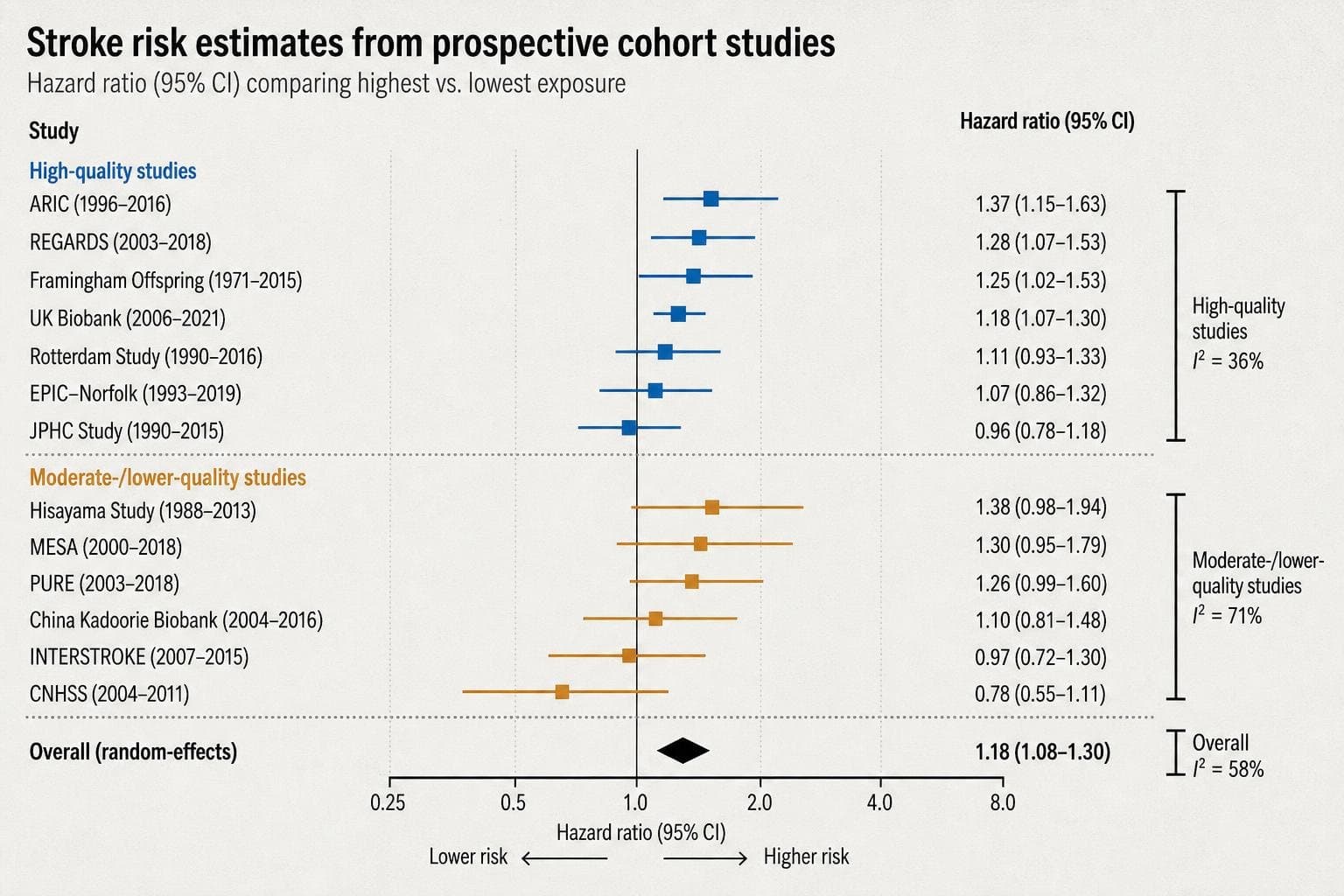
A meta-analysis published in Frontiers in Nutrition in June 2026 pooled 15 prospective cohort studies covering over 1.29 million subjects and roughly 26,000 stroke cases. The headline finding: red meat consumption was associated with increased stroke risk. That's a meaningful sample size, and prospective cohort designs are generally stronger than retrospective ones for this kind of question.
But the authors flag something that should give pause before anyone runs the "red meat causes strokes" headline: the heterogeneity across studies was substantial, with an I² of 72.5%. In plain terms, the studies weren't telling a consistent story. When you pool results that vary this much, the summary estimate becomes less a finding and more an average of disagreements. The researchers used a random-effects model to account for this — the appropriate statistical choice — but high heterogeneity is itself a signal that something more complicated is going on. Geography, red meat type (processed versus unprocessed), cooking methods, and baseline dietary context all likely matter, and most individual studies can't fully control for all of them simultaneously.
This is the confounding problem in miniature. A cohort study in Finland and a cohort study in Japan are both measuring "red meat consumption," but they're measuring it against very different dietary backgrounds, in populations with different genetic profiles, different cooking traditions, and different definitions of what counts as a serving.
Twenty Years of Dietary Patterns Tells a Different Story
Meanwhile, a 20-year follow-up from the ATTICA study, published in the European Journal of Nutrition, offers a useful reframe. Rather than isolating red meat as a single variable, the researchers identified three dietary patterns in a Mediterranean cohort of over 3,000 adults: a plant-based pattern, a Western pattern heavy in animal-sourced and processed foods, and a high-calorie pattern low in white meat. Higher adherence to the plant-based pattern was associated with a 26% lower 20-year cardiovascular disease risk (HR: 0.74, 95% CI 0.55–0.99).
What the ATTICA data can't tell us — and what the authors are careful not to claim — is whether the protective effect comes from eating less red meat specifically, or from eating more plants, or from the overall caloric and nutrient profile of the pattern, or from the lifestyle factors that tend to travel with plant-heavy diets. The Western pattern that showed elevated risk wasn't just "more red meat." It was more animal-sourced food, more processed food, and a whole cluster of behaviors that epidemiologists struggle to fully disentangle even with two decades of follow-up.
This is actually the more honest framing for what the evidence supports: dietary patterns matter for cardiovascular outcomes. The specific villain within those patterns is harder to name.
The Mechanism Question Remains Genuinely Open
One reason the red meat-heart disease debate has been so durable is that there are plausible biological mechanisms — saturated fat, heme iron, and the gut microbiome pathway involving carnitine and TMAO among them. The NIH's Office of Dietary Supplements notes that carnitine, found in high concentrations in red meat, is converted by gut bacteria to TMAO, a compound associated with cardiovascular risk — though the research on whether carnitine supplementation itself affects heart disease outcomes has produced mixed results, with some studies suggesting increased risk and others finding no effect. Mechanism plausibility is not the same as demonstrated causation, and the carnitine-TMAO pathway is still being worked out.
The CDC's established risk factor framework — high blood pressure, unhealthy cholesterol levels, diabetes — remains the strongest predictive model for cardiovascular disease. Red meat consumption may influence some of these intermediaries, but it sits several causal steps removed from the outcome, and those steps are where confounding does its most effective work.
What the Evidence Actually Supports
The honest summary, two years into covering this question: eating a lot of red meat, particularly processed red meat, within a Western dietary pattern is associated with elevated cardiovascular and stroke risk. That association is real and consistent enough to take seriously. Whether it's causal, and how much of the signal survives rigorous adjustment for lifestyle confounders, remains genuinely contested in the literature.
The practical implication isn't "red meat is fine" or "red meat will kill you." It's that dietary pattern matters more than any single food, and that the studies most worth watching are the ones that can separate processed from unprocessed meat, control for overall diet quality, and follow people long enough to see actual outcomes — not just biomarker changes. The ATTICA study's 20-year window is a step in that direction. More of that, please.


