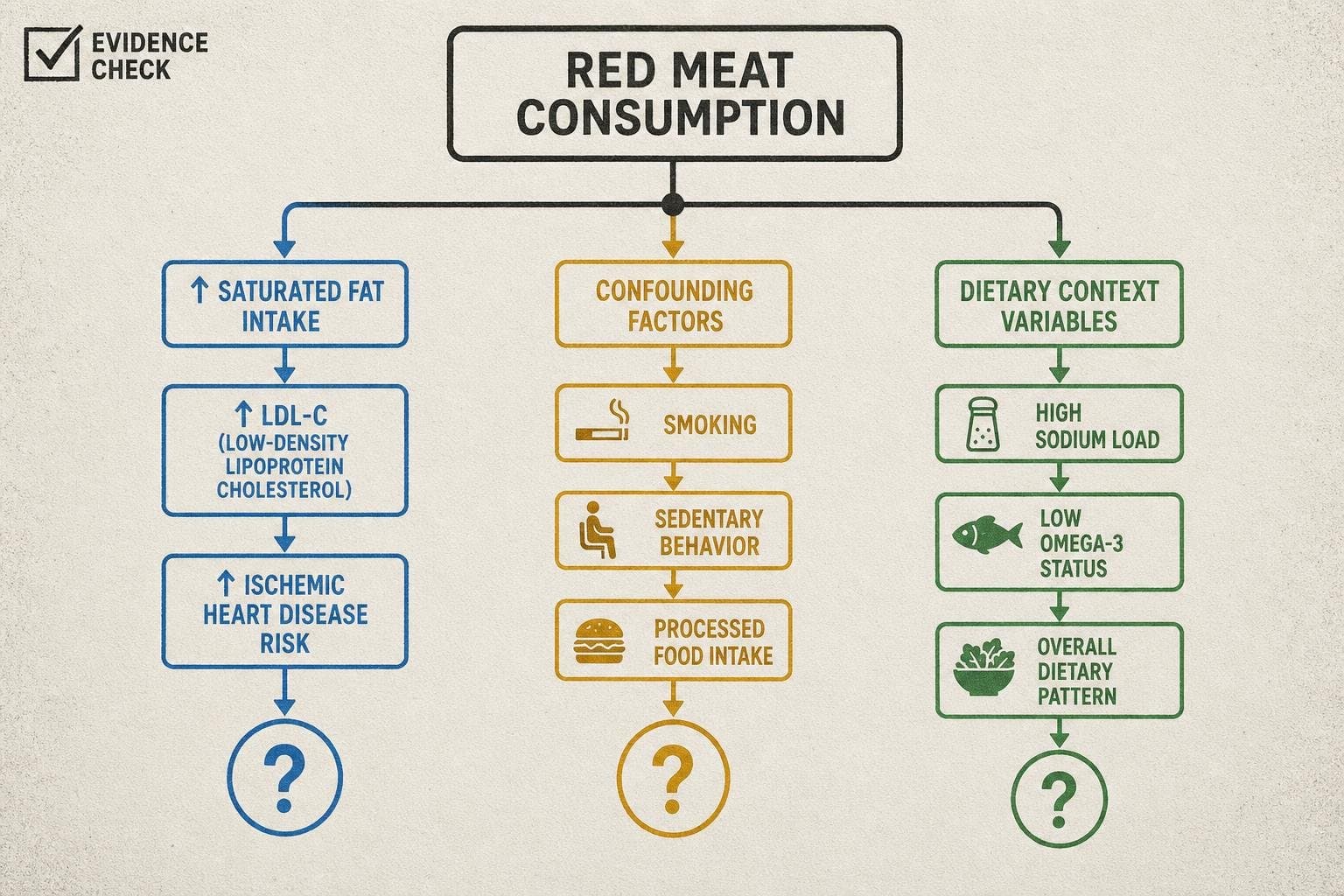

I've now written about this topic twice before, and each time the honest conclusion has been the same: the observational evidence linking red meat to heart disease is real but messy, because the people who eat the most red meat also tend to smoke more, exercise less, and eat more processed food. Separating "red meat did this" from "this entire dietary pattern did this" is genuinely hard.
So what's new? The source pool available this week doesn't deliver a clean resolution — but it does add a useful piece to the puzzle, and it sharpens the question in a way worth examining.
LDL-C Is the Clearest Link — and It's a Mechanism, Not a Verdict
The strongest source in this week's pool is a Global Burden of Disease Study 2023 analysis published in JAMA, which found that elevated LDL cholesterol caused an estimated 3.6 million deaths globally in 2023 — roughly 6% of all deaths — and 90.7 million disability-adjusted life years. The study derived its relative risk estimates from meta-analyses of 38 randomized clinical trials. That's a robust methodological foundation, and the LDL-cardiovascular disease link is about as well-established as anything in nutrition epidemiology.
Here's where red meat enters the picture: saturated fat from animal sources raises LDL-C, and red meat is a meaningful source of saturated fat. So the proposed causal chain is: red meat → elevated LDL-C → ischemic heart disease. That chain has biological plausibility and some experimental support.
But "biological plausibility" is not the same as "demonstrated in humans eating normal diets over decades." The JAMA GBD study establishes that elevated LDL-C is dangerous. It does not establish that eating red meat is the primary driver of elevated LDL-C in any given person, or that reducing red meat consumption specifically will lower cardiovascular mortality. Those are separate empirical questions, and the answers are considerably murkier.
The Confounding Problem, Restated
The BMJ letter on the Minnesota Coronary Experiment — a re-examination of a landmark dietary fat trial — is a useful reminder of how contested the diet-heart hypothesis has been even at the mechanistic level. The recovered data from that trial complicated the simple "saturated fat raises LDL, therefore reduces saturated fat reduces heart disease" story, partly because the omega-6 to omega-3 fatty acid ratio appears to matter independently of total saturated fat intake. Red meat's fatty acid profile is not uniform across cuts, animals, or farming methods, which makes population-level claims about "red meat" as a single exposure category inherently imprecise.
The NIH's Office of Dietary Supplements fact sheet on omega-3 fatty acids reinforces this: the two major classes of polyunsaturated fatty acids interact in ways that affect cardiovascular outcomes, and dietary patterns that are high in red meat are often simultaneously low in omega-3-rich foods like fatty fish. Whether the harm attributed to red meat is partly the absence of protective foods is a question observational studies struggle to answer cleanly.
This is the confounding problem in its most stubborn form. It's not just that red meat eaters smoke more. It's that the dietary pattern surrounding red meat consumption — what people eat instead of red meat, what they eat alongside it — may be doing as much work as the meat itself.
What the Evidence Actually Supports
Here's a fair summary of where things stand, based on what the sources actually show rather than what the headlines tend to claim:
Well-established: Elevated LDL-C is a major, modifiable cardiovascular risk factor with strong evidence from randomized trials, as the JAMA GBD 2023 study documents. Reducing LDL-C through statins demonstrably reduces cardiovascular mortality.
Plausible but not proven at the dietary level: That reducing red meat consumption specifically will lower LDL-C enough to produce meaningful cardiovascular benefit in otherwise healthy adults eating varied diets. The mechanism exists; the population-level effect size is uncertain.
Underappreciated: The dietary context around red meat consumption — sodium load, processed meat versus unprocessed, omega-3 intake, overall dietary pattern — likely modifies whatever effect red meat itself has. The CDC's guidance on sodium reduction is a reminder that processed meats carry a sodium burden that independently raises cardiovascular risk, which means "processed red meat" and "unprocessed red meat" probably shouldn't be treated as the same exposure.
The honest answer to "does red meat cause heart disease" is: probably contributes, through LDL-C and other pathways, in ways that are hard to isolate from the broader dietary pattern it tends to travel with. That's less satisfying than a yes or no. It's also more accurate.
What would actually move this debate forward isn't another large observational cohort — we have plenty of those. It's long-term randomized trials comparing specific dietary substitutions in controlled conditions. Those are expensive, difficult to run, and largely absent from the literature. Until they exist, the confounding problem isn't going away.


