


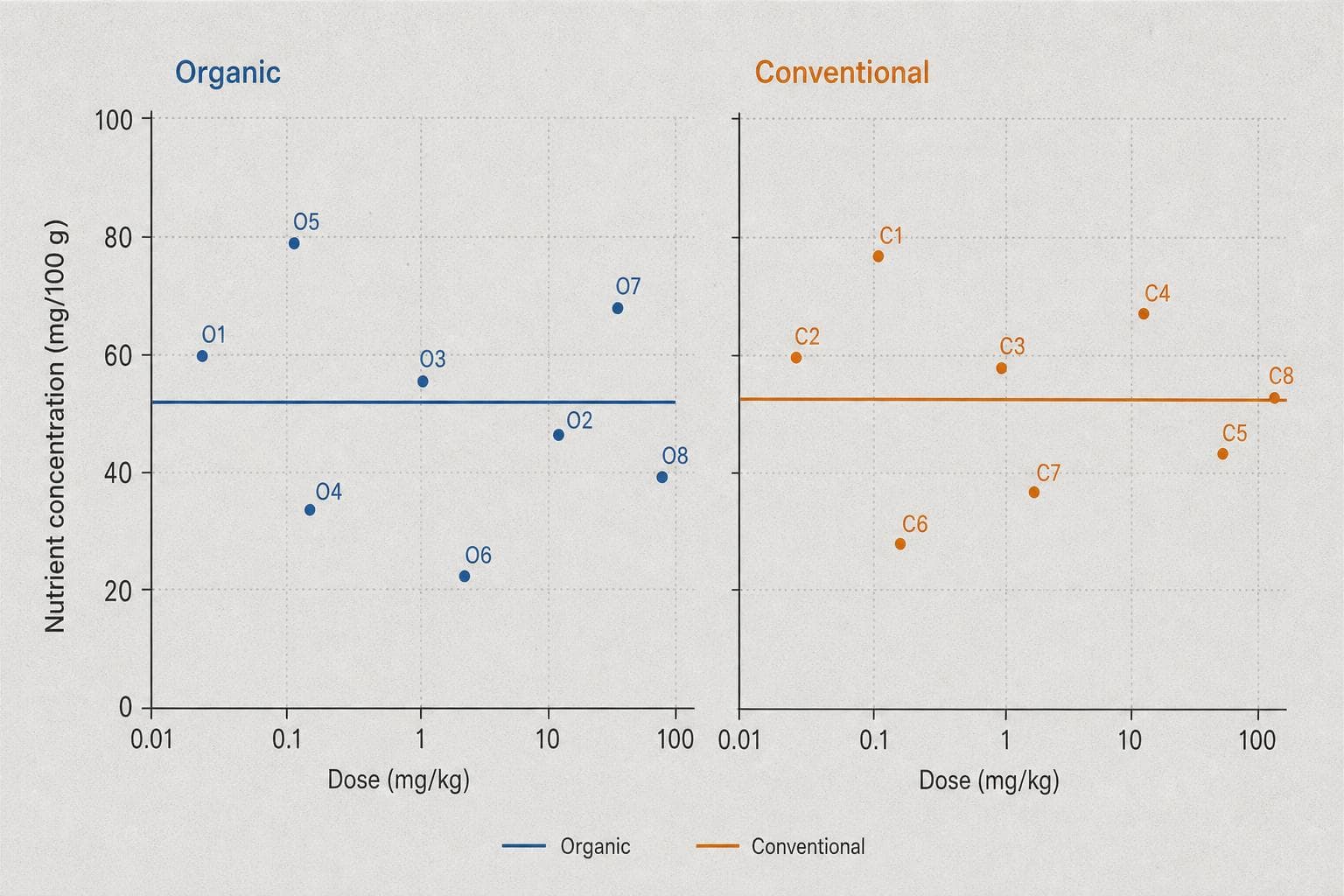

The organic food industry has built a multi-billion dollar market on a simple intuition: fewer synthetic inputs going in means something better coming out. It's a reasonable hypothesis. It's also, after decades of research, still mostly a hypothesis.
The Claim: "Organic Means More Nutritious"
Walk through any grocery store and the implicit promise is everywhere — the USDA Organic seal, the earthy packaging, the premium price tag that signals quality. The belief driving most organic purchases is that organic produce contains more vitamins, minerals, and beneficial compounds than its conventionally grown counterpart. Eat cleaner food, get more nutrition. Simple.
The appeal is partly intuitive and partly ecological. If a plant isn't relying on synthetic fertilizers to grow fast, the thinking goes, it has to work harder — developing more of its own protective phytochemicals in the process. No synthetic pesticides means the plant produces more of its own natural defenses, which happen to be the same polyphenols and antioxidants we value nutritionally. The logic isn't crazy. It's just not consistently supported by data.
Why the Belief Persists (Even When the Evidence Doesn't)
The organic claim has survived decades of mixed research for a few reasons. First, it's unfalsifiable in practice — if you feel better eating organic, there's no clean way to isolate whether that's the food, the diet quality of people who buy organic, or the simple satisfaction of a choice that aligns with your values.
Second, there are real differences in some categories. Harvard Health acknowledges that organic foods may genuinely be better in some respects — the issue is that the evidence is inconsistent enough that blanket claims don't hold. A summary of the research from Scripps Health notes that while many people choose organic for health reasons, the science on whether it delivers meaningfully superior nutrition remains unsettled.
Third, the organic-is-healthier belief gets bundled with other legitimate concerns — pesticide residues, environmental sustainability, antibiotic use in livestock — where the evidence is somewhat stronger. The nutritional claim rides along on the coattails of those more defensible arguments.
What the Research Actually Shows
Here's the honest summary: when nutrient levels differ between organic and conventional produce, organic tends to come out slightly ahead on vitamin C and certain phytonutrients. Organic meat and dairy show higher levels of polyunsaturated fatty acids, including omega-3s. These are real findings. But as the evidence overview from researcher Leigh Wagner, PhD, RDN notes, nutrient density doesn't consistently differ between the two — and when it does, the magnitude is often modest.
The confounding problem is severe. People who eat more organic food also tend to eat more fruits and vegetables overall, exercise more, smoke less, and have higher incomes. Separating "organic food effect" from "health-conscious person effect" in observational data is genuinely hard. Some studies suggest organic eaters have lower rates of certain cancers and better cardiometabolic markers — but crediting the organic label specifically, rather than the overall dietary pattern, requires a leap the data doesn't fully support.
There's also the definitional problem. "Organic" covers an enormous range of farming practices, soil conditions, crop varieties, and storage times. A conventionally grown tomato picked ripe from a local farm and eaten the same day may deliver more bioavailable nutrients than an organic tomato shipped across the country and sitting in a warehouse. The label tells you something about inputs; it tells you much less about what ends up in your body.
What to Actually Do With This
The practical takeaway isn't "organic is a scam" — it's that you're probably buying it for the wrong reason if nutrition is your primary justification. The pesticide-reduction argument is more defensible, particularly for produce categories with consistently higher residue loads. The environmental argument has its own merits and complications. But if you're paying a significant premium specifically because you believe organic strawberries contain meaningfully more vitamin C than conventional ones, the evidence doesn't reliably back that up.
What does reliably improve nutritional intake? Eating more produce, period. A diet built around conventional fruits and vegetables beats a diet built around organic processed snacks by every meaningful measure. The organic label is not a nutritional multiplier — it's a production standard. Those are different things, and conflating them has been very good for marketing and not particularly good for public understanding of nutrition.
Buy organic if you want to. Just know what you're actually buying.