


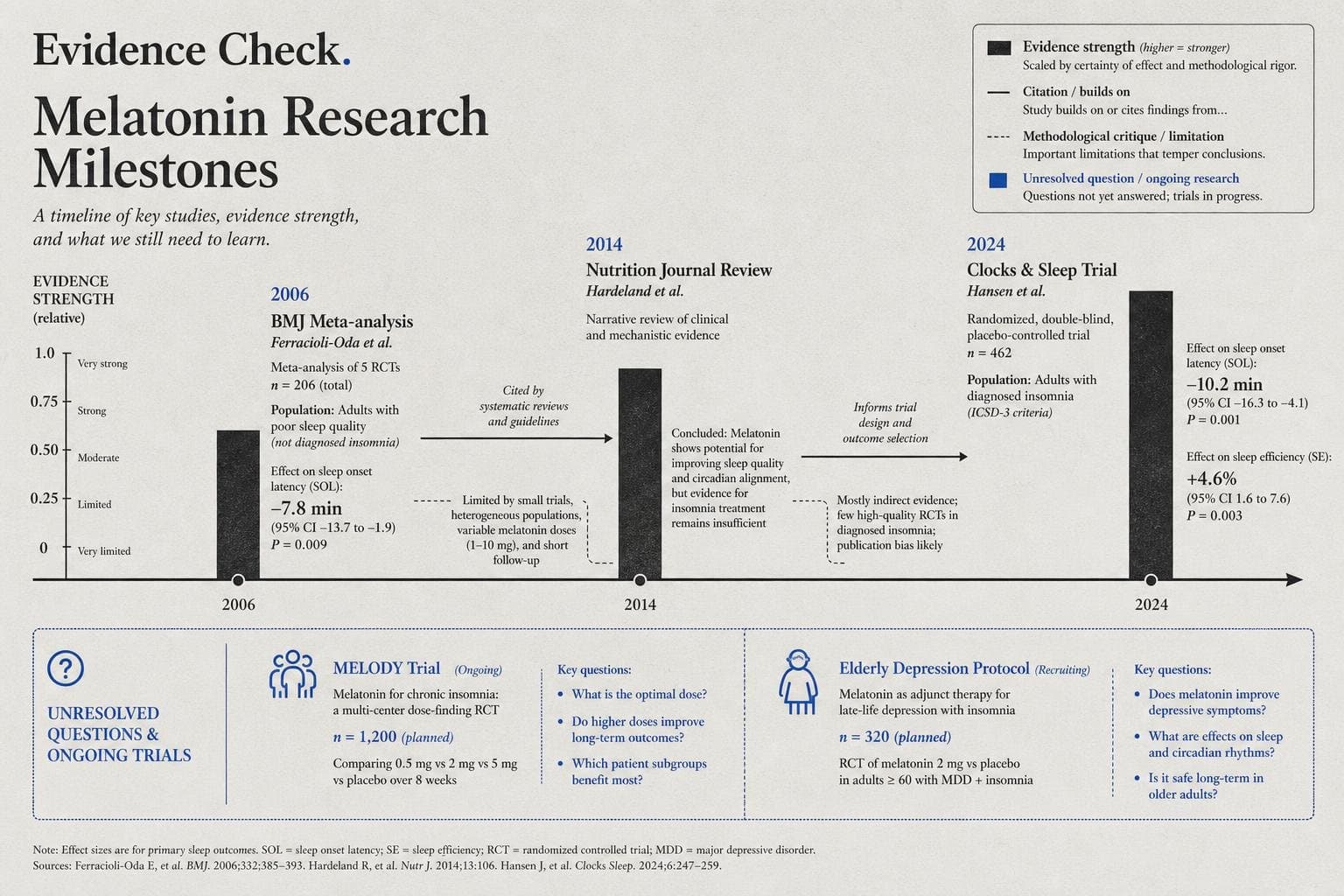

Walk into any pharmacy and the melatonin aisle has grown year over year, yet the single most-cited piece of evidence against it is a meta-analysis old enough to vote. Published in the BMJ in 2006, it found melatonin "ineffective in treating secondary sleep disorders or sleep disorders accompanying sleep restriction such as jet lag or shift work," a conclusion contested at the time by sleep researchers who argued the analysis excluded studies with positive results and ignored dosing timing relative to circadian phase (BMJ rapid response, 2011). Twenty years later, that argument — about which studies count and how melatonin's timing-dependent mechanism gets tested — still shapes the debate.
The next big synthesis came from a 2014 systematic review in Nutrition Journal, which pooled 35 randomized controlled trials in healthy, active adult populations. Using GRADE methodology, the authors landed on "weak recommendations" for melatonin improving sleep initiation and sleep efficiency in both healthy volunteers and people with a history of insomnia — not strong evidence of benefit, but not nothing either (Costello et al., Nutrition Journal, 2014). The review explicitly called for larger, longer trials with well-characterized products before clinicians should feel confident recommending melatonin to young, healthy adults. More than a decade on, that call has gone largely unanswered at scale.
The Newest Trial Tells You Something, But Not What the Label Implies
A more recent randomized, double-blind, placebo-controlled trial tested a sustained-release 2 mg melatonin capsule in adults with poor sleep quality (Clocks & Sleep, MDPI). That phrasing matters: the study population was adults reporting poor sleep quality, not people with a clinical insomnia diagnosis, which is a narrower and more specific condition than "I sleep badly sometimes." It's a distinction wellness marketing collapses constantly, and researchers generally don't. Poor sleep quality is a self-reported symptom cluster; insomnia disorder requires a specific pattern of difficulty falling or staying asleep, daytime impairment, and duration criteria. A trial showing benefit in the former doesn't automatically transfer to the latter, even though headlines tend to blur the two.
That gap — poor sleepers versus diagnosed insomniacs — is where a lot of melatonin's reputation gets built on sand. Most consumer-facing claims about melatonin "curing insomnia" are extrapolated from trials that never enrolled anyone meeting formal insomnia criteria.
Researchers Are Still Hedging Their Bets on What Melatonin Actually Treats
If you want a sense of how unsettled the field still is, look at where current research dollars are going. A registered systematic review protocol is underway to evaluate melatonin and melatonin agonists as antidepressants in elderly populations, explicitly noting that oral melatonin's "main clinical indication" remains insomnia even as researchers investigate whether it does something separate for mood (PubMed protocol, PROSPERO CRD42023391092). Separately, the MELODY trial — a phase 3 randomized controlled trial out of the University of Sydney's Brain and Mind Centre — is testing adjunctive melatonin alongside digital CBT for insomnia in young adults with mood disorders, treating melatonin and CBT-I as parallel interventions worth comparing head-to-head rather than assuming either one obviously works (BMJ Open protocol). Neither of these trials has reported results. Their existence tells you the clinical and research communities still don't treat melatonin's insomnia benefit as a closed question, let alone its effects beyond sleep.
Meanwhile, on the safety side, a systematic review of melatonin use in young children found evidence supporting its use in most pediatric cases remains limited, according to coverage of that review (JAMA Network Open) — a reminder that melatonin's regulatory status as an unregulated supplement in the U.S. means dosing, purity, and evidence quality vary by population far more than the supplement aisle suggests.
What This Actually Adds Up To
The honest summary is unglamorous: melatonin has decades of weak-to-moderate evidence for modest improvements in sleep onset and efficiency in general sleep-disturbed populations, built mostly on trials that predate the current supplement boom by years. The newest adult trial strengthens that modest case specifically for poor sleep quality, not for clinically diagnosed insomnia. Nobody has run the large, well-characterized, insomnia-specific RCT the 2014 review called for. Until that trial exists, "melatonin works for insomnia" is a claim borrowed from adjacent evidence, not a claim insomnia research has actually earned. Watch for results from the MELODY trial and the elderly-depression systematic review — both will tell us more about what melatonin does beyond the sleep-onset effect everyone already assumes it has.