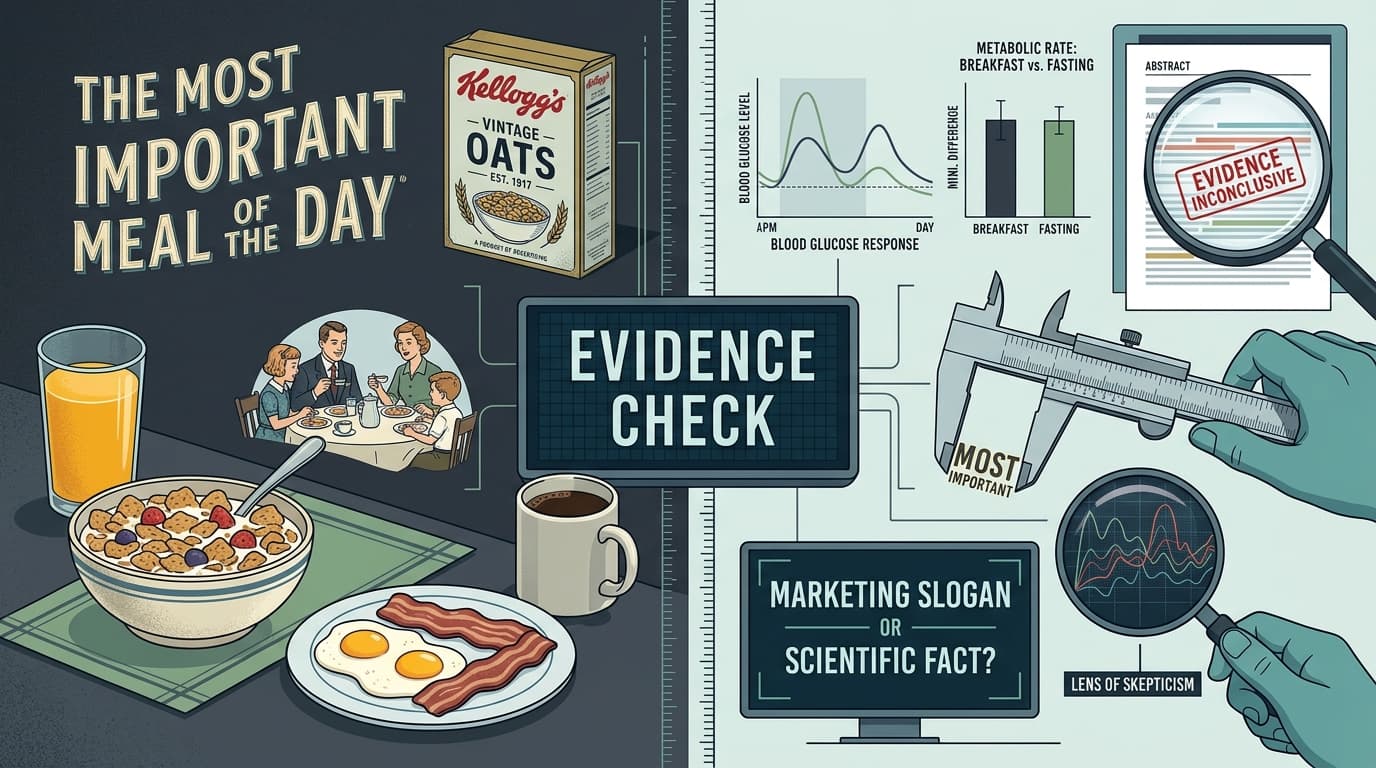

Every morning, somewhere, a cereal box is telling you that breakfast is the foundation of a healthy day. It's one of those health beliefs so thoroughly absorbed into culture that questioning it feels almost reckless — like suggesting you don't need to floss. But the science behind breakfast's exalted status is considerably messier than the slogan suggests.
The Claim
Ask most people why breakfast matters and you'll get some version of the same answer: it "jump-starts your metabolism," prevents overeating later, improves concentration, and sets the tone for healthy eating all day. Children especially, the story goes, cannot learn without it. Adults who skip it are practically inviting weight gain.
This belief is so entrenched that it shapes public health messaging, school nutrition programs, and the daily guilt of anyone who's ever rushed out the door without eating. The phrase "most important meal of the day" has been traced back to early 20th-century marketing — Kellogg's, specifically — but it found its way into clinical guidance and parenting advice with remarkable ease.
The Appeal
There's a reason this idea stuck. It has intuitive logic on its side. You've been fasting for eight hours. Your blood sugar is lower than it will be at any other point in the day. Eating something seems obviously corrective. The word "breakfast" literally means breaking a fast — surely that's a signal you're supposed to do it.
There's also the psychological comfort of structure. Breakfast as ritual, as the thing that separates sleep from the day, carries real meaning for a lot of people. And for parents, the idea that feeding children before school is a direct investment in their academic performance is both appealing and actionable. It gives you something concrete to do.
The problem is that intuitive logic and marketing copy are not the same as evidence. And when researchers have actually tried to test breakfast's benefits rigorously, the results have been far more complicated.
The Evidence
The core issue with breakfast research is that most of it is observational. Studies consistently find that people who eat breakfast tend to have lower BMIs, better diet quality, and improved cognitive performance compared to those who skip it. The problem: people who eat breakfast regularly also tend to have more stable routines, higher incomes, better sleep, and healthier overall diets. Correlation is doing a lot of work here.
When researchers run randomized controlled trials — where they actually assign people to eat or skip breakfast — the picture changes. A frequently cited Cochrane-style analysis of breakfast trials found that the evidence for breakfast promoting weight loss or preventing obesity was weak and inconsistent. Studies that assigned breakfast skippers to eat breakfast often found they consumed more total calories over the day, not fewer. The "compensatory eating" effect that breakfast was supposed to prevent didn't reliably materialize.
The metabolism argument fares no better. Resting metabolic rate doesn't meaningfully spike because you ate eggs at 7 a.m. The "thermic effect of food" — the small caloric cost of digesting a meal — is real but modest, and it applies to any meal, not breakfast specifically. There's no metabolic magic in the morning hours.
What about children and cognition? This is where the evidence is slightly more sympathetic to breakfast's reputation, but still conditional. Studies in children who are undernourished or food-insecure do show cognitive benefits from eating breakfast — attention, memory, and classroom performance improve. But extrapolating that finding to well-nourished children in high-income settings requires a leap the data doesn't fully support. The benefit appears to be about adequate nutrition overall, not the timing of the first meal.
Intermittent fasting research has added another wrinkle. Time-restricted eating protocols — many of which involve skipping breakfast entirely — have shown metabolic benefits in some populations, including improvements in insulin sensitivity and inflammatory markers. The research is still evolving and the effects vary considerably by individual, but it's hard to square with the idea that skipping breakfast is categorically harmful.
It's also worth noting where a lot of the pro-breakfast research has come from. Industry-funded studies — particularly those funded by cereal and dairy companies — have historically shown stronger breakfast benefits than independently funded research. That's not a conspiracy; it's a well-documented pattern in nutrition science. Funding source shapes research questions, study design, and which results get published.
None of this means breakfast is bad. For people who are hungry in the morning, who have jobs requiring early sustained concentration, or who find that eating early helps them make better food choices throughout the day, breakfast is probably a good idea. For people who aren't hungry until noon and function fine without it, the evidence does not support forcing the issue.
Practical Takeaways
The honest answer to "is breakfast the most important meal of the day?" is: probably not, and almost certainly not for the reasons you've been told.
What seems to matter is total dietary quality over the course of the day — what you eat, how much, and whether it meets your nutritional needs. The timing of your first meal is a secondary variable at best, and one that interacts heavily with individual factors like chronotype, activity level, and whether you're actually hungry.
If breakfast works for you, keep eating it. If it doesn't, you're not sabotaging your metabolism or setting yourself up for failure. What you probably shouldn't do is let a slogan invented to sell cereal dictate your eating schedule.
The broader lesson here is one that comes up constantly in nutrition research: when a health claim is both intuitively satisfying and commercially useful, it deserves extra scrutiny. The evidence for breakfast's primacy has always been thinner than its reputation. It just had very good marketing.


