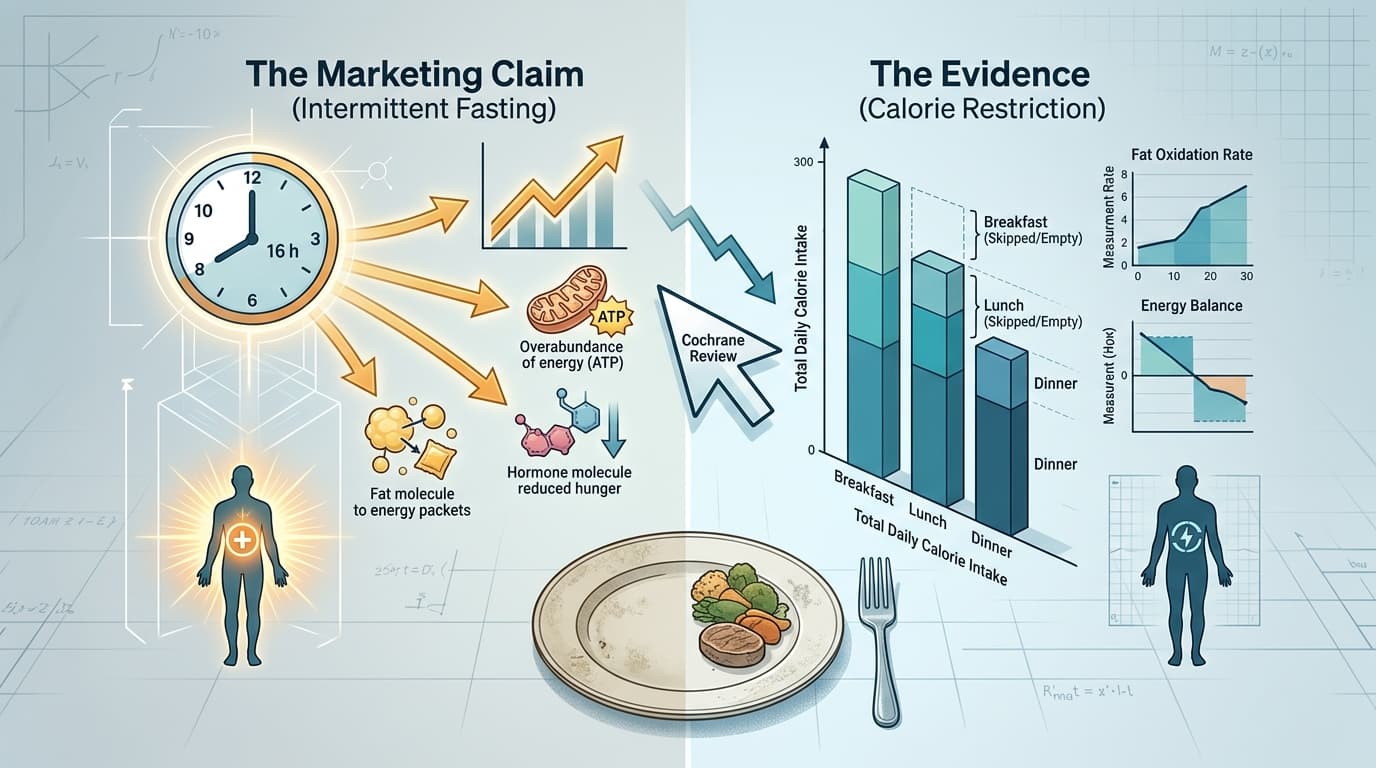

Somewhere between the wellness influencers and the biohacking podcasts, intermittent fasting acquired a reputation it probably doesn't deserve. Not as a bad diet — it isn't — but as a superior one. The pitch is seductive: forget counting calories, just compress your eating window, and your metabolism does the rest. Millions of Americans have bought in.
A Cochrane systematic review published this spring suggests they bought a rebranded product.
The Claim: Fasting Works Differently Than Dieting
The popular version of intermittent fasting isn't just "eat less." It carries a specific mechanistic story. By restricting eating to a defined window — typically eight to ten hours — or cycling through feast-and-fast days, you supposedly trigger metabolic shifts that calorie restriction alone can't achieve. The body enters a different hormonal state. Fat burns more efficiently. Hunger hormones reset. You're not just eating less; you're eating smarter, at the cellular level.
This framing has been enormously effective. Time-restricted eating, alternate-day fasting, and the "5:2" protocol (five normal days, two severely restricted) all carry the implicit promise that when you eat matters as much as — or more than — how much you eat. That's a more interesting story than "consume fewer calories," and it's a lot easier to sell.
The Appeal: A Rule Instead of a Calculation
Part of what makes intermittent fasting sticky is that it converts an open-ended problem into a binary one. Calorie restriction requires ongoing arithmetic — weighing food, reading labels, doing math at every meal. Intermittent fasting replaces all of that with a clock. Eat before 8 p.m. Don't eat before noon. The rule is simple enough to follow without a spreadsheet.
There's also the metabolic narrative, which feels scientific without requiring anyone to understand the science. Ketogenesis. Lipolysis. Autophagy. These are real biological processes, and fasting does influence them — which makes the story feel grounded even when the clinical implications get overstated. It's the wellness culture playbook: take a genuine mechanism, strip out the nuance, and sell the mechanism as the outcome.
What the Evidence Actually Shows: Equivalent, Not Superior
Here's where the story gets less exciting, in the best possible way.
A Cochrane systematic review — the kind of rigorous, pre-registered, gold-standard analysis that exists precisely to cut through cherry-picked studies — examined 22 randomized controlled trials involving nearly 2,000 participants. It compared multiple forms of intermittent fasting against conventional dietary approaches and found that the differences in weight loss, quality of life, and adverse events were, in the words of co-author Diane Rigassio Radler of Rutgers, "statistically indistinguishable from zero."
Not slightly worse. Not slightly better. Equivalent.
A separate study published in the International Journal of Obesity examined time-restricted eating specifically in adults with overweight, obesity, and type 2 diabetes — a population where metabolic differences might plausibly show up more clearly. Participants following a 20-hour fast with a 4-hour eating window did lose weight and did show some hormonal changes: fasting leptin dropped significantly, and fasting ghrelin increased. But the key hunger and satiety hormones — GLP-1, glucagon, peptide YY — showed no meaningful difference compared to standard lifestyle intervention. The weight loss, the researchers found, was driven by a self-reported calorie deficit of roughly 384 calories per day. The mechanism, in other words, was still just eating less.
That's not a knock on intermittent fasting. It's a clarification of why it works when it works. The eating window creates a structural constraint that reduces calorie intake. The metabolic magic is largely downstream of that reduction, not independent of it.
There are real limitations worth acknowledging: most trials in this space are short-term, involve relatively small samples, and rely on self-reported dietary intake — which is notoriously unreliable. Longer-term data on adherence, cardiovascular outcomes, and metabolic health remains thin. A meta-analysis in Nutrition Reviews found some favorable signals for metabolic risk factors in overweight and obese adults, but systematic reviews consistently find that effect sizes are modest and comparisons to conventional dieting remain close.
What to Do With This
The practical takeaway isn't "intermittent fasting doesn't work." It's "intermittent fasting works about as well as other approaches, for the same basic reason." If a compressed eating window helps you eat less without feeling deprived, that's a legitimate tool — and adherence matters more than mechanism. The best diet is the one you'll actually follow.
What the evidence doesn't support is paying a premium — in money, in social identity, in certainty — for a method that outperforms conventional calorie reduction. The metabolic story is real but overstated. The outcomes are real but unremarkable.
If you're doing intermittent fasting and it's working, keep going. If you've tried it and hated it, the research gives you full permission to stop. The clock isn't magic. The calories still count.


