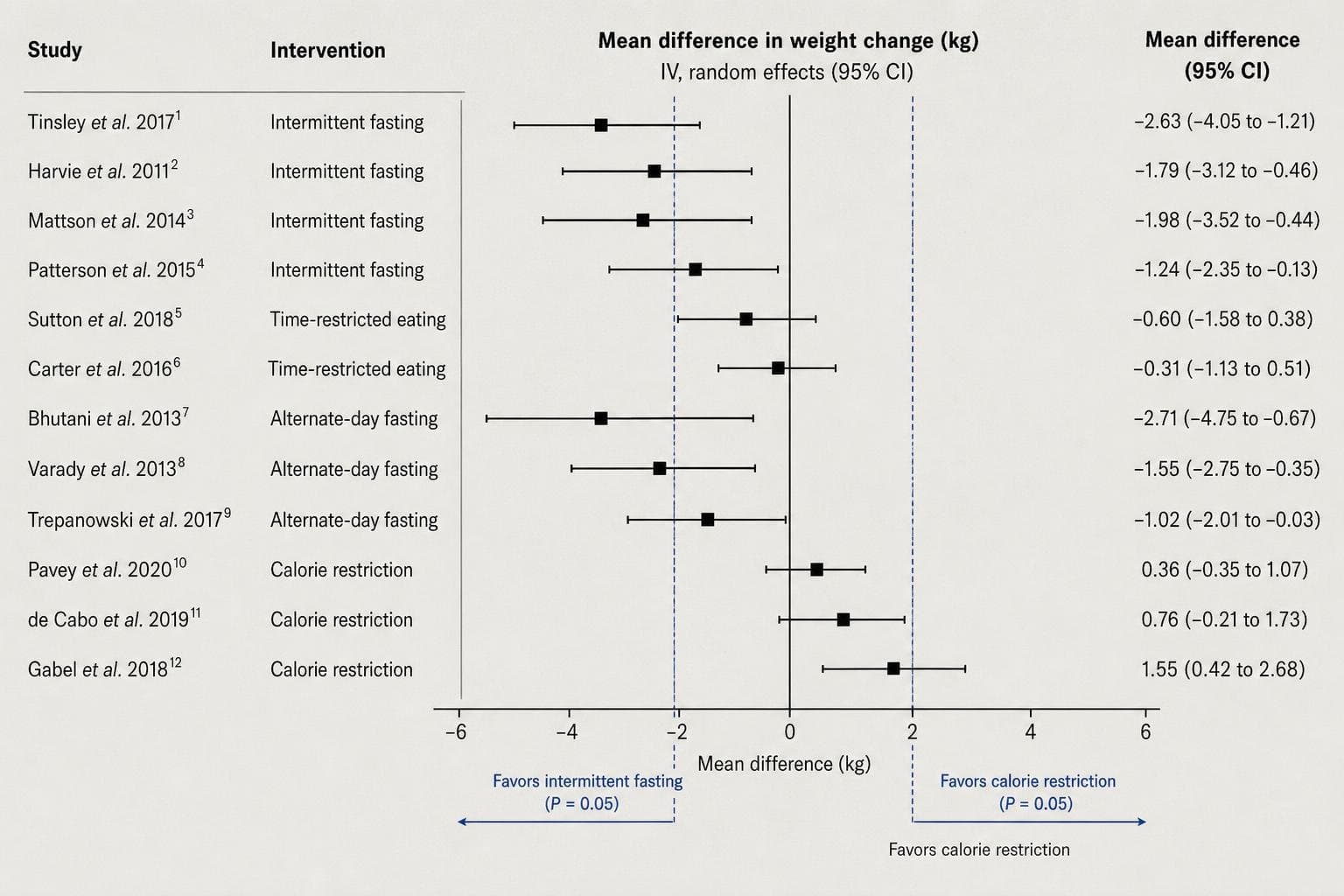

I've covered intermittent fasting three times now (May, June, July), and the story has been stubbornly consistent: when you control for calories eaten, fasting's special metabolic powers mostly evaporate. Two new meta-analyses published this summer add enough nuance to that picture that it's worth one more look — not because the conclusion flips, but because the details have gotten more interesting.
The Rankings Game, and Why It's Tricky
The freshest data comes from a network meta-analysis published August 6 in Frontiers in Nutrition, which pooled 39 randomized controlled trials covering 3,236 adults with cardiometabolic risk factors. The researchers compared early time-restricted eating (eTRE — eating earlier in the day), midday TRE, and late TRE, with and without exercise, against both calorie restriction and a control condition.
The headline finding: most TRE protocols reduced body weight and anthropometric measures compared to doing nothing. Early TRE also reduced fasting blood glucose and insulin resistance (HOMA-IR) compared to control. When combined with exercise, eTRE produced the largest HOMA-IR reduction in the analysis.
So far, so promising. But here's the part that gets buried in the press release version: the authors explicitly note that "clear differences between TRE patterns and CR were limited." The rankings — expressed as SUCRA scores, a statistical tool for ordering interventions — consistently favored eTRE, but SUCRA rankings tell you which intervention tends to come out ahead across outcomes, not whether the differences are large enough to matter clinically. Ranking first among similar interventions is not the same as winning decisively.
The certainty of evidence? The authors rate it as ranging from very low to moderate for most outcomes. That's not a damning verdict, but it's not a ringing endorsement either.
A Cleaner Test in a Specific Population
A separate meta-analysis on PubMed, searching literature through August 2025, took a more targeted approach: ten RCTs, 599 participants, all with prediabetes or type 2 diabetes, all comparing TRE against non-time-restricted control diets. The eating windows ranged from 4 to 10 hours per day, and studies ran an average of four months.
The pooled result for HbA1c — a key marker of blood sugar control over time — showed no statistically significant overall effect (p=0.06). But when the researchers split the group, something emerged: TRE did reduce HbA1c in people with prediabetes, while the effect in people with established type 2 diabetes didn't reach significance. That's a meaningful distinction. It suggests TRE might be most useful as a preventive or early-intervention tool rather than a treatment for advanced metabolic disease — and it's the kind of subgroup finding that warrants follow-up rather than confident generalization.
The Mechanism Question Still Doesn't Have a Clean Answer
One reason fasting has attracted so much enthusiasm is the theory that it does something beyond just reducing calories — suppressing hunger hormones, elevating metabolic rate, triggering cellular repair pathways. A study summarized by Examine in July 2026 tested this directly in 100 participants with obesity, comparing a week of time-restricted eating (10 a.m. to 6 p.m.) against unrestricted calorie restriction. Changes in resting metabolic rate were similar between groups. Three of four appetite measures showed no difference. One hunger measure favored TRE, but the study was only a week long and adherence was poor.
A broader review in the European Journal of Clinical Nutrition lays out the theoretical mechanisms — AMPK activation, mTOR suppression, autophagy, mitochondrial biogenesis — in considerable detail. These pathways are real and well-characterized in animal models and short-term human studies. The review acknowledges, though, that "inconsistencies and methodological limitations are also reported" across the clinical literature. The gap between a plausible mechanism and a demonstrated clinical advantage remains wide.
What the Evidence Actually Supports
The Frontiers in Nutrition network meta-analysis from July, focused specifically on overweight and obese adults with type 2 diabetes, found that TRE was associated with reductions in body weight, BMI, waist circumference, and fasting blood glucose compared to a general diet — and that continuous energy restriction showed "similar favorable effects" on most of the same outcomes. TRE ranked first by SUCRA, but the authors' own framing is cautious: the evidence certainty was evaluated using the CINeMA framework, and the optimal strategy "remains uncertain."
That phrase — "remains uncertain" — is doing a lot of work in this literature right now. What the evidence does support: TRE is a legitimate dietary approach that produces real weight and metabolic benefits, particularly when eating is front-loaded earlier in the day and combined with exercise. What it doesn't support: the claim that TRE is categorically superior to simply eating less. The advantage, if it exists, appears modest and population-dependent.
For most people, the more useful question isn't whether fasting beats calorie restriction in a meta-analysis. It's whether a defined eating window is a structure they can actually maintain. Adherence is the variable that matters most in long-term dietary interventions — and as the StatPearls review on metabolic consequences of weight reduction notes, the body's compensatory responses to weight loss (rising hunger signals, declining energy expenditure) make sustained adherence the central challenge regardless of which method gets you there.
The next thing worth watching: whether longer-duration RCTs — beyond the four-month average in the current literature — show the eTRE advantage holding or fading as the novelty of a new eating pattern wears off.


